

National Fruit of Spain: Importance and Varieties of Grapes
Have you ever wondered why people connect grapes so strongly with Spain even though the country has many famous fruits?…
National Symbols of Bhutan represent the country’s history, culture, religion, wildlife, and national identity. Bhutan is a small Himalayan kingdom between India and China. It is known for its mountain landscapes, Buddhist traditions, and strong cultural identity. Its national symbols include the takin, common raven, blue poppy, Himalayan cypress, and thunder dragon. Each has a special connection to Bhutanese life. Some are officially recognised national symbols. Others are important cultural and religious signs. Learning about these symbols helps explain how Bhutan protects its traditions while developing as a modern country.
The national symbols of Bhutan are animals, plants, objects, traditions, and official signs that represent the country. They help people recognise Bhutan and understand its national values. Some appear on government buildings and official documents. Others are found in forests, temples, traditional clothing, and public celebrations.
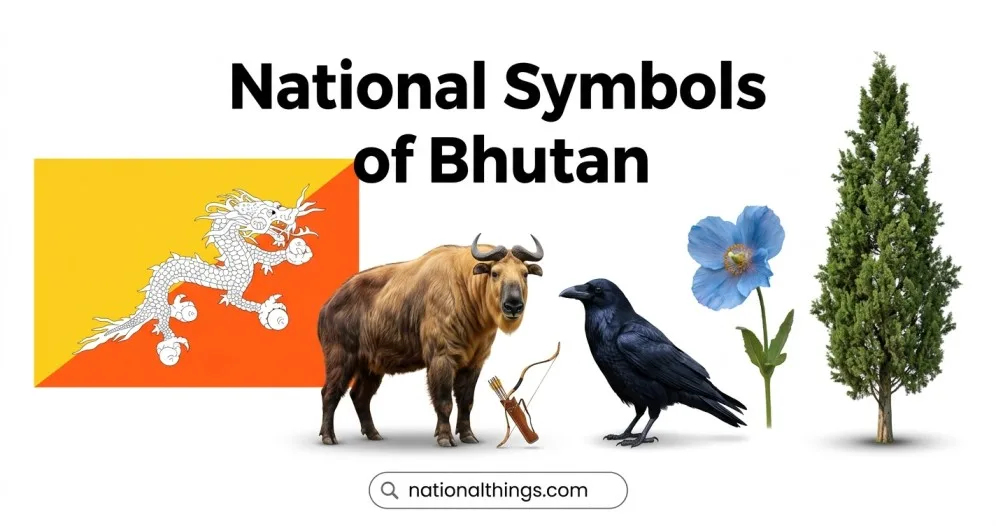
Bhutan’s national flag shows a white dragon against yellow and orange backgrounds. Its national animal is the takin, a large mountain mammal. The national bird is the common raven. The national flower is the blue poppy, while the national tree is the Himalayan cypress.
Bhutan also has an official national anthem called Druk Tsenden. Dzongkha is its national language. Archery is its national sport. Traditional clothing is another important part of Bhutanese identity. Men commonly wear the gho, while women wear the kira.
These symbols do not all have the same legal status. The flag, emblem, and anthem are established state symbols. Other national designations are recognised through government institutions and established tradition.
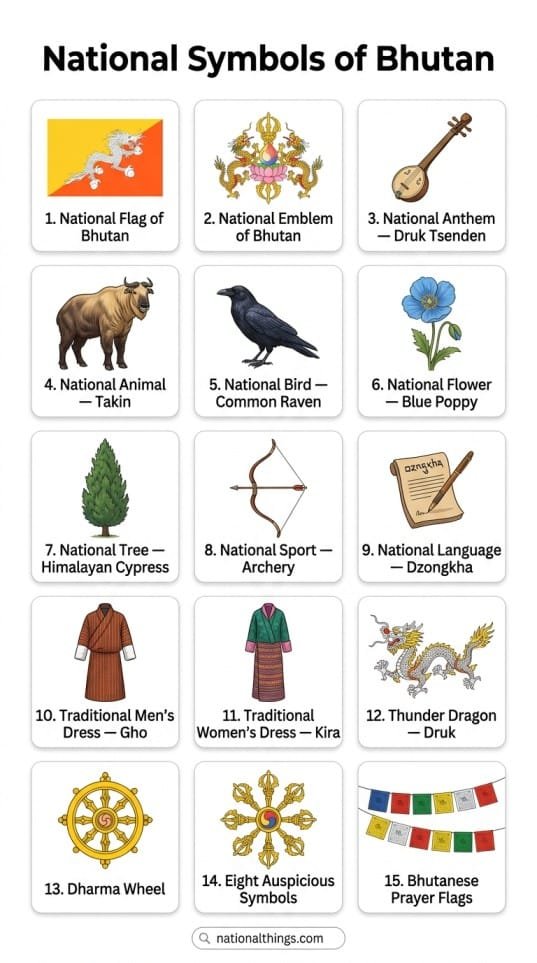
Bhutan’s national symbols help preserve the country’s identity. Bhutan has a relatively small population and is surrounded by two much larger countries. Its language, customs, architecture, and religious traditions help distinguish it from its neighbours.
The national flag represents the country’s political and spiritual traditions. The takin and blue poppy draw attention to Bhutan’s mountain wildlife. Traditional clothing keeps local weaving skills and dress customs visible in daily life.
National symbols also help children learn about their country. Schools use flags, national celebrations, and cultural activities to teach students about Bhutanese history. The national anthem is performed at important public events.
Several symbols have a connection to environmental protection. Bhutan’s Constitution requires the country to maintain at least 60% of its total land area under forest cover for all time. This requirement appears in Article 5 of the Constitution and reflects the country’s commitment to protecting nature.
Source: Constitution of Bhutan, Article 5.
Bhutan’s national identity developed through centuries of local traditions and Tibetan Buddhist influence. In the 17th century, Zhabdrung Ngawang Namgyal helped unite different valleys and religious communities under a central system of government. This period shaped many institutions and customs that remain important today.
The Wangchuck monarchy began in 1907 when Ugyen Wangchuck became Bhutan’s first hereditary king. The monarchy later played an important role in the development of modern national institutions and symbols.
Bhutan’s present national flag developed during the 20th century. Earlier versions used different proportions and colours. The design was refined as Bhutan developed its modern international identity. The dragon remained its central feature because of its connection to the country’s traditional name, Druk Yul.
Bhutan joined the United Nations on 21 September 1971. This was an important step in its international recognition. The flag and other official symbols became visible representations of Bhutan at diplomatic events.
In 2008, Bhutan adopted its Constitution and became a democratic constitutional monarchy. The Constitution formally describes the national flag, national emblem, and national anthem in its First Schedule.
The following list brings together Bhutan’s main official symbols and widely recognised national cultural designations.
The flag, emblem, and anthem have formal constitutional descriptions. The animal, bird, flower, tree, sport, language, and dress are recognised in Bhutanese public life through national institutions, laws, or established cultural practice.
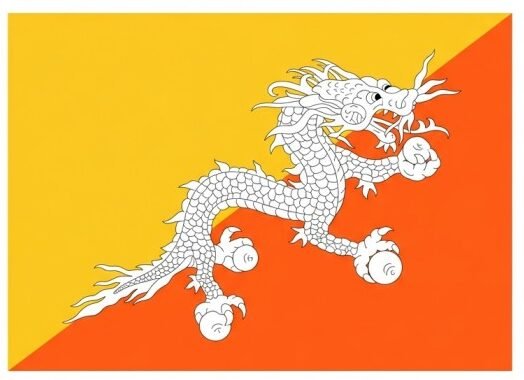
The flag has two diagonal sections. Yellow represents the country’s civil tradition and royal authority. Orange represents its Buddhist spiritual tradition. A white dragon stands across both colours. Its white body represents purity and loyalty. The jewels held in its claws symbolise national wealth and well-being.
The dragon is called Druk, meaning thunder dragon. Bhutan is traditionally known as Druk Yul, or Land of the Thunder Dragon. The dragon’s open mouth expresses the strength of the country’s protective deities. The flag therefore combines Bhutan’s monarchy, religion, and national identity in one design.
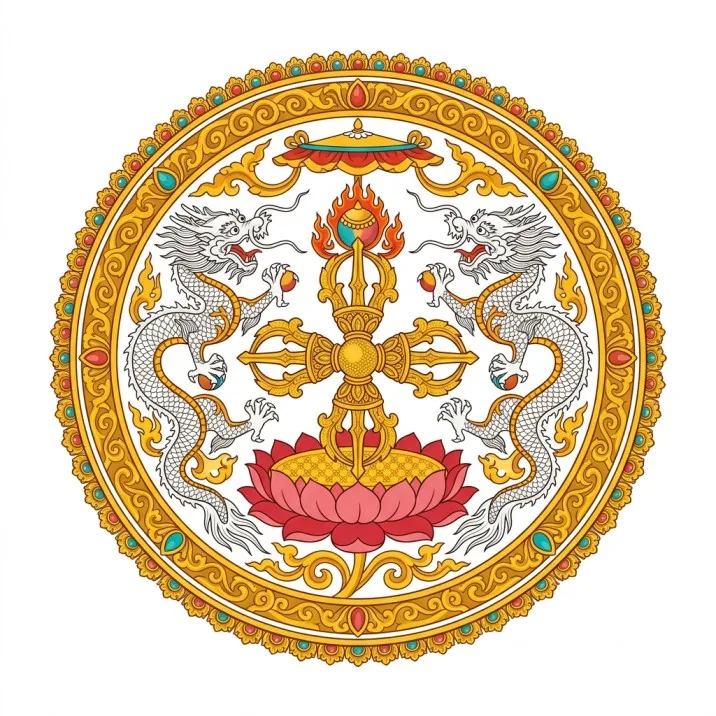
The national emblem contains a double diamond thunderbolt, known as a dorje or vajra, placed above a lotus. It also includes a jewel and two dragons. The vajra represents harmony between religious and secular authority. The lotus stands for purity, while the jewel represents sovereign power.
The two dragons represent Bhutan’s identity as Druk Yul. The emblem appears in official state settings and helps distinguish the authority of the Bhutanese government. Its Buddhist imagery also shows how religious ideas have influenced the country’s political history.
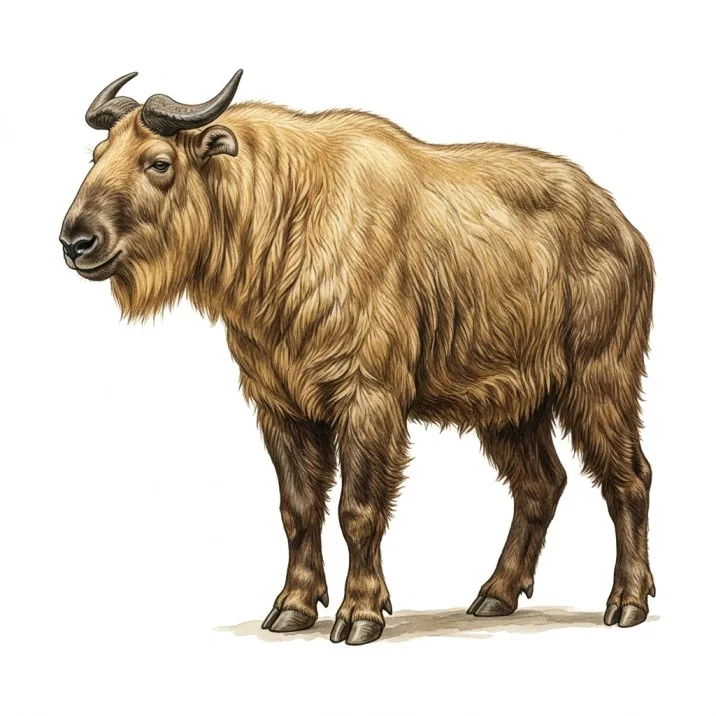
The takin is a large hoofed mammal found in Himalayan mountain forests and grasslands. Its scientific name is Budorcas taxicolor. It has a thick body, short legs, and curved horns. Bhutanese folklore connects the animal to the Buddhist saint Drukpa Kunley, who is said to have created it using the bones of a cow and the head of a goat. The takin is a wild animal, not a cow-goat hybrid.
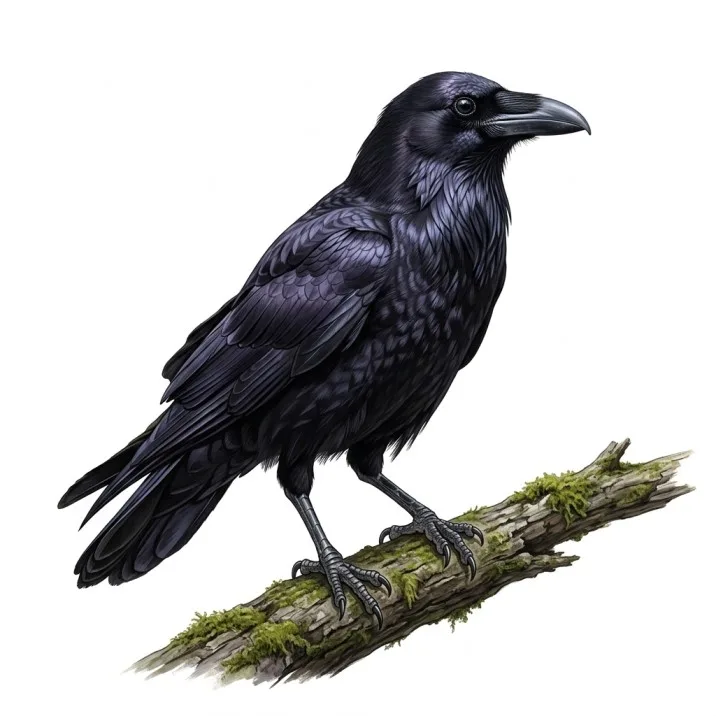
The common raven (Corvus corax) is a large black bird with a strong beak and a deep call. It is known for its intelligence and ability to solve problems. In Bhutan, the raven has religious and royal importance. The raven-headed crown of Bhutan’s kings connects the monarchy to a protective deity associated with the raven.
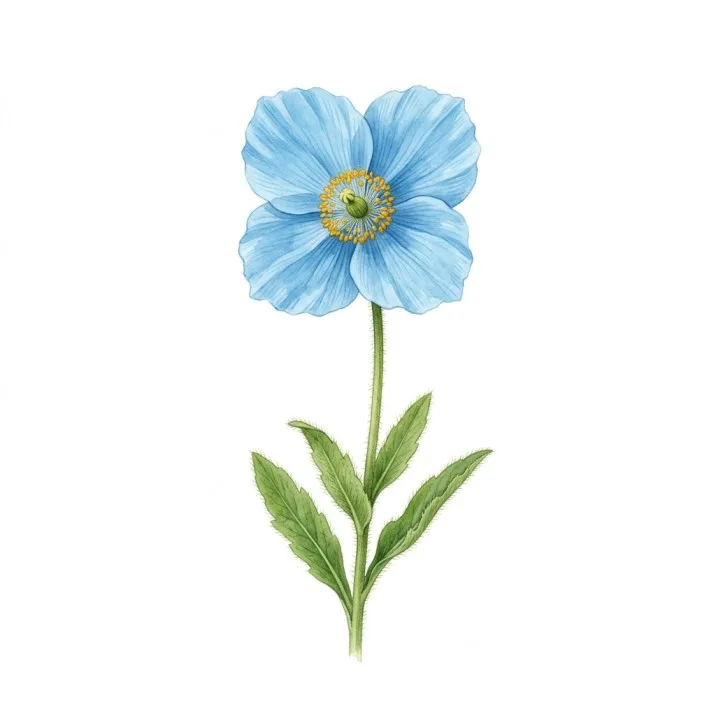
Bhutan’s national flower is a blue Himalayan poppy. It is commonly associated with Meconopsis species, and Bhutanese botanical sources identify Meconopsis gakyidiana as the country’s national flower. It grows in cold mountain environments and is admired for its striking blue petals. Older references often use the name Meconopsis grandis, so scientific names should be checked when identifying a particular plant.

The Himalayan cypress (Cupressus torulosa) is an evergreen conifer that grows in mountain regions. It has small scale-like leaves and woody cones. In Bhutan, cypress trees are associated with sacred places and religious buildings. Their tall shape makes them easy to recognise near monasteries and temples.
These four symbols represent different parts of Bhutan’s natural heritage. The takin reflects mountain wildlife. The raven connects nature with royal tradition. The blue poppy represents alpine plant life, while the Himalayan cypress shows the importance of trees in religious landscapes.
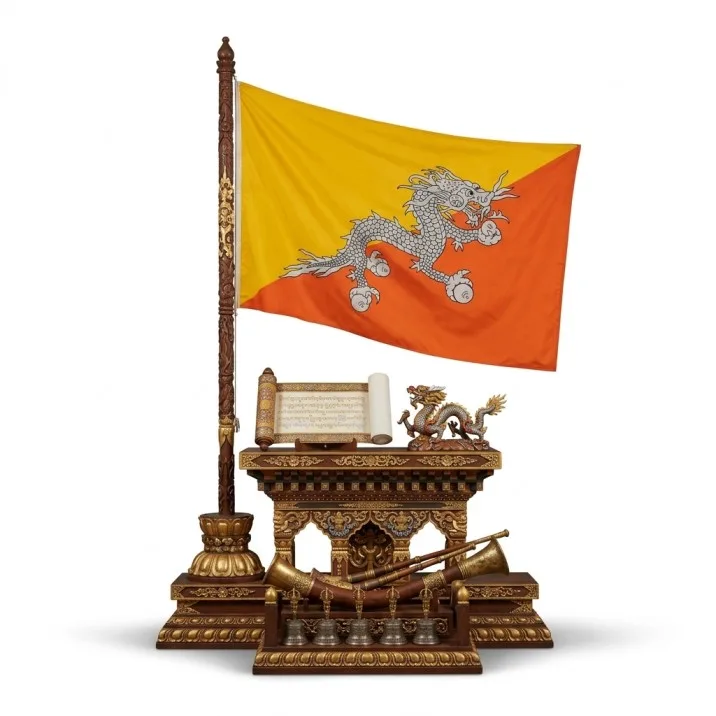
Bhutan’s national anthem is called Druk Tsenden, meaning “The Thunder Dragon Kingdom.” Its words honour the country, its king, and the Buddhist teachings that have shaped Bhutanese society. The anthem is associated with Aku Tongmi, a Bhutanese musician who played an important role in its musical development during the 1950s.
The national anthem is performed at state ceremonies, official celebrations, and important school events. It expresses respect for the monarchy and hopes for the country’s peace and prosperity. The Constitution of Bhutan recognises Druk Tsenden as the national anthem.
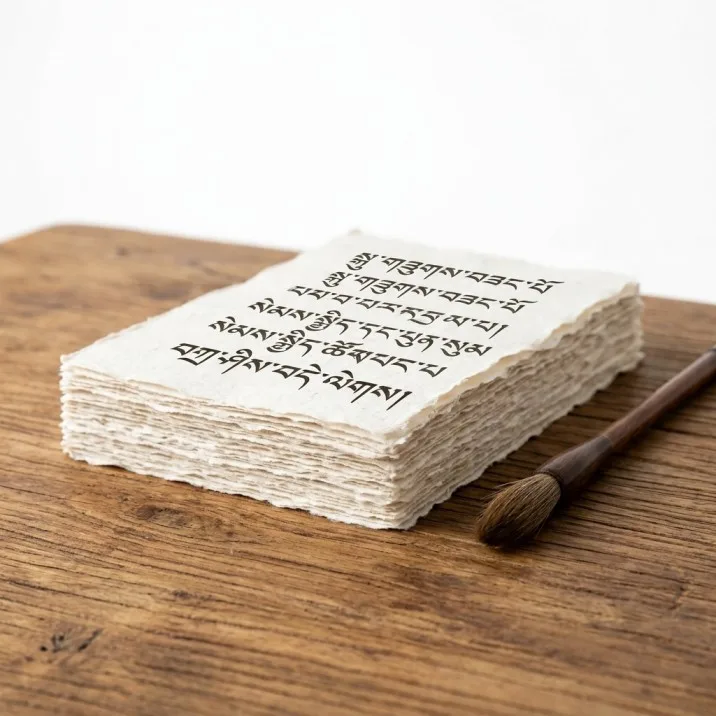
Dzongkha is Bhutan’s national language. It belongs to the Tibetic group of languages and is written using the Tibetan script. The word Dzongkha is associated with the language traditionally spoken in the country’s dzongs, which are fortified buildings used for administration and religious activities.
Dzongkha is used in government administration, official communication, and national cultural activities. English is also widely used in Bhutan’s education system. The country has several other languages, including Tshangla and Lhotshamkha, which reflect its regional and ethnic diversity.
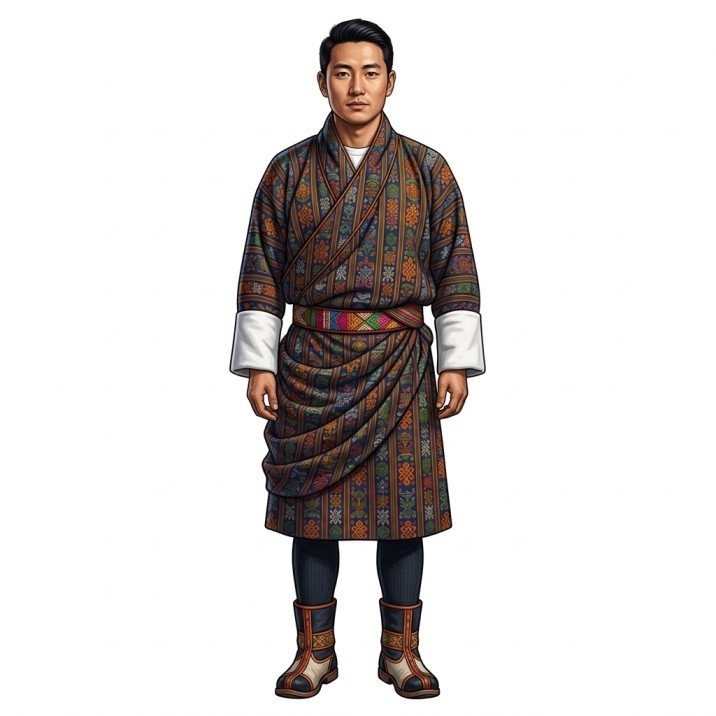
Bhutan’s traditional national clothing includes the gho for men and the kira for women. A gho is a knee-length robe tied at the waist with a woven belt called a kera. It creates a pouch-like fold above the belt. Men generally wear long socks with the gho.
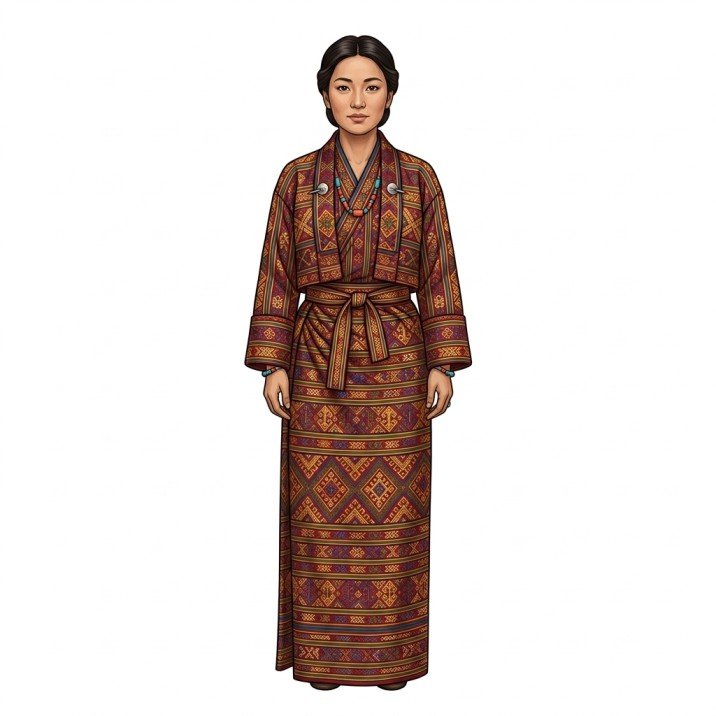
A kira is a long woven garment wrapped around the body and worn with a blouse called a wonju and a short jacket called a tego. Both garments often feature detailed patterns made by Bhutanese weavers. Traditional dress is required in many government offices, schools, and formal settings under applicable dress rules.
Bhutanese textiles are an important form of cultural art. Different regions produce distinctive woven designs. Traditional clothing therefore supports local craftsmanship while keeping historic styles visible in public life.
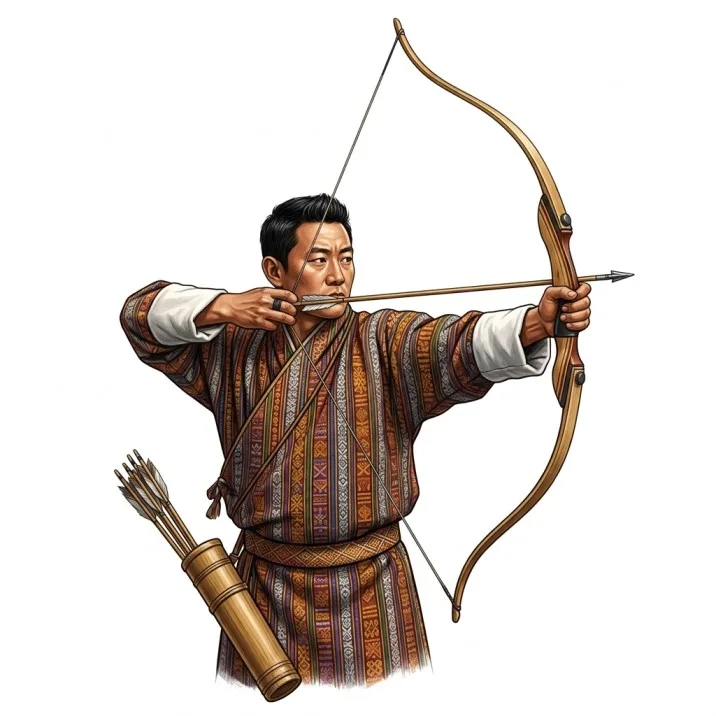
Archery is Bhutan’s national sport and one of its most popular traditional competitions. Known locally as dha, it has a long history in Bhutanese society. Traditional matches use targets placed about 145 metres apart. This is much farther than the 70-metre distance used in Olympic recurve archery.
Bhutanese archery matches are social occasions as well as sporting events. Players compete in teams while supporters sing, dance, and celebrate successful shots. Some competitions use traditional bamboo bows, while others use modern compound bows.
Archery is especially visible during local festivals and community gatherings. Its combination of skill, teamwork, and celebration makes it an important part of Bhutanese social life.
Buddhism has shaped Bhutan’s architecture, art, festivals, and public traditions for centuries. Many important cultural symbols are connected to Vajrayana Buddhism. These signs appear in monasteries, temples, religious paintings, and ceremonial objects.
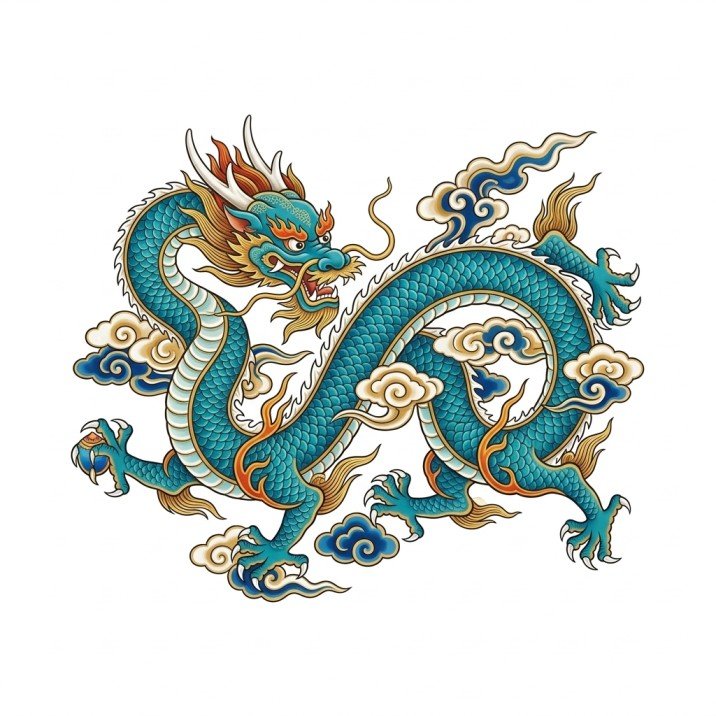
The thunder dragon is one of Bhutan’s best-known cultural symbols. It represents the country’s traditional name and its connection to the Drukpa school of Buddhism. The dragon is especially important in national imagery because it connects religious heritage with state identity.
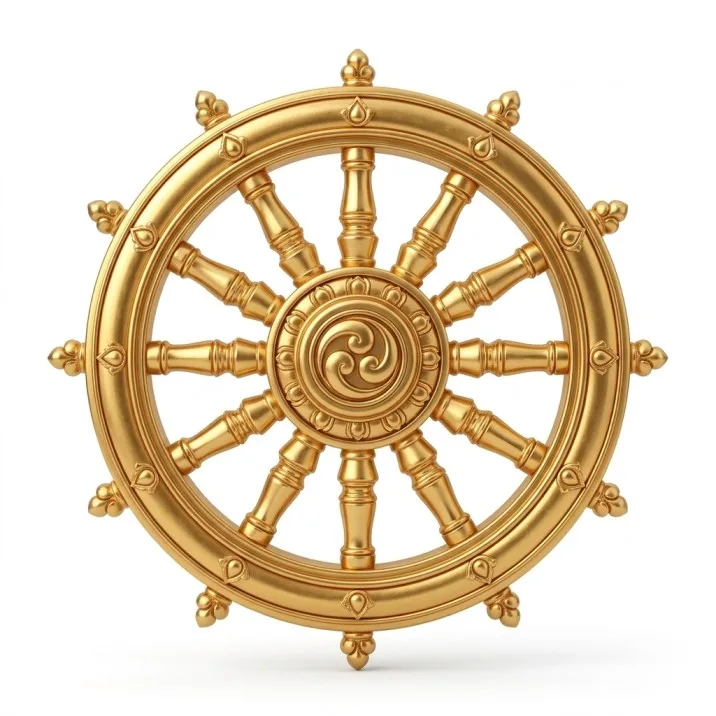
The Dharma Wheel is a Buddhist symbol representing the teachings of the Buddha. It commonly has eight spokes, which refer to the Noble Eightfold Path. In Bhutan, it appears on religious buildings, paintings, and ceremonial objects. It reminds Buddhists of the path towards wisdom and freedom from suffering.
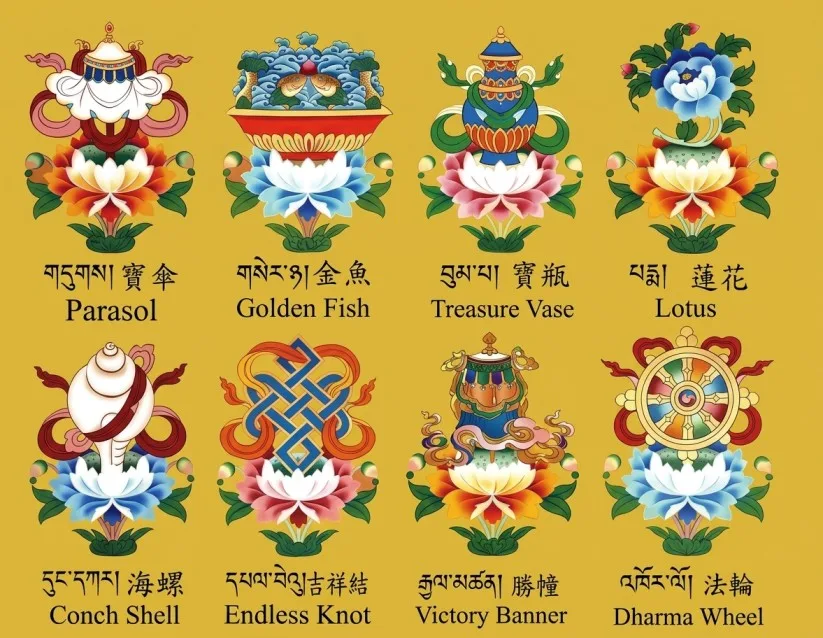
The Eight Auspicious Symbols are important in Bhutanese Buddhist art. They include the parasol, golden fish, treasure vase, lotus, conch shell, endless knot, victory banner, and Dharma Wheel. Each represents a different Buddhist teaching or blessing. They are often displayed together in temples and traditional artwork.
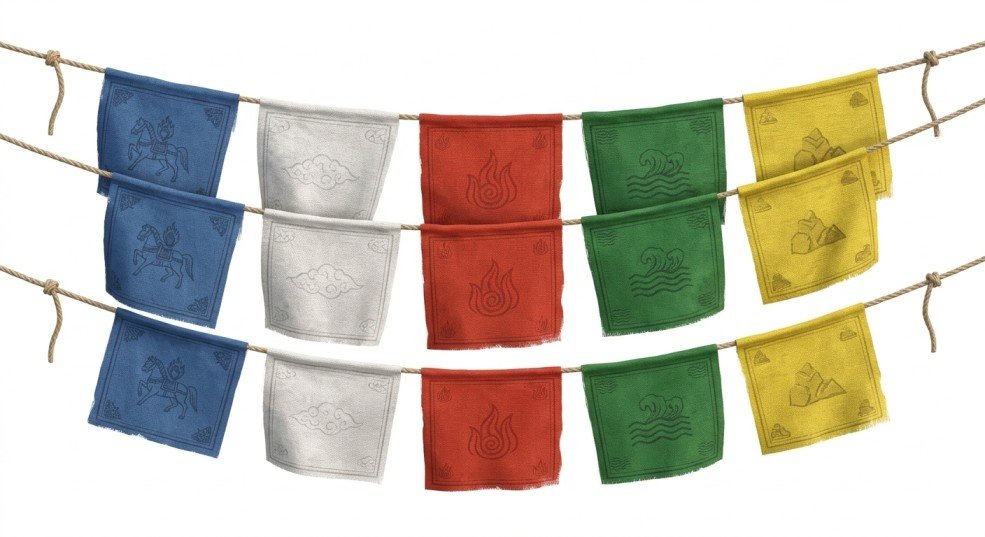
Prayer flags are common across Bhutan’s mountain valleys and passes. They carry printed prayers, mantras, and sacred images. Many are displayed in five colours associated with the natural elements. Tall white flags are also raised for religious purposes, including prayers connected with deceased family members.
These religious symbols are not all official national emblems. Their importance comes from their continued use in Bhutanese Buddhist practice and community traditions.
The National Symbols of Bhutan carry meanings connected to the country’s political history, religious beliefs, and natural environment. Their meanings are not always literal. For example, the dragon represents a national identity rather than an actual animal found in Bhutan.
The colours of the flag represent two important parts of Bhutanese public life. Yellow is connected to the king and civil authority. Orange reflects the country’s Buddhist spiritual heritage. Together, they show the historical relationship between government and religion.
The national animal and bird have different cultural associations. The takin is connected to a traditional story about Drukpa Kunley. The raven is linked to the protective deity Mahakala and the royal crown. These connections explain why particular animals gained national importance beyond their biological features.
The national flower and tree represent the country’s mountain environment. The blue poppy grows in alpine habitats, while the Himalayan cypress has strong associations with sacred sites.
Bhutan’s national dress and sport represent living traditions. They are not simply objects displayed in museums. People continue to wear traditional clothing and take part in archery competitions.
The following chart provides a quick reference to the country’s main national symbols.
| National Symbol | Name | Key Fact |
|---|---|---|
| National Flag | Bhutanese Flag | Features a white dragon |
| National Emblem | Royal Emblem | Includes two dragons and a lotus |
| National Anthem | Druk Tsenden | Honours the Thunder Dragon Kingdom |
| National Animal | Takin | Himalayan hoofed mammal |
| National Bird | Common Raven | Linked to the royal crown |
| National Flower | Blue Poppy | Native to alpine habitats |
| National Tree | Himalayan Cypress | Evergreen conifer |
| National Sport | Archery | Traditional targets about 145 m apart |
| National Language | Dzongkha | Written in Tibetan script |
| National Dress | Gho and Kira | Traditional men’s and women’s clothing |
Note: The chart includes constitutional state symbols and other nationally recognised cultural designations. They do not all have the same legal classification.
National symbols have practical roles in Bhutanese government, education, tourism, and cultural life. Their use depends on the meaning and status of each symbol.
Government and official ceremonies: The national flag is displayed at government buildings and during national celebrations. The national emblem identifies state authority. The anthem is performed at formal occasions and important public gatherings.
Education: Students learn about the flag, monarchy, language, and cultural traditions. National celebrations give schools opportunities to teach Bhutanese history through performances, traditional dress, and public activities.
Tourism: Images of the takin, blue poppy, dragon, and traditional architecture appear in travel information and cultural displays. Visitors can learn about the takin at the Motithang Takin Preserve in Thimphu. Bhutanese textiles and archery competitions also offer ways to experience local traditions.
Cultural preservation: Traditional clothing supports weaving and textile production. Religious symbols remain visible in Bhutan’s dzongs, monasteries, and temples. Archery competitions bring communities together and help pass sporting customs to younger generations.
International representation: The flag identifies Bhutan at United Nations events, diplomatic meetings, and international sporting competitions. The national anthem is used to represent the country during appropriate official ceremonies.
Bhutan’s national symbols show how the country maintains a connection between its past and present. The monarchy, Buddhist institutions, and local communities have all contributed to the development of its national identity.
The country follows a development philosophy known as Gross National Happiness. This approach considers well-being, cultural preservation, environmental protection, and good governance alongside economic development. National symbols reflect several of these priorities.
Traditional clothing provides an example of cultural continuity. Bhutanese people wear modern clothing in many everyday situations, but the gho and kira remain important in schools, offices, and ceremonies. This allows traditional weaving practices to retain a place in modern society.
Nature-related symbols also have historical value. Bhutan’s mountains and forests have influenced settlement patterns, religious practices, and local livelihoods. The country’s national animal, flower, and tree draw attention to environments that require protection.
The raven and dragon show how religious stories became part of national identity. Their meanings developed through centuries of Buddhist belief and royal tradition. Understanding these connections helps explain why Bhutan’s symbols remain culturally important.
The National Symbols of Bhutan include several unusual features that distinguish the country from other nations.
1. Bhutan’s traditional name is Druk Yul. It means Land of the Thunder Dragon and explains why a dragon appears on the national flag.
2. The takin has an unusual appearance. Its large head, thick neck, and strong body give it a distinctive shape. Despite its appearance, it belongs to the same mammal family as goats, sheep, and cattle.
3. Bhutanese archery uses unusually long distances. Traditional targets are placed about 145 metres apart. This requires players to judge distance and aim carefully.
4. The raven appears in royal tradition. Bhutanese kings wear a raven-headed crown during important ceremonies. The crown has religious meaning connected to a protective deity.
5. The blue poppy is adapted to mountain conditions. Its alpine habitat is very different from the warm gardens where many familiar flowers grow.
6. Bhutan’s national language is not its only language. Communities across the country speak several regional languages, reflecting Bhutan’s varied cultural background.
7. Bhutan has a constitutional forest protection requirement. Article 5 requires at least 60% of the country to remain under forest cover.
8. Bhutan’s national emblem contains a double vajra. This Buddhist symbol represents harmony between secular and religious authority.
9. Bhutanese prayer flags have different forms. Long vertical white flags and strings of colourful flags serve different religious and ceremonial purposes.
10. The country’s national day is 17 December. It commemorates the coronation of Ugyen Wangchuck as the first hereditary king in 1907.
Bhutan’s main symbols include its flag, emblem, anthem, takin, raven, blue poppy, Himalayan cypress, archery, Dzongkha language, and traditional dress.
The takin is Bhutan’s national animal. It is a large mountain mammal associated with the Buddhist saint Drukpa Kunley.
The common raven is Bhutan’s national bird. It has a special connection to the monarchy and the country’s religious traditions.
The blue poppy is Bhutan’s national flower. Bhutanese botanical sources identify Meconopsis gakyidiana as the national species.
The Himalayan cypress is Bhutan’s national tree. This evergreen species is associated with sacred places and religious buildings.
The white dragon represents Bhutan’s identity as Druk Yul. Its jewels symbolise national wealth and well-being.
Archery is Bhutan’s national sport. Traditional competitions combine shooting skills with team celebrations, music, and dancing.
The gho is the traditional national dress for men, while the kira is the traditional national dress for women. Both are important parts of Bhutanese culture.