

100 Top Countries and Their National Birds Explained

100 Countries and Their National Birds
Countries and Their National Birds

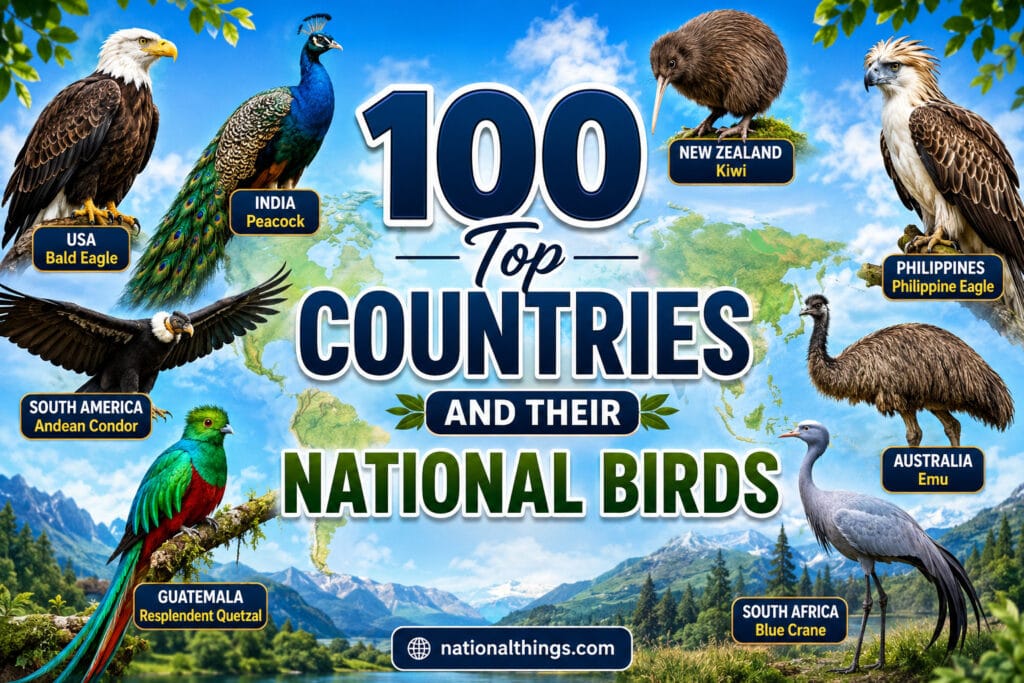
Countries and Their National Birds tell amazing stories about culture, history, wildlife, and national identity. Have you ever wondered why one country chooses an eagle while another proudly celebrates a tiny colorful bird? Every national bird represents something special. Some stand for freedom and strength while others reflect beauty, peace, courage, or local traditions. Learning about these birds also helps people understand nature and the heritage of different nations around the world.

Many countries officially recognize a bird as a national symbol. Some governments select the bird through law while others adopt it through tradition or public support. These birds often appear on coins, stamps, flags, government logos, and tourism campaigns. They also remind people to protect wildlife and preserve natural habitats for future generations.

What Are National Birds

A national bird is a bird species that represents a country and its people. The selection usually reflects local wildlife, history, culture, or important values.

Common reasons countries choose a national bird include:
  • Native presence in the country
  • Historical importance in local traditions
  • Cultural meaning in stories and art
  • Symbol of freedom or strength
  • Unique appearance that makes the country easy to recognize
Top Countries and Their National Birds Explained with Pictures
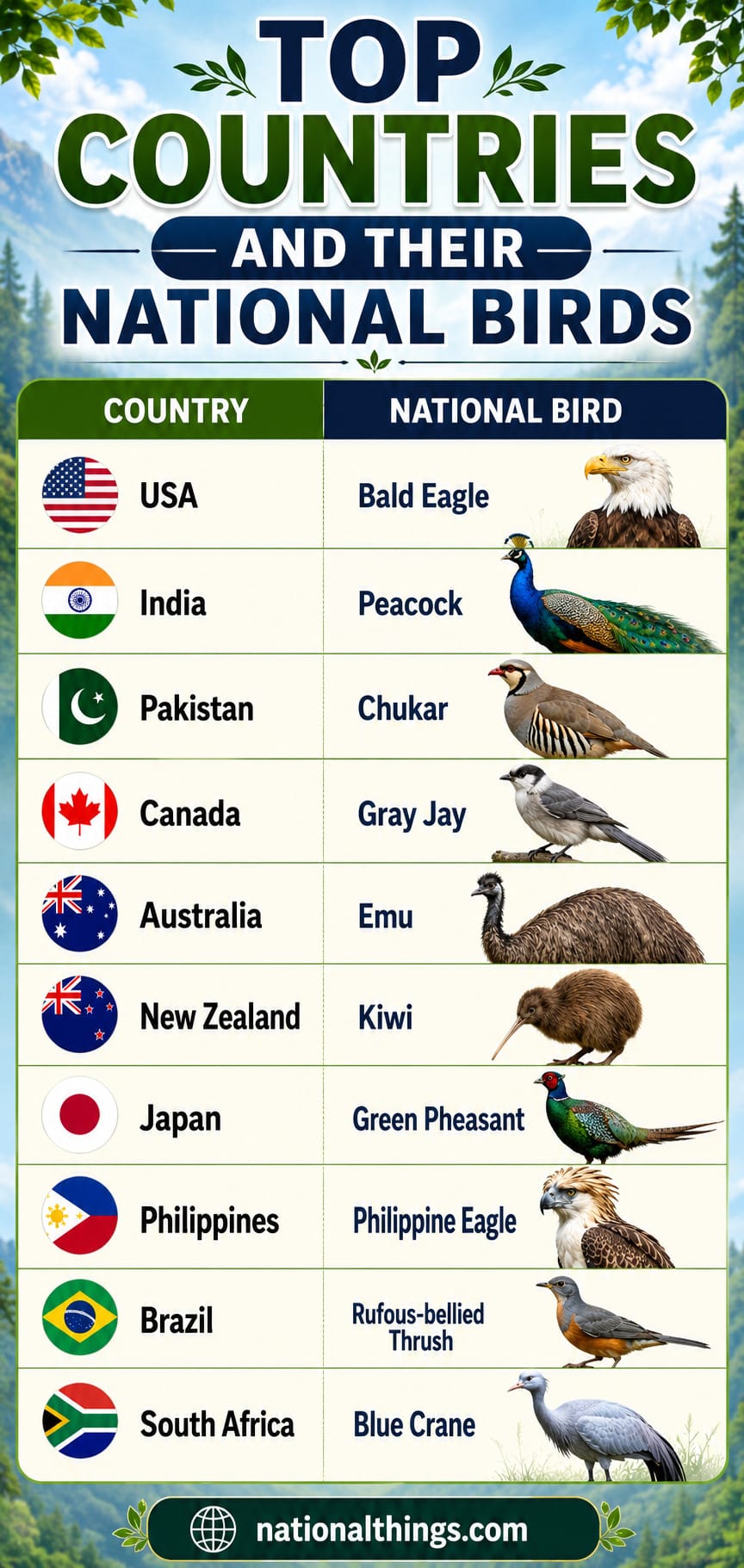
Top Countries and Their National Birds

Many national birds also become important symbols for conservation programs.

Why Countries Choose National Birds

Every country has different reasons for selecting its official bird.

Some common factors include:

  • Birds that have lived there for centuries
  • Species linked to famous legends
  • Birds admired for bravery or intelligence
  • Birds connected with royal families or national heroes
  • Rare species found only in that region

For example, the Bald Eagle became the national bird of the United States because people viewed it as a symbol of independence and power.
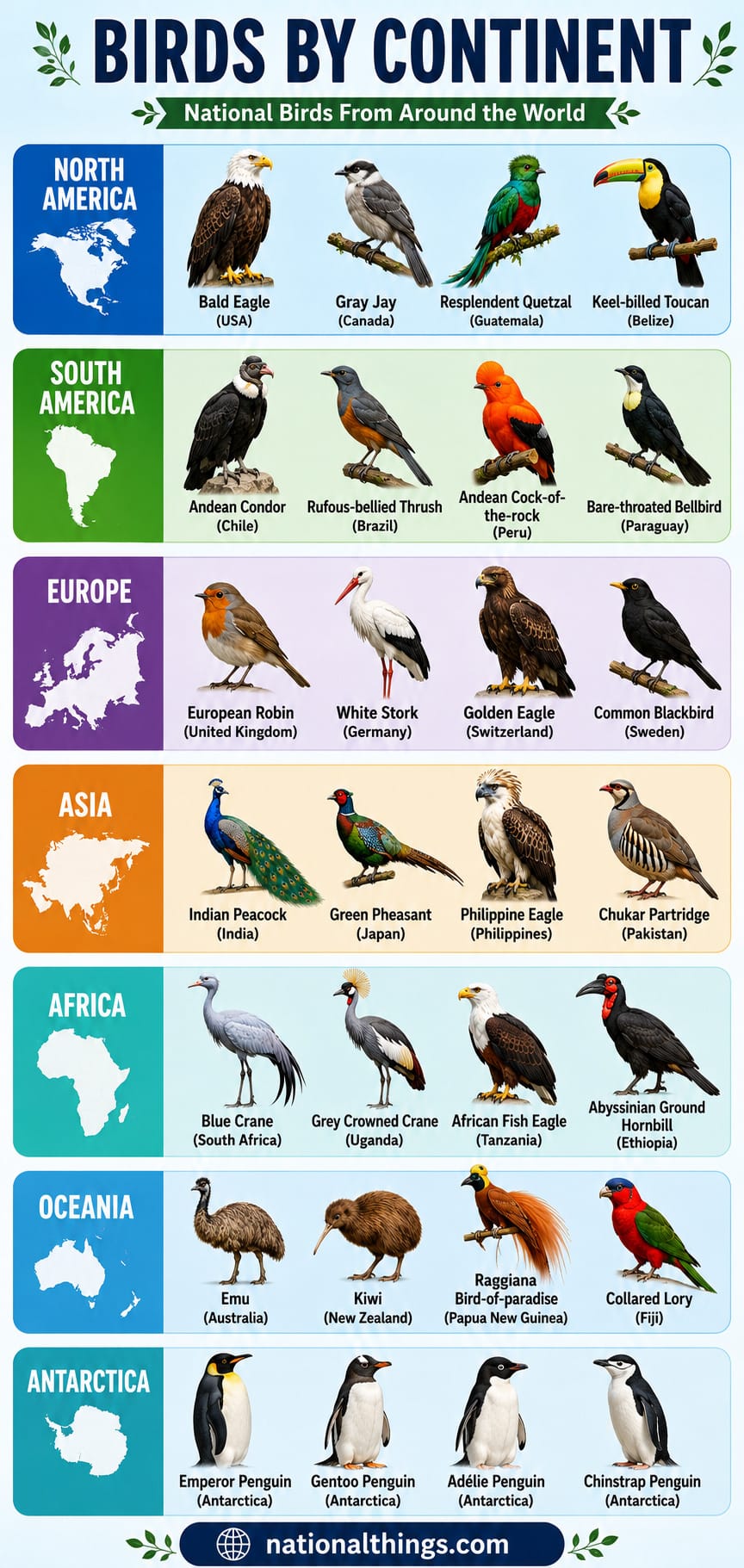
100 Top Countries and Their National Birds

North America

  • United States – Bald Eagle
  • Canada – Gray Jay
  • Mexico – Golden Eagle
  • Guatemala – Resplendent Quetzal
  • Belize – Keel Billed Toucan
  • Jamaica – Doctor Bird
  • Cuba – Cuban Trogon
  • Bahamas – Flamingo
  • Dominican Republic – Palmchat
  • Haiti – Hispaniolan Trogon

South America

  • Brazil – Rufous Bellied Thrush
  • Argentina – Rufous Hornero
  • Chile – Andean Condor
  • Peru – Andean Cock of the Rock
  • Colombia – Andean Condor
  • Ecuador – Andean Condor
  • Venezuela – Venezuelan Troupial
  • Bolivia – Andean Condor
  • Paraguay – Bare Throated Bellbird
  • Uruguay – Southern Lapwing

Europe

  • United Kingdom – European Robin
  • Ireland – Northern Lapwing
  • France – Gallic Rooster
  • Germany – White Stork
  • Spain – Spanish Imperial Eagle
  • Portugal – Rooster of Barcelos
  • Italy – Italian Sparrow
  • Netherlands – Black Tailed Godwit
  • Belgium – Common Kestrel
  • Switzerland – Golden Eagle
  • Austria – Barn Swallow
  • Norway – White Throated Dipper
  • Sweden – Common Blackbird
  • Finland – Whooper Swan
  • Denmark – Mute Swan
  • Poland – White Eagle
  • Czech Republic – Common Kestrel
  • Slovakia – Tatra Chamois Bird Symbol traditionally linked with Golden Eagle
  • Hungary – Turul Falcon Symbol
  • Greece – Little Owl

Asia

  • Pakistan – Chukar Partridge
  • India – Indian Peacock
  • China – Red Crowned Crane
  • Japan – Green Pheasant
  • South Korea – Korean Magpie
  • North Korea – Northern Goshawk
  • Bangladesh – Oriental Magpie Robin
  • Nepal – Himalayan Monal
  • Sri Lanka – Sri Lanka Junglefowl
  • Bhutan – Raven
  • Afghanistan – Golden Eagle
  • Iran – Nightingale
  • Iraq – Chukar Partridge
  • Saudi Arabia – Saker Falcon
  • United Arab Emirates – Falcon
  • Qatar – Falcon
  • Oman – Arabian Oryx Bird Symbol commonly linked with Owl traditions
  • Kuwait – Falcon
  • Malaysia – Rhinoceros Hornbill
  • Singapore – Crimson Sunbird

Southeast Asia

  • Indonesia – Javan Hawk Eagle
  • Thailand – Siamese Fireback
  • Vietnam – Red Crowned Crane
  • Philippines – Philippine Eagle
  • Myanmar – Green Peacock
  • Cambodia – Giant Ibis
  • Laos – Indian Peafowl
  • Brunei – White Bellied Sea Eagle
  • Timor Leste – Yellow Crested Cockatoo

Africa

  • South Africa – Blue Crane
  • Kenya – Lilac Breasted Roller
  • Uganda – Grey Crowned Crane
  • Tanzania – African Fish Eagle
  • Nigeria – Black Crowned Crane
  • Ghana – Golden Eagle Symbolic Use
  • Ethiopia – Abyssinian Ground Hornbill
  • Rwanda – Grey Crowned Crane
  • Zimbabwe – Zimbabwe Bird
  • Zambia – African Fish Eagle
  • Botswana – Kori Bustard
  • Namibia – African Fish Eagle
  • Morocco – Moussier’s Redstart
  • Algeria – Barbary Partridge
  • Tunisia – Barbary Falcon

Oceania

  • Australia – Emu
  • New Zealand – Kiwi
  • Papua New Guinea – Raggiana Bird of Paradise
  • Fiji – Collared Lory
  • Samoa – Manumea
  • Tonga – Pacific Imperial Pigeon
  • Solomon Islands – Sanford’s Sea Eagle
  • Vanuatu – Vanuatu Megapode
  • Palau – Palau Fruit Dove
  • Kiribati – Frigatebird
National Birds by Countries

Famous National Birds and Their Meaning

Bald Eagle

The Bald Eagle represents freedom, courage, and independence in the United States. It has appeared on the Great Seal since 1782 and remains one of the world’s most recognized national symbols.

Indian Peacock

The Indian Peacock stands for beauty, pride, and grace. Its colorful feathers have inspired art, dance, and literature across India for centuries.

Kiwi

The Kiwi cannot fly but has become a powerful symbol of New Zealand. People from New Zealand are often proudly called “Kiwis.”

Philippine Eagle

The Philippine Eagle is one of the largest eagles on Earth. It represents strength and is protected because it faces serious habitat loss.

Andean Condor

The Andean Condor appears in several South American countries. Its huge wingspan and high mountain flights make it a symbol of power and endurance.

Interesting Facts About National Birds

National birds often teach interesting lessons about biodiversity.

  • Some countries share the same bird.
  • A few national birds are endangered.
  • Several birds migrate across continents.
  • Some national birds cannot fly.
  • Many appear on official government seals and currency.

According to BirdLife International, more than 13 percent of bird species worldwide face the risk of extinction, making conservation efforts increasingly important. Source: https://www.birdlife.org

Why National Birds Matter for Conservation

National birds encourage governments and citizens to protect wildlife.

Benefits include:

  • Raising awareness about endangered species
  • Supporting habitat protection
  • Promoting wildlife tourism
  • Inspiring environmental education
  • Building national pride through conservation

Many countries use their national bird to educate children about biodiversity and ecosystem health.

How National Birds Reflect Culture

National birds often appear in:

  • Traditional stories
  • Ancient myths
  • Folk songs
  • Paintings
  • Government emblems
  • Currency designs
  • Sports logos
  • Tourism advertisements

These connections make the birds important cultural symbols instead of simple wildlife species.

Common Types of National Birds

Countries often choose birds from these groups:

  • Eagles for strength
  • Cranes for peace
  • Falcons for courage
  • Peacocks for beauty
  • Swans for elegance
  • Owls for wisdom
  • Parrots for uniqueness
  • Hornbills for local identity

Each choice reflects different traditions and values.

Fun Facts About Countries and Their National Birds

  • The Kiwi is famous even though it cannot fly.
  • The Emu appears on Australia’s coat of arms.
  • The Resplendent Quetzal gives its name to Guatemala’s currency.
  • The Philippine Eagle can reach an impressive size with powerful hunting skills.
  • The Grey Crowned Crane performs unique courtship dances.
  • The Blue Crane is one of South Africa’s most recognizable birds.
  • The Peacock can spread more than 200 colorful feathers during displays.

How to Learn National Birds Easily

Simple methods make learning easier.

  • Study by continent.
  • Match birds with flags.
  • Use maps and flashcards.
  • Watch wildlife documentaries.
  • Practice quizzes regularly.
  • Learn one country every day.

This approach helps students remember information much faster.

FAQs about Countries and Their National Birds

What is a national bird?

A national bird is a bird that officially or traditionally represents a country. It reflects the country’s culture, history, wildlife, or important values and often appears on national symbols like stamps, coins, or emblems.

Why do countries have national birds?

Countries choose national birds to show pride in their natural heritage and identity. Many of these birds have cultural importance, live naturally in the region, or symbolize qualities such as freedom, strength, or peace.

Which country has the Bald Eagle as its national bird?

The United States has the Bald Eagle as its national bird. It has been a national symbol since 1782 and represents independence, courage, and power.

Can two countries have the same national bird?

Yes. Some countries share the same national bird or use closely related species. For example, the Andean Condor is recognized as a national symbol by several South American countries.

Are all national birds native to their countries?

Most national birds are native to the country that selected them, but there are a few exceptions. In some cases, tradition or historical meaning played a bigger role than natural distribution.

Do national birds receive legal protection?

In many countries, national birds are protected by wildlife laws. Governments often create conservation programs to protect these birds and preserve their natural habitats.

Why is it useful to learn about countries and their national birds?

Learning about countries and their national birds helps you understand geography, culture, and biodiversity at the same time. It also makes it easier to remember national symbols and appreciate wildlife around the world.

Final Thoughts

Countries and Their National Birds offer much more than a list of names. They connect people with wildlife, history, and national identity. From the mighty Bald Eagle to the tiny Crimson Sunbird, each bird tells a different story about the place it represents. Learning these symbols also builds respect for nature and reminds us why protecting bird species matters for every generation.