National Animal of France: Le Coq Gaulois
The national animal of France is the Gallic Rooster, known in French as Le Coq Gaulois. Unlike many countries that…
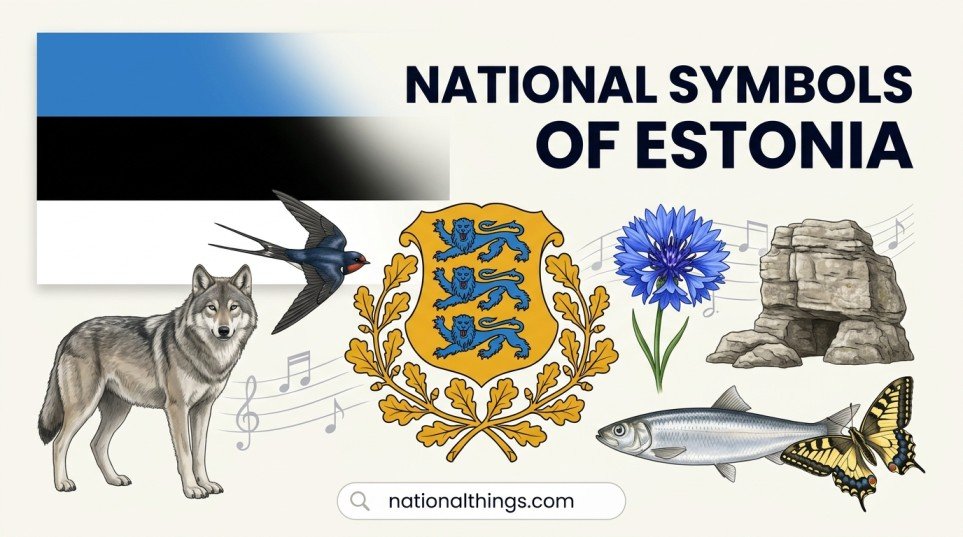
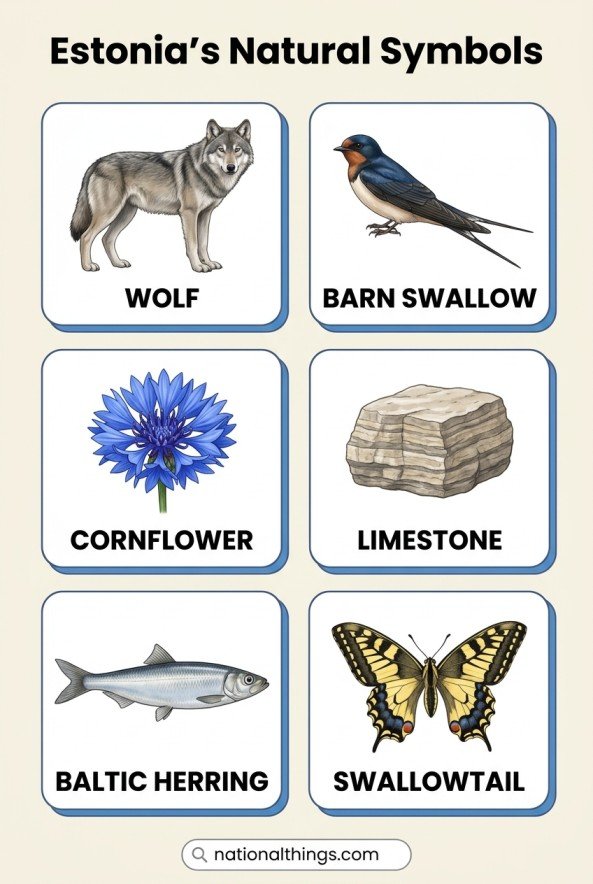
National symbols of Estonia represent the country’s independence, history, cultural identity, and natural heritage. Its principal state symbols include the blue, black, and white national flag, the coat of arms featuring three blue lions, and the national anthem, Mu isamaa, mu õnn ja rõõm. Estonia is also associated with several natural symbols, including the wolf, barn swallow, cornflower, limestone, Baltic herring, and swallowtail butterfly. These symbols connect Estonian identity with the country’s landscape, traditions, and history. However, not every widely recognised national symbol has the same legal status. Understanding the distinction between official state symbols and cultural associations helps explain what each symbol represents and why it matters.
National symbols are objects, emblems, songs, animals, or plants that represent a country’s identity and heritage. Estonia’s symbols reflect its independent statehood, historical struggles, cultural traditions, and distinctive natural environment.
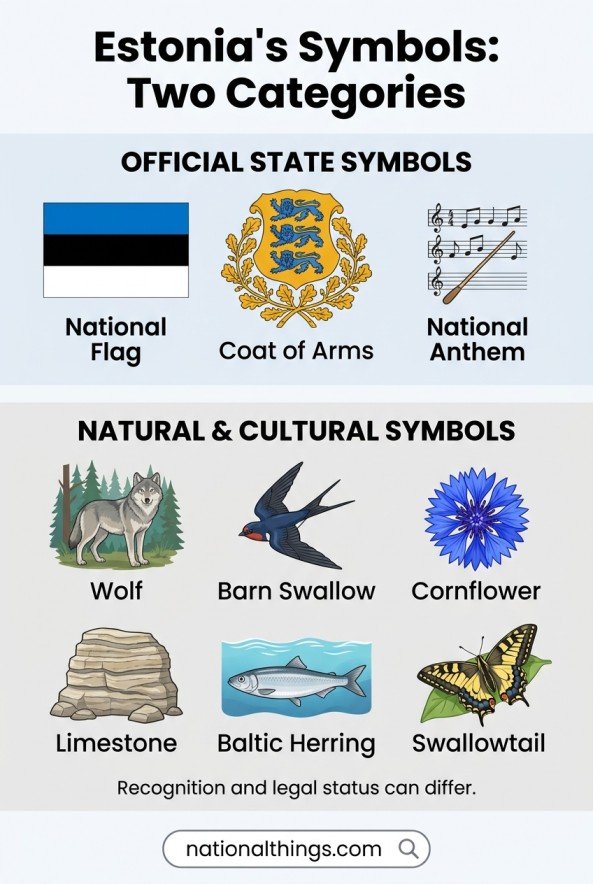
The country’s symbols fall into two broad groups:
These categories are not legally equivalent. Some natural symbols have been selected through public campaigns or recognised by specialist organisations rather than established as state symbols by law.
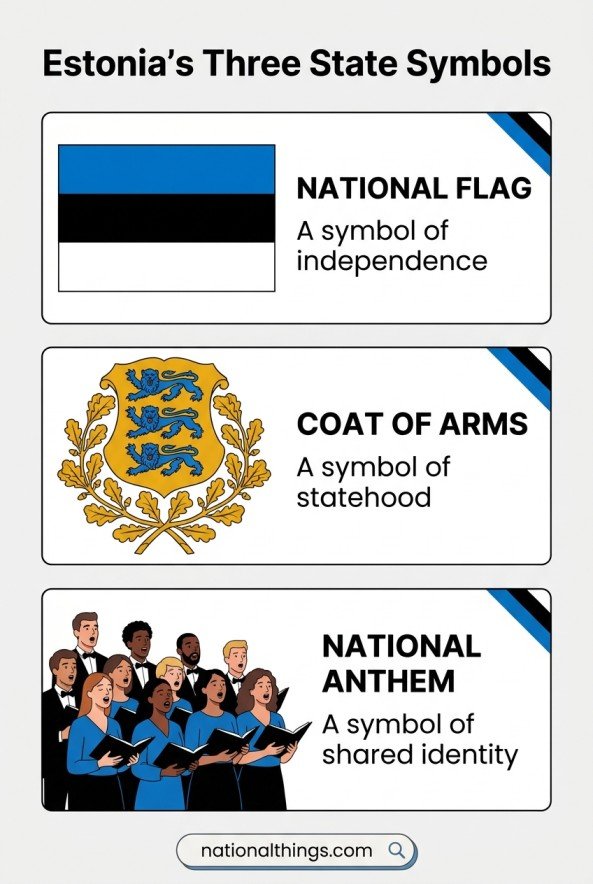
The national flag of Estonia consists of three equal horizontal stripes: blue at the top, black in the middle, and white at the bottom. It is one of the country’s most recognisable symbols of independence and national identity.
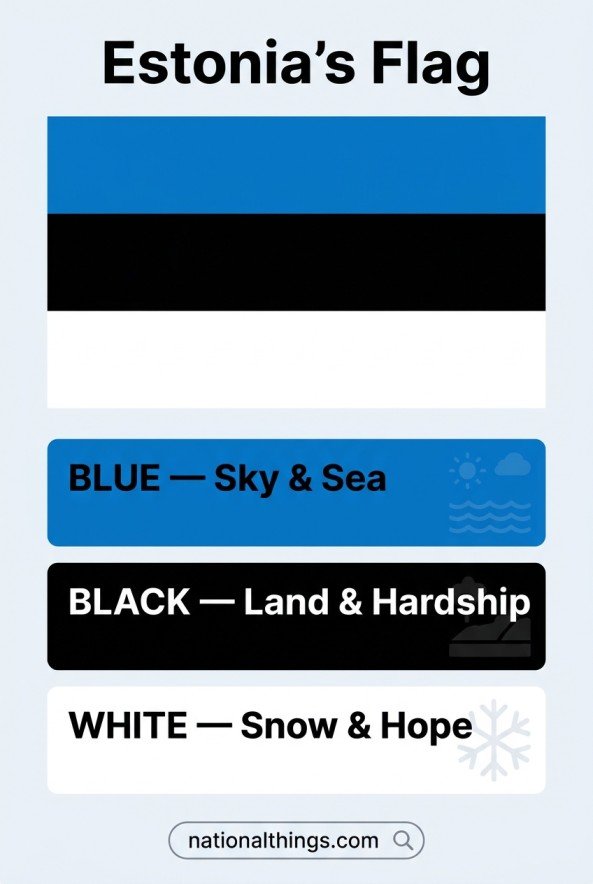
The colours have traditional interpretations that connect the flag with Estonia’s landscape and national aspirations.
These explanations are traditional interpretations rather than a definitive list of meanings prescribed by law.
The blue-black-white tricolour originated with the Estonian Students’ Society in the nineteenth century. Its colours became closely associated with the Estonian national awakening and the growing movement for national self-determination.
The flag was consecrated in 1884 and subsequently became a powerful expression of Estonian identity. Estonia declared independence in 1918, and the tricolour became the national flag. During Soviet rule, its public use as a national symbol was suppressed. It returned as a prominent emblem of independence during the late 1980s and was restored as the national flag in 1990.
The Estonian Flag Act establishes rules governing the national flag, including its design, use, display, and appropriate occasions for flying it. The prescribed tricolour has a 7:11 width-to-length ratio.
The flag’s legal status is distinct from the traditional meanings attributed to its colours. For precise requirements concerning display and protocol, the current legislation should be consulted.
The national coat of arms of Estonia features three blue lions on a golden shield, surrounded by oak branches in its larger form. It represents the country’s statehood and is used in official government and institutional contexts.
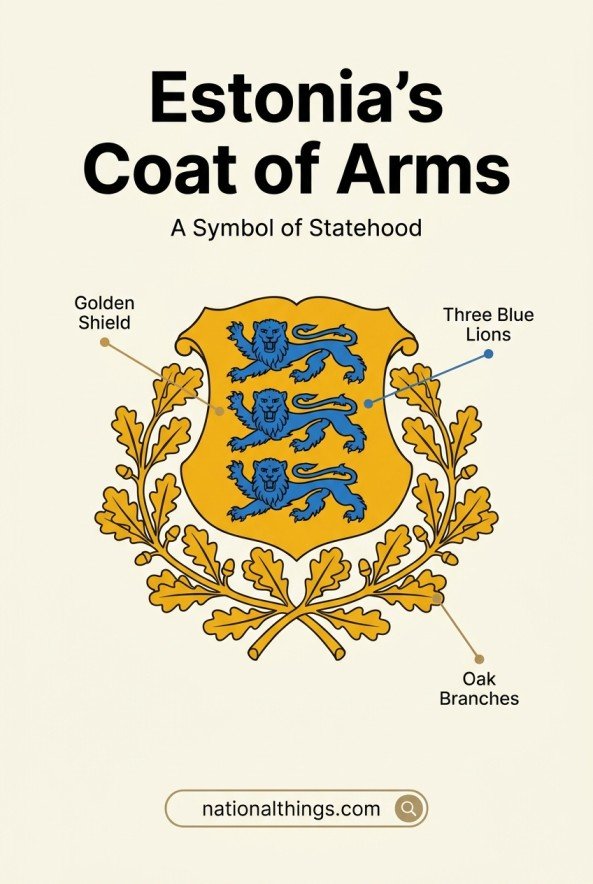
The three lions are arranged one above another, facing forward in a heraldic walking pose. Their blue colour contrasts with the gold background.
The design has historical roots in Estonian heraldry and the country’s earlier political history. Its continued use connects modern Estonia with its historical identity.
Oak branches form part of the larger coat of arms. Oak trees have a longstanding place in European heraldic traditions, but any specific interpretation of the branches should be supported by an authoritative source.
The coat of arms became an important state emblem during Estonia’s early period of independence in the twentieth century. Like the national flag, its use as a national emblem was restricted under Soviet rule.
Following the restoration of independence, Estonia reinstated its national heraldic symbols. The coat of arms is legally distinct from the national flag and from the smaller or specialised emblems used by individual institutions.
Estonia’s national anthem is Mu isamaa, mu õnn ja rõõm, commonly translated as “My Fatherland, My Happiness and Joy.” The song expresses attachment to the homeland and remains an important part of national ceremonies.
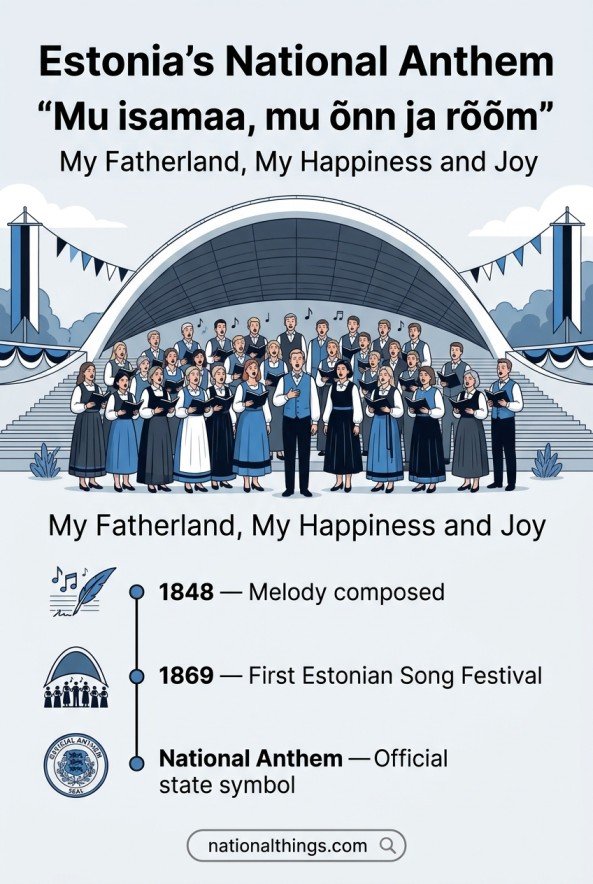
The anthem’s lyrics were written by Johann Voldemar Jannsen, and its melody was composed by Fredrik Pacius in 1848. The song was performed at the first Estonian Song Festival in 1869, an important event in the development of Estonian national consciousness.
The melody is also used by Finland’s national anthem, although the two countries have different lyrics and national histories.
Estonia adopted the song as its national anthem during its first period of independence. Its public role was suppressed during Soviet rule, and it returned as a national symbol with the restoration of independence.
The anthem’s significance comes from both its formal state status and its connection with the Estonian national movement.
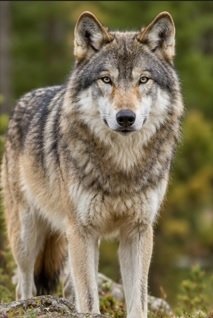
The wolf is widely recognised as Estonia’s national animal. It represents a connection with the country’s wildlife and forest ecosystems, although its designation should not be confused with the legal status of the national flag or coat of arms.
The grey wolf (Canis lupus) is a large carnivorous mammal found in Estonia. It inhabits forests and other suitable landscapes, moving across substantial territories in search of food.
Wolves play an important ecological role because they prey on animals such as deer and other ungulates. Their presence is relevant to discussions about biodiversity, wildlife management, and the relationship between people and nature.
The wolf appears in stories, folklore, and cultural traditions across northern and eastern Europe. In Estonia, it is also a prominent wildlife species.
However, individual interpretations of the wolf as a symbol of courage, independence, or resilience should be presented as cultural associations rather than official meanings unless reliable sources document them.
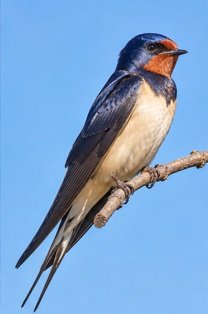
The barn swallow (Hirundo rustica) is recognised as Estonia’s national bird. Its connection with rural landscapes and seasonal changes makes it a familiar part of the country’s natural heritage.
The barn swallow is a slender migratory bird with long, pointed wings, a deeply forked tail, a dark blue upper body, and reddish colouring around the throat and forehead.
It feeds mainly on flying insects and often nests in or around barns, farm buildings, and other structures. Its presence is particularly noticeable during the warmer months, when it returns from its wintering grounds.
The bird is associated with the countryside, summer, and the seasonal rhythms of rural life. Its designation as a national bird gives it a distinctive place among Estonia’s natural symbols.
The barn swallow’s ecological role and its cultural associations are related but different: its insect-eating behaviour is a biological fact, while interpretations of it as a symbol of home or good fortune belong to cultural tradition.
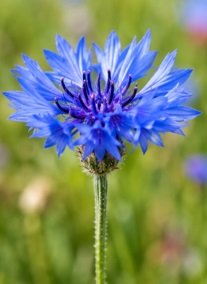
The cornflower (Centaurea cyanus) is recognised as Estonia’s national flower. Its vivid blue petals connect it visually with the blue in the Estonian flag, although the flower’s national significance extends beyond colour alone.
Cornflowers are flowering plants with distinctive blue, fringed flower heads. They commonly grow in open, sunny habitats and have historically been associated with cultivated fields and grassland.
The species is also known in other European countries, so its presence is not unique to Estonia.
The cornflower has a place in Estonian national and cultural symbolism. Its colour and familiar appearance make it a recognisable emblem of the country’s natural heritage.
The flower should not be confused with a legally prescribed state emblem. Its national-symbol status belongs to a different category from the official flag and coat of arms.
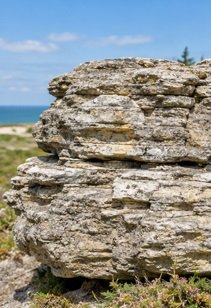
Limestone is recognised as Estonia’s national stone. This sedimentary rock is particularly important to the country’s geology, coastal landscapes, and architectural heritage.
Limestone forms from carbonate-rich sediments, often containing the remains of marine organisms. Estonia has extensive limestone formations that developed when the region was covered by ancient seas.
These rocks provide valuable evidence of geological history and contain fossils that help researchers understand past marine environments.
Limestone has been used in buildings, walls, and other structures across Estonia. It is especially associated with historic architecture and the country’s northern geological landscape.
Its significance reflects both the natural environment and the ways people have used local materials. The stone’s designation as a national symbol should be distinguished from its geological classification, which is established by scientific evidence.
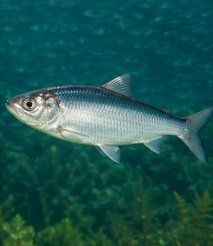
The Baltic herring is recognised as Estonia’s national fish. It has longstanding importance in the Baltic Sea’s marine ecosystem and in the fishing and food traditions of Estonia’s coastal communities.
Baltic herring is a form of Atlantic herring (Clupea harengus) adapted to the brackish waters of the Baltic Sea. It is a schooling fish that feeds mainly on small planktonic organisms.
Its populations form an important part of the marine food web, supporting larger fish, seabirds, and marine mammals.
Herring has traditionally been used in Estonian cooking, including salted, marinated, and other preserved preparations. Fishing has also supported livelihoods in coastal communities.
The fish therefore connects Estonia’s national-symbol tradition with the sea, local food culture, and maritime history. Its cultural significance should not be treated as evidence of a particular legal designation without supporting documentation.
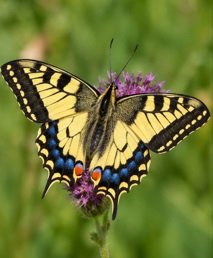
The swallowtail butterfly (Papilio machaon) is commonly identified as Estonia’s national butterfly. Its striking appearance and presence in suitable habitats make it a recognisable representative of the country’s insect life.
The Old World swallowtail is a large butterfly with yellow wings marked by black patterns and distinctive tail-like extensions on its hindwings. Blue markings and reddish spots are visible near the hindwing edges.
Its caterpillars feed on particular host plants, while adult butterflies visit flowers for nectar. The species occurs across a broad geographic range, including parts of Europe and northern Eurasia.
The swallowtail contributes to Estonia’s biodiversity and offers an example of the country’s insect fauna. Its national-symbol association highlights a group of animals that receives less public attention than mammals and birds.
The exact basis and institutional recognition of its national designation should be checked against authoritative Estonian entomological or nature-conservation sources.
Estonia’s national identity is also expressed through its language, traditional celebrations, music, landscape, and cultural heritage. These associations help explain the country’s identity, but they do not all constitute formally designated national symbols.
Relevant examples include:
These examples are best described as cultural or historical associations unless an authoritative source establishes a specific official designation. Estonia’s national flag, coat of arms, and anthem remain distinct from these broader expressions of national identity.
Estonia’s symbols do not all have the same recognition status. The distinction matters because a symbol can be widely accepted by the public without being established in national legislation.
The principal state symbols include:
Their legal and institutional status distinguishes them from symbols selected through cultural initiatives or specialist organisations.
The wolf, barn swallow, cornflower, limestone, Baltic herring, and swallowtail are commonly identified with Estonia’s national-symbol tradition. However, their recognition may derive from public selections, specialist organisations, or cultural usage rather than legislation establishing them as state symbols.
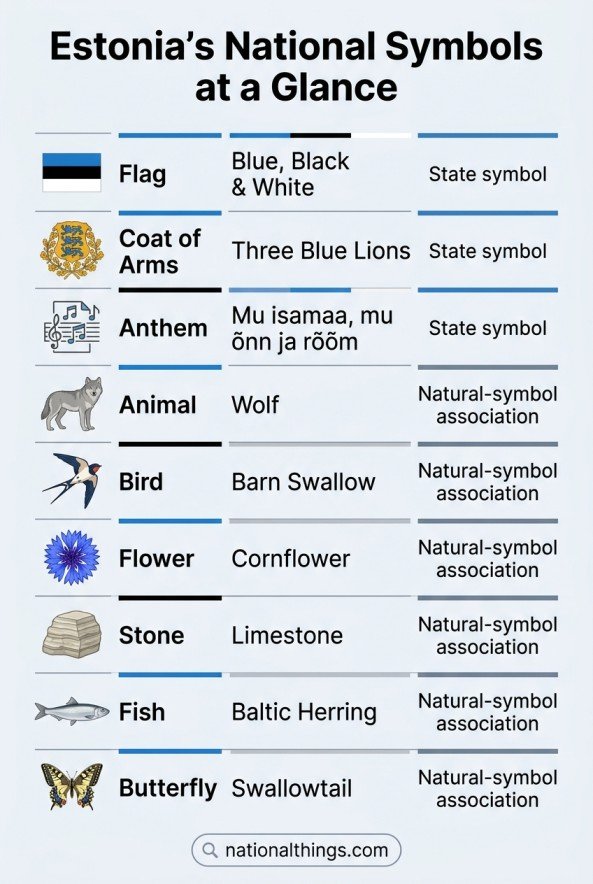
The following table summarises the principal symbols discussed in this article. It distinguishes established state symbols from natural symbols whose recognition status requires more specific documentation.
| Symbol | Category | Significance | Recognition status |
|---|---|---|---|
| Blue, black, and white tricolour | National flag | Independence and national identity | Official state symbol |
| Three blue lions on a golden shield | Coat of arms | Statehood and historical heraldry | Official state symbol |
| Mu isamaa, mu õnn ja rõõm | National anthem | Patriotism and national identity | Official state symbol |
| Wolf | Animal | Wildlife and forest ecosystems | National-symbol association; verify designation basis |
| Barn swallow | Bird | Rural landscapes and seasonal wildlife | Recognised national bird; verify institutional basis |
| Cornflower | Flower | Natural and cultural heritage | Recognised national flower; verify institutional basis |
| Limestone | Stone | Geology and architectural heritage | Recognised national stone; verify institutional basis |
| Baltic herring | Fish | Marine ecosystems and coastal food traditions | Recognised national fish; verify institutional basis |
| Swallowtail | Butterfly | Insect biodiversity and natural heritage | National-symbol association; verify designation basis |
This overview is useful for students and readers comparing symbol categories, but it should not be interpreted as a complete legal register. Exact designations and adoption details require confirmation from authoritative sources.
Estonia’s principal state symbols are its national flag, coat of arms, and anthem. The wolf, barn swallow, cornflower, limestone, Baltic herring, and swallowtail are also associated with its national-symbol tradition.
The blue stripe is commonly associated with the sky and loyalty, black with the land and historical hardship, and white with snow, light, and hope. These are traditional interpretations, not a definitive legal list.
The wolf is commonly identified as Estonia’s national animal, while the barn swallow is recognised as its national bird. Their specific designation histories should be distinguished from the legal status of state symbols.
No. The flag, coat of arms, and anthem have formal state status. Natural symbols may be recognised through specialist organisations, public selections, or cultural traditions without having the same legal status.
Natural symbols connect national identity with Estonia’s forests, wildlife, coastal waters, geology, and traditional livelihoods. They also help communicate the country’s natural heritage to students, visitors, and future generations.