
National Fruit of China: Meaning, History and Pictures
The national fruit of China is widely recognized as the kiwi fruit, a crop that originated in China and later…
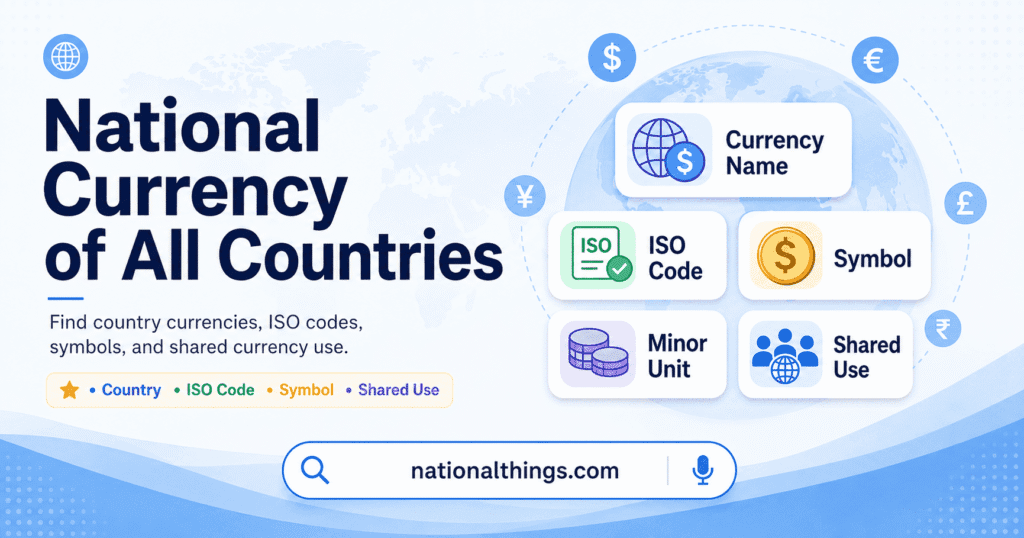
The national currency of all countries may look like a simple list. The subject becomes more complex when two countries use the same currency name or one country accepts several forms of legal tender. The dollar sign alone can refer to the US dollar, Canadian dollar, Australian dollar, Singapore dollar, and many others. This guide solves that problem with a complete list of currency names, ISO currency codes, symbols, and useful notes.
The list covers the 193 United Nations member states plus Palestine and Vatican City. Kosovo and Taiwan appear separately because readers often include them in world currency searches. Currency codes follow ISO 4217, the international standard used by banks, payment systems, airlines, traders, and accounting software. The information was checked against the official ISO 4217 Maintenance Agency and current monetary sources. The most important recent change is Bulgaria’s adoption of the euro on January 1, 2026.
Last updated July 31, 2026
A national currency is the main form of money officially used in a country. People use it to buy products, pay bills, receive salaries, calculate prices, save money, and pay taxes. A government normally gives a central bank or monetary authority the power to manage the currency.
A national currency performs several basic jobs:
Most countries issue their own banknotes and coins. Others use a shared regional currency such as the euro or CFA franc. Some small countries officially use the currency of a larger country instead of creating their own.
These terms are closely related. They do not always have the same meaning.
A national currency is the money most closely connected with a country. Pakistan uses the Pakistan rupee. Japan uses the yen. Nigeria uses the naira. Each has its own name and ISO code.
Some countries do not have a separate national currency. Ecuador uses the US dollar. Andorra uses the euro. Nauru uses the Australian dollar.
An official currency is formally recognized by a government for public and private financial activity. It usually appears in government accounts, tax records, salaries, banking systems, and official prices.
A foreign currency can become an official currency. The US dollar is issued by the United States but also serves as the official currency of Ecuador, El Salvador, Timor-Leste, Palau, the Marshall Islands, and Micronesia.
Legal tender is money that the law recognizes for settling financial obligations. The exact rules differ by country. Legal-tender status does not mean every shop must accept every note in every situation. Businesses may still apply rules about payment methods, damaged money, or large banknotes.
A currency can also circulate widely without being the main national currency. US dollars circulate in several countries where the local currency remains official.
The table below lists the national currencies of all countries in alphabetical order. The ISO codes come from the current currency list maintained by SIX, the official ISO 4217 Maintenance Agency. SIX states that it updates the list when currencies are created, changed, or withdrawn.
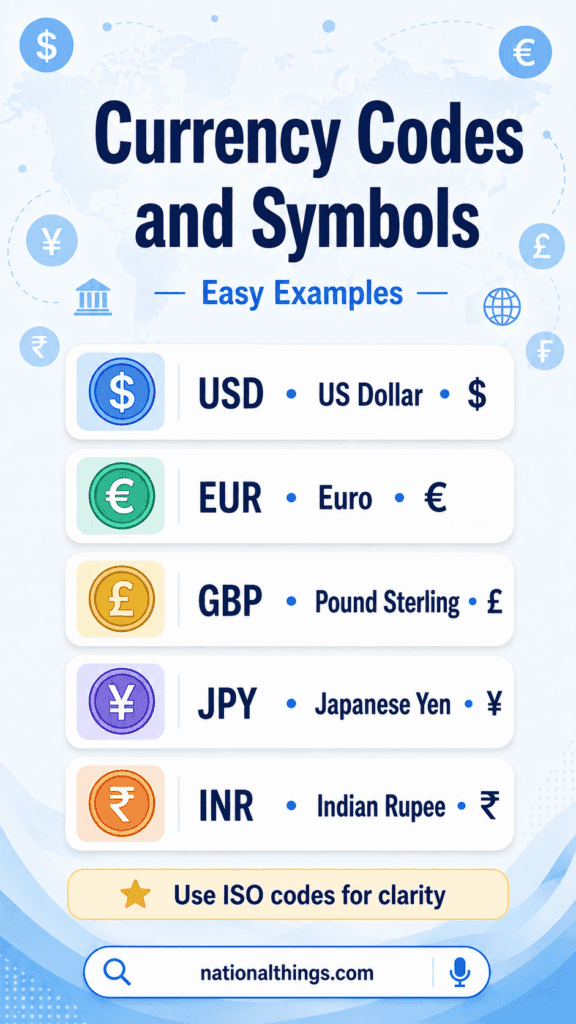
A symbol is not always unique. For example, “$” may identify many different dollars. Use the ISO code when accuracy matters.
| Country | Official currency | ISO code | Common symbol | Minor unit or note |
|---|---|---|---|---|
| Afghanistan | Afghani | AFN | ؋ | Pul |
| Albania | Lek | ALL | L | Qindarkë |
| Algeria | Algerian dinar | DZD | دج | Centime |
| Andorra | Euro | EUR | € | Cent |
| Angola | Kwanza | AOA | Kz | Cêntimo |
| Antigua and Barbuda | East Caribbean dollar | XCD | EC$ | Cent |
| Argentina | Argentine peso | ARS | $ | Centavo |
| Armenia | Dram | AMD | ֏ | Luma |
| Australia | Australian dollar | AUD | A$ | Cent |
| Austria | Euro | EUR | € | Cent |
| Azerbaijan | Manat | AZN | ₼ | Qəpik |
| Bahamas | Bahamian dollar | BSD | B$ | Cent |
| Bahrain | Bahraini dinar | BHD | د.ب | 1,000 fils |
| Bangladesh | Taka | BDT | ৳ | Poisha |
| Barbados | Barbados dollar | BBD | Bds$ | Cent |
| Belarus | Belarusian ruble | BYN | Br | Kopeck |
| Belgium | Euro | EUR | € | Cent |
| Belize | Belize dollar | BZD | BZ$ | Cent |
| Benin | West African CFA franc | XOF | CFA | No minor coin in normal use |
| Bhutan | Ngultrum | BTN | Nu. | Chhertum |
| Bolivia | Boliviano | BOB | Bs | Centavo |
| Bosnia and Herzegovina | Convertible mark | BAM | KM | Fening |
| Botswana | Pula | BWP | P | Thebe |
| Brazil | Real | BRL | R$ | Centavo |
| Brunei | Brunei dollar | BND | B$ | Sen |
| Bulgaria | Euro | EUR | € | Cent |
| Burkina Faso | West African CFA franc | XOF | CFA | No minor coin in normal use |
| Burundi | Burundi franc | BIF | FBu | No minor coin in normal use |
| Cabo Verde | Cabo Verde escudo | CVE | Esc | Centavo |
| Cambodia | Riel | KHR | ៛ | Sen |
| Cameroon | Central African CFA franc | XAF | FCFA | No minor coin in normal use |
| Canada | Canadian dollar | CAD | C$ | Cent |
| Central African Republic | Central African CFA franc | XAF | FCFA | No minor coin in normal use |
| Chad | Central African CFA franc | XAF | FCFA | No minor coin in normal use |
| Chile | Chilean peso | CLP | CLP$ | No minor coin in normal use |
| China | Renminbi yuan | CNY | ¥ | Jiao and fen |
| Colombia | Colombian peso | COP | COL$ | Centavo |
| Comoros | Comorian franc | KMF | CF | No minor coin in normal use |
| Congo Democratic Republic | Congolese franc | CDF | FC | Centime |
| Congo Republic | Central African CFA franc | XAF | FCFA | No minor coin in normal use |
| Costa Rica | Costa Rican colón | CRC | ₡ | Céntimo |
| Côte d’Ivoire | West African CFA franc | XOF | CFA | No minor coin in normal use |
| Croatia | Euro | EUR | € | Cent |
| Cuba | Cuban peso | CUP | $ | Centavo |
| Cyprus | Euro | EUR | € | Cent |
| Czechia | Czech koruna | CZK | Kč | Haléř |
| Denmark | Danish krone | DKK | kr | Øre |
| Djibouti | Djibouti franc | DJF | Fdj | No minor coin in normal use |
| Dominica | East Caribbean dollar | XCD | EC$ | Cent |
| Dominican Republic | Dominican peso | DOP | RD$ | Centavo |
| Ecuador | US dollar | USD | $ | Cent |
| Egypt | Egyptian pound | EGP | E£ | Piastre |
| El Salvador | US dollar | USD | $ | Cent |
| Equatorial Guinea | Central African CFA franc | XAF | FCFA | No minor coin in normal use |
| Eritrea | Nakfa | ERN | Nfk | Cent |
| Estonia | Euro | EUR | € | Cent |
| Eswatini | Lilangeni | SZL | L | South African rand also circulates |
| Ethiopia | Birr | ETB | Br | Santim |
| Fiji | Fijian dollar | FJD | FJ$ | Cent |
| Finland | Euro | EUR | € | Cent |
| France | Euro | EUR | € | Cent |
| Gabon | Central African CFA franc | XAF | FCFA | No minor coin in normal use |
| Gambia | Dalasi | GMD | D | Butut |
| Georgia | Lari | GEL | ₾ | Tetri |
| Germany | Euro | EUR | € | Cent |
| Ghana | Cedi | GHS | GH₵ | Pesewa |
| Greece | Euro | EUR | € | Cent |
| Grenada | East Caribbean dollar | XCD | EC$ | Cent |
| Guatemala | Quetzal | GTQ | Q | Centavo |
| Guinea | Guinean franc | GNF | FG | No minor coin in normal use |
| Guinea-Bissau | West African CFA franc | XOF | CFA | No minor coin in normal use |
| Guyana | Guyana dollar | GYD | G$ | Cent |
| Haiti | Gourde | HTG | G | Centime |
| Honduras | Lempira | HNL | L | Centavo |
| Hungary | Forint | HUF | Ft | Fillér |
| Iceland | Icelandic króna | ISK | kr | No minor coin in normal use |
| India | Indian rupee | INR | ₹ | Paise |
| Indonesia | Rupiah | IDR | Rp | Sen |
| Iran | Iranian rial | IRR | ﷼ | Dinar |
| Iraq | Iraqi dinar | IQD | ع.د | 1,000 fils |
| Ireland | Euro | EUR | € | Cent |
| Israel | New Israeli shekel | ILS | ₪ | Agora |
| Italy | Euro | EUR | € | Cent |
| Jamaica | Jamaican dollar | JMD | J$ | Cent |
| Japan | Yen | JPY | ¥ | No minor unit in normal use |
| Jordan | Jordanian dinar | JOD | د.ا | 1,000 fils |
| Kazakhstan | Tenge | KZT | ₸ | Tiyn |
| Kenya | Kenyan shilling | KES | KSh | Cent |
| Kiribati | Australian dollar | AUD | A$ | Local Kiribati coins also exist |
| Kuwait | Kuwaiti dinar | KWD | د.ك | 1,000 fils |
| Kyrgyzstan | Som | KGS | сом | Tyiyn |
| Laos | Kip | LAK | ₭ | Att |
| Latvia | Euro | EUR | € | Cent |
| Lebanon | Lebanese pound | LBP | ل.ل | Piastre |
| Lesotho | Loti | LSL | L | South African rand is also legal tender |
| Liberia | Liberian dollar | LRD | L$ | US dollars also circulate widely |
| Libya | Libyan dinar | LYD | ل.د | 1,000 dirhams |
| Liechtenstein | Swiss franc | CHF | CHF | Rappen |
| Lithuania | Euro | EUR | € | Cent |
| Luxembourg | Euro | EUR | € | Cent |
| Madagascar | Ariary | MGA | Ar | Iraimbilanja equals one fifth |
| Malawi | Kwacha | MWK | MK | Tambala |
| Malaysia | Ringgit | MYR | RM | Sen |
| Maldives | Rufiyaa | MVR | Rf | Laari |
| Mali | West African CFA franc | XOF | CFA | No minor coin in normal use |
| Malta | Euro | EUR | € | Cent |
| Marshall Islands | US dollar | USD | $ | Cent |
| Mauritania | Ouguiya | MRU | UM | Khoum equals one fifth |
| Mauritius | Mauritian rupee | MUR | ₨ | Cent |
| Mexico | Mexican peso | MXN | Mex$ | Centavo |
| Micronesia | US dollar | USD | $ | Cent |
| Moldova | Moldovan leu | MDL | L | Ban |
| Monaco | Euro | EUR | € | Cent |
| Mongolia | Tögrög | MNT | ₮ | Möngö |
| Montenegro | Euro | EUR | € | Uses euro without euro-area membership |
| Morocco | Moroccan dirham | MAD | DH | Centime |
| Mozambique | Metical | MZN | MT | Centavo |
| Myanmar | Kyat | MMK | K | Pya |
| Namibia | Namibian dollar | NAD | N$ | South African rand is also legal tender |
| Nauru | Australian dollar | AUD | A$ | Cent |
| Nepal | Nepalese rupee | NPR | रू | Paisa |
| Netherlands | Euro | EUR | € | Cent |
| New Zealand | New Zealand dollar | NZD | NZ$ | Cent |
| Nicaragua | Córdoba | NIO | C$ | Centavo |
| Niger | West African CFA franc | XOF | CFA | No minor coin in normal use |
| Nigeria | Naira | NGN | ₦ | Kobo |
| North Korea | North Korean won | KPW | ₩ | Chŏn |
| North Macedonia | Denar | MKD | ден | Deni |
| Norway | Norwegian krone | NOK | kr | Øre |
| Oman | Omani rial | OMR | ر.ع. | 1,000 baisa |
| Pakistan | Pakistan rupee | PKR | Rs | Paisa |
| Palau | US dollar | USD | $ | Cent |
| Palestine | No single national currency | ILS, JOD, USD | ₪, د.ا, $ | Several currencies circulate |
| Panama | Balboa and US dollar | PAB, USD | B/. and $ | Balboa coins and US banknotes |
| Papua New Guinea | Kina | PGK | K | Toea |
| Paraguay | Guaraní | PYG | ₲ | No minor coin in normal use |
| Peru | Sol | PEN | S/ | Céntimo |
| Philippines | Philippine peso | PHP | ₱ | Sentimo |
| Poland | Złoty | PLN | zł | Grosz |
| Portugal | Euro | EUR | € | Cent |
| Qatar | Qatari riyal | QAR | ر.ق | Dirham |
| Romania | Romanian leu | RON | lei | Ban |
| Russia | Russian ruble | RUB | ₽ | Kopeck |
| Rwanda | Rwandan franc | RWF | FRw | No minor coin in normal use |
| Saint Kitts and Nevis | East Caribbean dollar | XCD | EC$ | Cent |
| Saint Lucia | East Caribbean dollar | XCD | EC$ | Cent |
| Saint Vincent and the Grenadines | East Caribbean dollar | XCD | EC$ | Cent |
| Samoa | Tālā | WST | WS$ | Sene |
| San Marino | Euro | EUR | € | Cent |
| São Tomé and Príncipe | Dobra | STN | Db | Cêntimo |
| Saudi Arabia | Saudi riyal | SAR | ر.س | Halala |
| Senegal | West African CFA franc | XOF | CFA | No minor coin in normal use |
| Serbia | Serbian dinar | RSD | дин | Para |
| Seychelles | Seychellois rupee | SCR | ₨ | Cent |
| Sierra Leone | Leone | SLE | Le | Cent |
| Singapore | Singapore dollar | SGD | S$ | Cent |
| Slovakia | Euro | EUR | € | Cent |
| Slovenia | Euro | EUR | € | Cent |
| Solomon Islands | Solomon Islands dollar | SBD | SI$ | Cent |
| Somalia | Somali shilling | SOS | Sh | Cent |
| South Africa | Rand | ZAR | R | Cent |
| South Korea | South Korean won | KRW | ₩ | No minor unit in normal use |
| South Sudan | South Sudanese pound | SSP | SS£ | Piastre |
| Spain | Euro | EUR | € | Cent |
| Sri Lanka | Sri Lankan rupee | LKR | Rs | Cent |
| Sudan | Sudanese pound | SDG | ج.س | Piastre |
| Suriname | Surinamese dollar | SRD | SRD$ | Cent |
| Sweden | Swedish krona | SEK | kr | Öre |
| Switzerland | Swiss franc | CHF | CHF | Rappen |
| Syria | Syrian pound | SYP | £S | Piastre |
| Tajikistan | Somoni | TJS | ЅМ | Diram |
| Tanzania | Tanzanian shilling | TZS | TSh | Cent |
| Thailand | Baht | THB | ฿ | Satang |
| Timor-Leste | US dollar | USD | $ | Uses local centavo coins |
| Togo | West African CFA franc | XOF | CFA | No minor coin in normal use |
| Tonga | Paʻanga | TOP | T$ | Seniti |
| Trinidad and Tobago | Trinidad and Tobago dollar | TTD | TT$ | Cent |
| Tunisia | Tunisian dinar | TND | د.ت | 1,000 millimes |
| Türkiye | Turkish lira | TRY | ₺ | Kuruş |
| Turkmenistan | Manat | TMT | m | Tenge |
| Tuvalu | Australian dollar | AUD | A$ | Local Tuvalu coins also exist |
| Uganda | Ugandan shilling | UGX | USh | No minor coin in normal use |
| Ukraine | Hryvnia | UAH | ₴ | Kopiyka |
| United Arab Emirates | UAE dirham | AED | د.إ | Fils |
| United Kingdom | Pound sterling | GBP | £ | Penny |
| United States | US dollar | USD | $ | Cent |
| Uruguay | Uruguayan peso | UYU | $U | Centésimo |
| Uzbekistan | Sum | UZS | soʻm | Tiyin |
| Vanuatu | Vatu | VUV | VT | No minor unit |
| Vatican City | Euro | EUR | € | Cent |
| Venezuela | Bolívar | VES | Bs. | Céntimo |
| Vietnam | Đồng | VND | ₫ | No minor unit in normal use |
| Yemen | Yemeni rial | YER | ﷼ | Fils |
| Zambia | Zambian kwacha | ZMW | ZK | Ngwee |
| Zimbabwe | Zimbabwe Gold | ZWG | ZiG | Foreign currencies are also legal tender |
Zimbabwe introduced Zimbabwe Gold in April 2024. Its ISO code is ZWG. The country continues to operate a multicurrency system in which approved foreign currencies can serve as legal tender alongside ZiG.
Readers can use the following regional groups to find countries more quickly:
Asia has a wide range of currency systems. Large economies such as China, India, Japan, Indonesia, and South Korea issue independent currencies. Several Gulf countries use rials, riyals, dinars, or dirhams. These similar names do not mean the currencies have the same value.
Important Asian examples include:
Europe includes countries with independent currencies, euro-area members, and small states that use a neighbour’s currency. The European Union and the euro area are not the same group. EU members such as Denmark, Hungary, Poland, Romania, Sweden, and Czechia do not use the euro as their national currency.
Bulgaria became the 21st euro-area member on January 1, 2026. The Bulgarian lev became a historical currency for current ISO listing purposes. The official conversion rate was fixed at EUR 1 to BGN 1.95583.
Other European arrangements include:
Africa has national currencies such as the South African rand, Nigerian naira, Ghanaian cedi, Ethiopian birr, Kenyan shilling, and Egyptian pound. It also has two regional CFA currencies.
The two CFA francs have similar names but different codes:
Countries using XOF are Benin, Burkina Faso, Côte d’Ivoire, Guinea-Bissau, Mali, Niger, Senegal, and Togo.
Countries using XAF are Cameroon, the Central African Republic, Chad, the Republic of the Congo, Equatorial Guinea, and Gabon.
Several southern African countries have close links to the South African rand:
This article groups Central America and the Caribbean with North America. The region includes many separate dollars as well as the Mexican peso, Guatemalan quetzal, Honduran lempira, Haitian gourde, and Dominican peso.
Key arrangements include:
El Salvador changed its Bitcoin framework in 2025. Private businesses are no longer required to accept Bitcoin and tax payments must use US dollars. This is why the country’s main currency entry remains USD rather than a cryptocurrency code.
Most South American countries issue their own pesos, soles, bolivianos, reais, guaraníes, or dollars. Ecuador is the main sovereign state in the region that uses the US dollar as its official currency.
Major examples include:
Exchange rates should not be added permanently beside these entries. The values of currencies such as ARS, BRL, COP, and VES can change often.
Australia and New Zealand issue the region’s two best-known currencies. Several Pacific states use one of these currencies instead of maintaining a completely separate monetary system.
The main arrangements are:
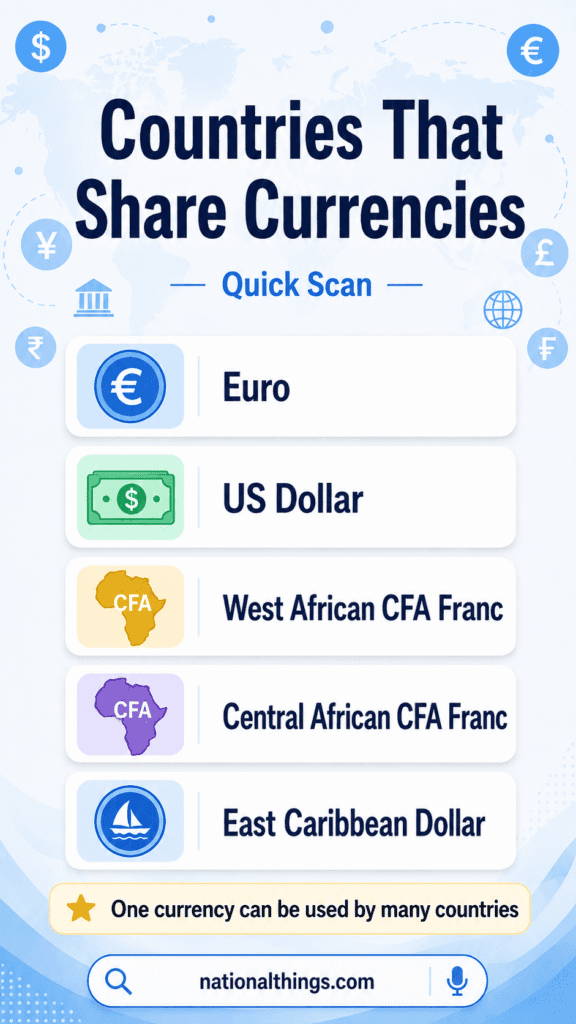
A shared currency allows several countries to use one monetary unit, one ISO code, and often one regional central bank. This can reduce conversion costs and make cross-border trade easier. It also means that each member has less independent control over interest rates and money supply.
The euro is used by the following 21 euro-area members as of July 2026:
Andorra, Monaco, San Marino, and Vatican City also use the euro through formal monetary agreements. These four countries may issue limited quantities of euro coins with national designs. Montenegro uses the euro without membership in the euro area.
The West African CFA franc has the ISO code XOF. Eight sovereign countries use it:
The symbol “CFA” is not enough for international banking because the Central African CFA franc uses a similar abbreviation. The code XOF removes this confusion.
The Central African CFA franc has the code XAF. Six sovereign states use it:
XAF and XOF are separate currencies even though both are commonly called the CFA franc.
The East Caribbean dollar uses the ISO code XCD. Six sovereign states use it:
Anguilla and Montserrat also use XCD but they are British territories rather than sovereign countries.
Other important shared arrangements include:
The US dollar is used far beyond the United States. Its ISO code is USD and its symbol is $. The symbol alone should not be used when another dollar currency could cause confusion.
Sovereign countries where USD is the main official currency include:
Panama uses the US dollar alongside the balboa. Balboa banknotes do not normally circulate. Panama relies on US notes and issues balboa coins at equal value.
Zimbabwe permits foreign currencies as legal tender within its multicurrency system. The US dollar therefore operates alongside Zimbabwe Gold rather than fully replacing it.
The US dollar also circulates widely in places such as Cambodia, Liberia, and parts of the Caribbean. Wide acceptance does not always give it the same legal position as the national currency.
Some states do not issue an independent national monetary unit. They use a foreign or shared currency because maintaining a separate currency and central bank may offer little benefit to a small economy.
| Country | Currency used | Issuing authority | Arrangement |
|---|---|---|---|
| Andorra | Euro | Eurosystem | Formal monetary agreement |
| Ecuador | US dollar | US Federal Reserve System | Official dollarization |
| El Salvador | US dollar | US Federal Reserve System | Official dollarization |
| Kiribati | Australian dollar | Reserve Bank of Australia | Official use with local coins |
| Liechtenstein | Swiss franc | Swiss National Bank | Currency agreement |
| Marshall Islands | US dollar | US Federal Reserve System | Official use |
| Micronesia | US dollar | US Federal Reserve System | Official use |
| Monaco | Euro | Eurosystem | Formal monetary agreement |
| Montenegro | Euro | Eurosystem | Unilateral use |
| Nauru | Australian dollar | Reserve Bank of Australia | Official use |
| Palau | US dollar | US Federal Reserve System | Official use |
| San Marino | Euro | Eurosystem | Formal monetary agreement |
| Timor-Leste | US dollar | US Federal Reserve System | Official use with local coins |
| Tuvalu | Australian dollar | Reserve Bank of Australia | Official use with local coins |
| Vatican City | Euro | Eurosystem | Formal monetary agreement |
A country using another state’s currency cannot independently create more of that money or set the issuing central bank’s interest rate.
A country may recognize more than one currency through law, treaty, or a formal multicurrency system.
Important examples include:
A shop accepting foreign cash does not automatically make that currency official. Legal status must come from legislation, a treaty, or an official monetary arrangement.
The same currency name may refer to several completely separate forms of money. A traveller who asks for “dollars” or “pesos” without naming the country may receive the wrong price or exchange rate.
Different dollars include:
The code provides more information than the symbol.
Several currencies use the word pound:
These currencies have separate issuers, values, notes, and monetary policies.
Current francs include:
The letters XOF and XAF are especially important because the two CFA francs share similar names.
Countries using distinct pesos include Argentina, Chile, Colombia, Cuba, the Dominican Republic, Mexico, the Philippines, and Uruguay. Each peso has its own ISO code and exchange value.
Dinar currencies appear mainly in North Africa, the Middle East, and the Balkans:
Some dinars divide into 1,000 minor units rather than 100.
India, Pakistan, Nepal, Sri Lanka, Mauritius, Seychelles, and the Maldives use currencies whose English names include rupee or a related form. Indonesia uses the rupiah, which is a separate currency with code IDR.
Several countries use these names:
The country name or ISO code should always appear in formal writing.
ISO 4217 assigns three-letter alphabetic codes and three-digit numeric codes to currencies. The standard helps banks, airlines, shops, trading platforms, and computer systems identify money without depending on language or symbols.
Examples include:
For many national currencies, the first two letters relate to the ISO country code. The third letter often comes from the currency name. “USD” combines “US” with “dollar.” “CHF” combines Switzerland’s country code “CH” with “franc.”
Shared or special currencies often begin with X. XOF and XAF are examples. The official ISO standard also records numeric codes and decimal relationships for minor units.
A currency symbol is a short sign placed beside an amount. Symbols save space on price labels but do not always identify the exact currency.
Common symbols include:
Writing CAD 100 is clearer than “$100” when the reader may think the price is in US dollars. International invoices should normally use ISO codes.
| Symbol | Common currency | ISO code | Main country or region |
|---|---|---|---|
| $ | US dollar | USD | United States and official dollar users |
| € | Euro | EUR | Euro area and other euro users |
| £ | Pound sterling | GBP | United Kingdom |
| ¥ | Japanese yen | JPY | Japan |
| CN¥ | Chinese yuan | CNY | China |
| ₹ | Indian rupee | INR | India |
| ₩ | South Korean won | KRW | South Korea |
| ₽ | Russian ruble | RUB | Russia |
| ₺ | Turkish lira | TRY | Türkiye |
| ₴ | Ukrainian hryvnia | UAH | Ukraine |
| ₦ | Nigerian naira | NGN | Nigeria |
| ₱ | Philippine peso | PHP | Philippines |
| ฿ | Thai baht | THB | Thailand |
| ₫ | Vietnamese đồng | VND | Vietnam |
| ₪ | New Israeli shekel | ILS | Israel |
| ₡ | Costa Rican colón | CRC | Costa Rica |
| ₲ | Paraguayan guaraní | PYG | Paraguay |
| ₾ | Georgian lari | GEL | Georgia |
| ₼ | Azerbaijani manat | AZN | Azerbaijan |
| ֏ | Armenian dram | AMD | Armenia |
Many currencies use abbreviations instead of a unique sign. Examples include CHF, KSh, RM, AED, and CFA.
A minor unit is a smaller part of a currency. Most decimal currencies divide one main unit into 100 smaller units. The names vary by country.
Examples include:
Not every system follows a 100-unit division. One Malagasy ariary equals five iraimbilanja. One Mauritanian ouguiya equals five khoums. Several currencies have a defined minor unit that people rarely use because its value has become too small.
A central bank or monetary authority usually manages the currency. Its legal powers differ by country but commonly include:
The European Central Bank manages euro-area monetary policy with the national central banks of member states. Countries that use the euro without euro-area membership do not receive the same role in setting that policy.
A country that uses the US dollar cannot order the US Federal Reserve to print money for its domestic budget. This loss of direct monetary control is one of the main costs of using a foreign currency.
Countries may share a currency to make trade and payments easier. Businesses can compare prices and pay suppliers without converting money at every border.
Possible benefits include:
Possible limits include:
A shared currency works best when members have clear fiscal rules, trusted institutions, and strong financial cooperation.
A country may replace, rename, or redesign its currency after economic or political change.
Common reasons include:
Recent examples include Bulgaria replacing the lev with the euro in 2026 and Zimbabwe introducing Zimbabwe Gold in 2024. Sierra Leone introduced the redenominated leone with code SLE to replace the old SLL unit. A redesigned banknote is not automatically a new currency. The name, unit, and ISO code may remain unchanged.
These terms describe different actions.
A redenomination changes the numbers printed on money. A government may remove several zeros to make prices and accounting easier.
For example, 1,000 old units may become 1 new unit. Wages, savings, debts, and prices convert at the same stated ratio. The change does not automatically make people richer or increase purchasing power.
A devaluation lowers a currency’s official value against another currency under a fixed or managed exchange-rate system. Imported products may become more expensive while exports may become cheaper for foreign buyers.
A market-driven fall under a floating exchange rate is usually called depreciation rather than an official devaluation.
A national currency belongs to the country or monetary union using it. A foreign currency comes from outside that monetary system.
For a person in Pakistan:
Foreign currency plays an important role in tourism, imports, exports, overseas education, remittances, and international investment.
A traditional national currency comes from a government-backed monetary system. A central bank or authorized institution manages its supply and payment framework. A cryptocurrency normally operates through distributed digital technology and does not require a national central bank.
The main differences are:
A government may allow cryptocurrency trading without making a token its national currency. El Salvador’s 2025 reforms made private Bitcoin acceptance voluntary and required taxes to be paid in US dollars.
A central bank digital currency, often called a CBDC, is a digital form of official central-bank money. It differs from a private cryptocurrency because a public monetary authority issues or backs it.
The main categories are:
A CBDC does not always replace cash. A country may design it as an additional payment option. Development stages differ widely, so any list of active projects needs frequent updates.
Several currencies have major roles in international reserves, banking, trade invoices, and cross-border payments. The US dollar remains the leading reserve currency. The euro ranks second. Pound sterling, Japanese yen, Chinese renminbi, Canadian dollar, Australian dollar, and Swiss franc also have international roles.
The IMF reported that the US dollar represented 57.13 percent of global foreign exchange reserves in the first quarter of 2026. The euro represented 20.03 percent and the Chinese renminbi represented 1.99 percent. Total reported foreign exchange reserves stood at $13.10 trillion.
A currency’s international use depends on several factors:
The most widely held currency is not automatically the strongest investment or the best choice for every payment.
An exchange rate shows how much one currency can buy of another. If USD 1 equals PKR 280, the rate states the value of the dollar in rupees at that moment. The actual buying and selling rates may differ because banks and exchange companies add margins or fees.
Currency values can move because of:
A strong currency does not always mean a strong economy. Some currencies use large numerical units because of historical inflation or earlier monetary decisions. Exchange rates also change too often to place permanently inside a country-currency reference table.
The main table uses 195 sovereign states as its core scope. This includes 193 UN member states plus the two UN observer states, Palestine and the Holy See represented here by Vatican City. The United Nations confirms that it currently has 193 member states.
Territories need a separate category because they are not independent states. A territory may:
Kosovo and Taiwan are often added to public “all countries” lists because each has its own government and currency arrangement.
| Additional entry | Currency | ISO code | Status note |
|---|---|---|---|
| Kosovo | Euro | EUR | Partially recognized and not a UN member |
| Taiwan | New Taiwan dollar | TWD | Self-governed and not a UN member |
Kosovo uses the euro without membership in the European Union or euro area. Taiwan issues the New Taiwan dollar through its central banking system.
Dependent territories may use the currency of the state that administers them or issue a separate local form.
| Territory | Administering state | Currency | ISO code | Currency status |
|---|---|---|---|---|
| Anguilla | United Kingdom | East Caribbean dollar | XCD | Regional currency |
| Aruba | Kingdom of the Netherlands | Aruban florin | AWG | Separate territorial currency |
| Bermuda | United Kingdom | Bermudian dollar | BMD | Linked to US dollar |
| British Virgin Islands | United Kingdom | US dollar | USD | Official use |
| Cayman Islands | United Kingdom | Cayman Islands dollar | KYD | Separate territorial currency |
| Curaçao | Kingdom of the Netherlands | Caribbean guilder | XCG | Shared with Sint Maarten |
| Falkland Islands | United Kingdom | Falkland Islands pound | FKP | Linked to pound sterling |
| Faroe Islands | Kingdom of Denmark | Danish krone | DKK | Local notes equal to DKK |
| Gibraltar | United Kingdom | Gibraltar pound | GIP | Linked to pound sterling |
| Greenland | Kingdom of Denmark | Danish krone | DKK | Official use |
| Guam | United States | US dollar | USD | Official use |
| Hong Kong | China | Hong Kong dollar | HKD | Separate monetary system |
| Isle of Man | British Crown Dependency | Pound sterling and Manx pound | GBP | Local pound linked to GBP |
| Macau | China | Pataca | MOP | Separate monetary system |
| Montserrat | United Kingdom | East Caribbean dollar | XCD | Regional currency |
| New Caledonia | France | CFP franc | XPF | Shared Pacific currency |
| Northern Mariana Islands | United States | US dollar | USD | Official use |
| Puerto Rico | United States | US dollar | USD | Official use |
| Sint Maarten | Kingdom of the Netherlands | Caribbean guilder | XCG | Shared with Curaçao |
| Turks and Caicos Islands | United Kingdom | US dollar | USD | Official use |
| US Virgin Islands | United States | US dollar | USD | Official use |
A territorial pound may have the same value as pound sterling but remain different in design and local acceptance. Banks outside the territory may not treat the local notes like ordinary Bank of England notes.
Former currencies should appear separately from current money. Mixing them into the main list can cause errors in schoolwork, travel planning, bank records, and currency conversion.
| Country | Former currency | Replacement currency | Change year |
|---|---|---|---|
| Bulgaria | Bulgarian lev BGN | Euro EUR | 2026 |
| Croatia | Croatian kuna HRK | Euro EUR | 2023 |
| Sierra Leone | Old leone SLL | New leone SLE | 2022 |
| Zimbabwe | Zimbabwe dollar ZWL | Zimbabwe Gold ZWG | 2024 |
| São Tomé and Príncipe | Old dobra STD | New dobra STN | 2018 |
| Venezuela | Bolívar soberano VES predecessor units | Current bolívar VES | Several reforms |
| Lithuania | Lithuanian litas LTL | Euro EUR | 2015 |
| Latvia | Latvian lats LVL | Euro EUR | 2014 |
| Estonia | Estonian kroon EEK | Euro EUR | 2011 |
| Slovakia | Slovak koruna SKK | Euro EUR | 2009 |
| Cyprus | Cyprus pound CYP | Euro EUR | 2008 |
| Malta | Maltese lira MTL | Euro EUR | 2008 |
| Slovenia | Slovenian tolar SIT | Euro EUR | 2007 |
| Germany | Deutsche mark DEM | Euro EUR | 1999 and 2002 cash changeover |
| France | French franc FRF | Euro EUR | 1999 and 2002 cash changeover |
| Italy | Italian lira ITL | Euro EUR | 1999 and 2002 cash changeover |
| Spain | Spanish peseta ESP | Euro EUR | 1999 and 2002 cash changeover |
The euro became an accounting currency in 1999 for its first members. Euro banknotes and coins entered public circulation in 2002.
This reference can support several practical tasks:
Use the ISO code instead of the symbol when accuracy affects money. “AUD 500” clearly means Australian dollars. “$500” does not.
For software or databases, store the country and currency as separate fields. One country may have multiple accepted currencies, while one currency may belong to several countries.
Currency information can change after a political decision, monetary reform, treaty, or period of high inflation. A reliable article should therefore include a visible last-updated date.
Use these checks when maintaining the list:
SIX identifies itself as the official and authoritative Maintenance Agency for ISO 4217 currency-code designations. It also publishes current and historical currency lists and formal amendments.
We checked the currency names, ISO codes, monetary unions, and country information through official international organizations and central banks.
It is the official money mainly used for local payments, prices, taxes, salaries, and accounts. A country may issue its own currency or officially use a foreign or shared currency.
There is no simple one-currency-per-country total. The world has fewer currencies than sovereign states because many countries share the euro, CFA francs, East Caribbean dollar, Australian dollar, or US dollar. A few states also recognize more than one currency.
No. Ecuador uses the US dollar. Nauru uses the Australian dollar. Liechtenstein uses the Swiss franc. Andorra uses the euro. These countries do not issue a fully separate national monetary unit.
It is a standard three-letter identifier used in international payments and computer systems. USD identifies the US dollar. CAD identifies the Canadian dollar. AUD identifies the Australian dollar.
The dollar sign became a common symbol for many currencies called “dollar” and some currencies called “peso.” It does not identify the issuing country. The ISO code gives the exact meaning.
The answer depends on how the count treats monetary unions, microstates, territories, and informal circulation. The euro has the largest formal group of sovereign users through the euro area and European microstate agreements. The US dollar also serves as official money in several sovereign countries and territories.
The euro-area members in July 2026 are Austria, Belgium, Bulgaria, Croatia, Cyprus, Estonia, Finland, France, Germany, Greece, Ireland, Italy, Latvia, Lithuania, Luxembourg, Malta, the Netherlands, Portugal, Slovakia, Slovenia, and Spain. Andorra, Monaco, San Marino, Vatican City, and Montenegro also use it under different arrangements.
The United States, Ecuador, El Salvador, Marshall Islands, Micronesia, Palau, and Timor-Leste use USD as their main official currency. Panama uses it alongside the balboa. Zimbabwe accepts it within a broader multicurrency system.
Yes. Panama uses the balboa and US dollar. Zimbabwe recognizes its local ZiG alongside approved foreign currencies. Lesotho and Namibia use local currencies while also recognizing the South African rand.
Yes. Many countries use currencies called the dollar, peso, pound, franc, dinar, rupee, shilling, rial, or dirham. The names may match while the codes and values remain different.
The national currency of all countries cannot be understood through currency names alone. Several countries share one currency. Some officially use foreign money. Others recognize more than one form of legal tender.
The most reliable way to identify money is to check three details together:
Symbols are useful on price labels but often create confusion. USD, CAD, AUD, SGD, and XCD are clearer than a dollar sign by itself. Currency rules also change, as shown by Bulgaria’s move to the euro and Zimbabwe’s introduction of ZWG. A current date and authoritative sources keep a world currency list accurate and useful.
Explore More National Symbols