
National Things of Canada: History, Meaning, and Pictures
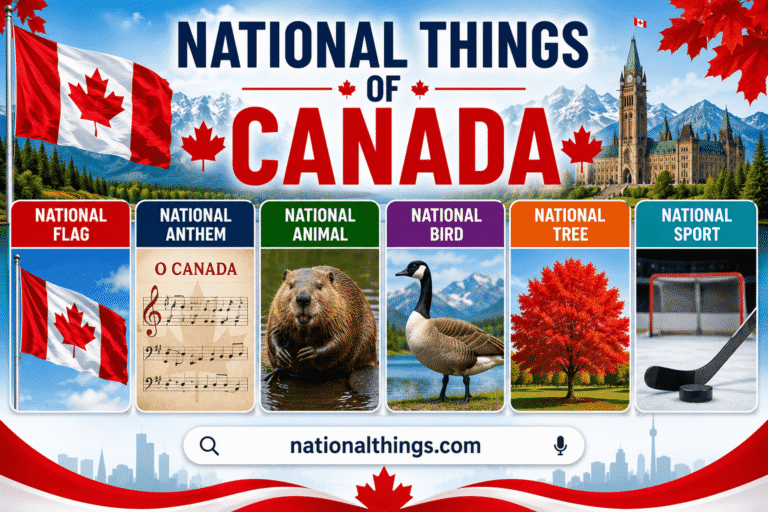
National things of Canada represent the country’s history, culture, wildlife, sports, and identity. These symbols help people understand what makes…
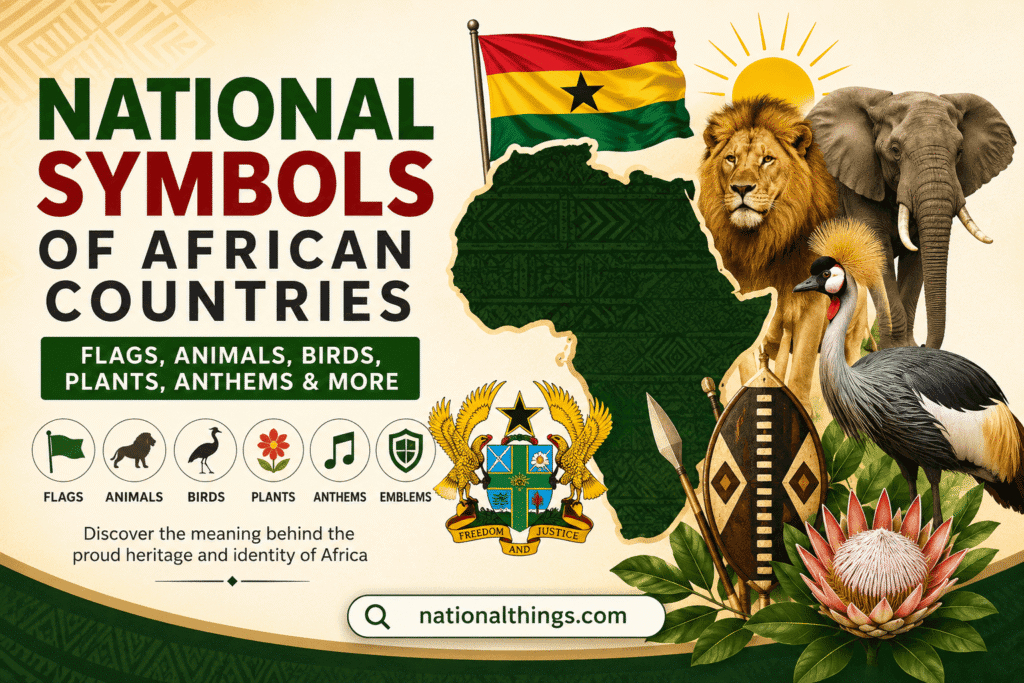
National symbols of African countries tell the continent’s story through colors, animals, plants, songs, and emblems. Ghana’s black star represents African freedom and independence. Uganda places the grey crowned crane on its flag as a sign of grace and national identity. Across the continent, elephants, lions, shields, farming tools, and rising suns appear on coats of arms to represent strength, work, unity, and hope. Together, these images connect each modern nation with its history, natural environment, and shared values.
The United Nations includes 54 African countries in its African Group. The African Union has 55 member states because it also includes the Sahrawi Arab Democratic Republic. This difference explains why some lists show 54 countries while others show 55.
This guide covers the main national flags, state emblems, national anthems, mottos, animals, birds, flowers, and trees connected with Africa’s 54 widely recognized sovereign states. It also explains an important fact. A flag and national anthem normally have a clear legal status. A national animal or flower may be official in one country but only widely recognized in another.
National symbols are objects, designs, words, songs, animals, or plants that represent a country. A government may establish a symbol through a constitution, law, decree, or official proclamation. Citizens may also accept a cultural symbol through long use even when no law formally names it.
A national flag is usually an official state symbol. Governments display it at public offices, border points, embassies, and international meetings. A widely used animal nickname has a different status. For example, a football team may use a lion or eagle without making that animal the country’s legal national animal.
This difference matters because many online lists describe every popular animal or flower as official. A careful article should separate legally adopted symbols from traditional, sporting, or cultural associations.
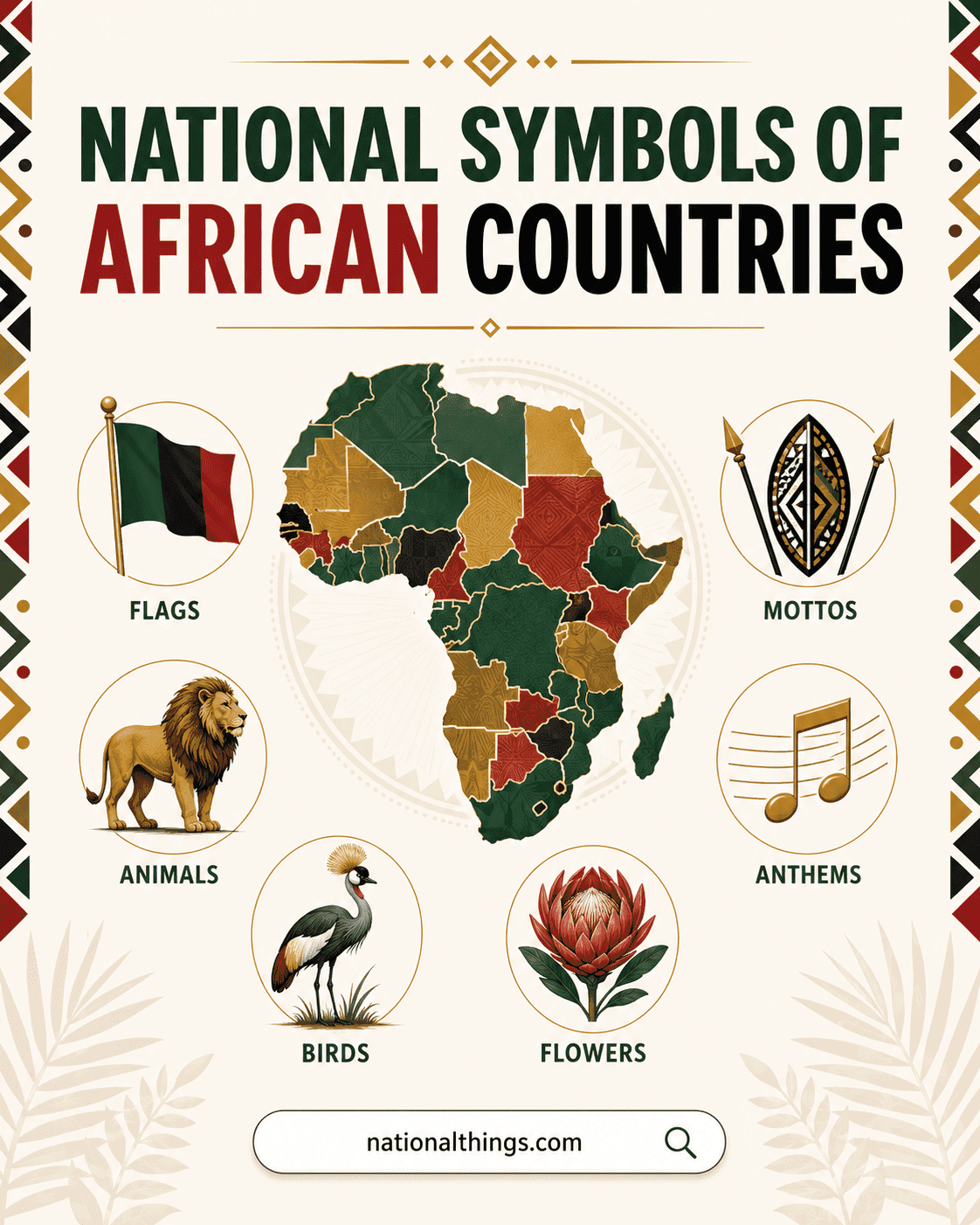
National symbols give people a shared visual and cultural language. They help citizens identify the country during public ceremonies and help foreign audiences recognize it at global events.
Their main roles include:
A symbol can also change when the political system changes. New governments sometimes replace flags, emblems, mottos, or anthems to mark a new constitution or a break from an earlier regime.
A national flag is one of the clearest signs of sovereignty. African national flags often use red, green, yellow, black, blue, and white. However, the meaning of a color changes from country to country.
Ghana’s red represents blood shed for independence. Its gold refers to mineral wealth. Green represents forests and natural resources. The black star stands for African freedom. Nigeria uses green for natural wealth and white for peace and unity. Kenya connects black with its people, red with the freedom struggle, green with natural wealth, and white with peace.
Flags also carry objects with a clear national meaning. Kenya uses a Maasai shield and crossed spears. Mozambique includes a book, hoe, star, and rifle. Uganda places the grey crowned crane in a white disc. Zimbabwe uses the Zimbabwe Bird from the stone sculptures of Great Zimbabwe.
A coat of arms is a detailed state design used on official papers, seals, courts, passports, and government buildings. It may contain a shield, supporters, a crest, local plants, animals, farming tools, mountains, or a national motto.
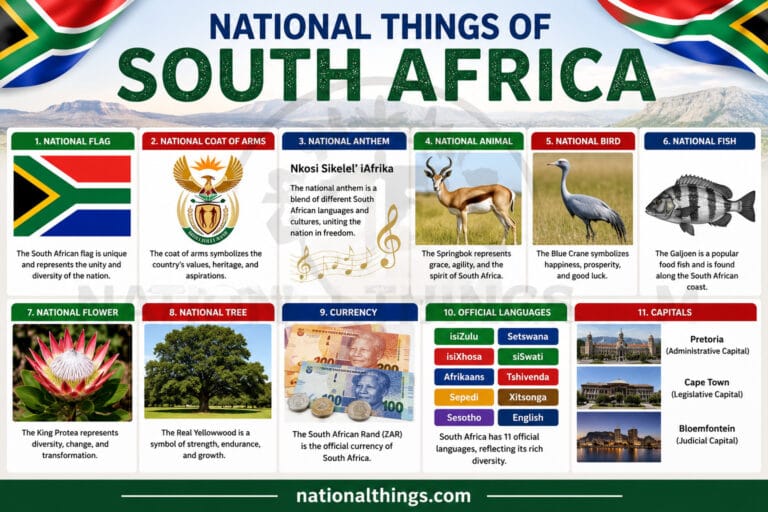
South Africa describes its coat of arms as the state’s highest visual symbol. Its design includes Khoisan figures, elephant tusks, wheat, a protea, a secretary bird, and a rising sun. Its motto means “Diverse people unite.”
Not every country uses a European-style heraldic shield. Some use a national seal or emblem. Angola’s emblem contains a cogwheel, machete, hoe, book, star, and rising sun. Ethiopia uses a gold pentagram on a blue disc. Eritrea uses a camel surrounded by an olive wreath.
A national animal may represent strength, courage, endurance, freedom, or local biodiversity. Lions, elephants, antelopes, leopards, zebras, and gazelles often appear in African state designs.
Some examples have strong official support. South Africa recognizes the springbok as its national animal. Botswana uses zebras as major state symbols. Angola strongly identifies with the giant sable antelope. The okapi represents the unique wildlife of the Democratic Republic of the Congo.
Other animals are cultural rather than legally declared. A sports nickname such as the Atlas Lions of Morocco or the Indomitable Lions of Cameroon does not alone prove official national-animal status.
Birds often represent freedom, watchfulness, peace, or national territory. Several African countries place birds directly on flags or coats of arms.
The grey crowned crane appears on Uganda’s flag. The African fish eagle appears on the coat of arms of South Sudan and is closely connected with Zambia and Namibia. South Africa officially recognizes the blue crane. Mauritius uses the extinct dodo as one of its strongest national icons.
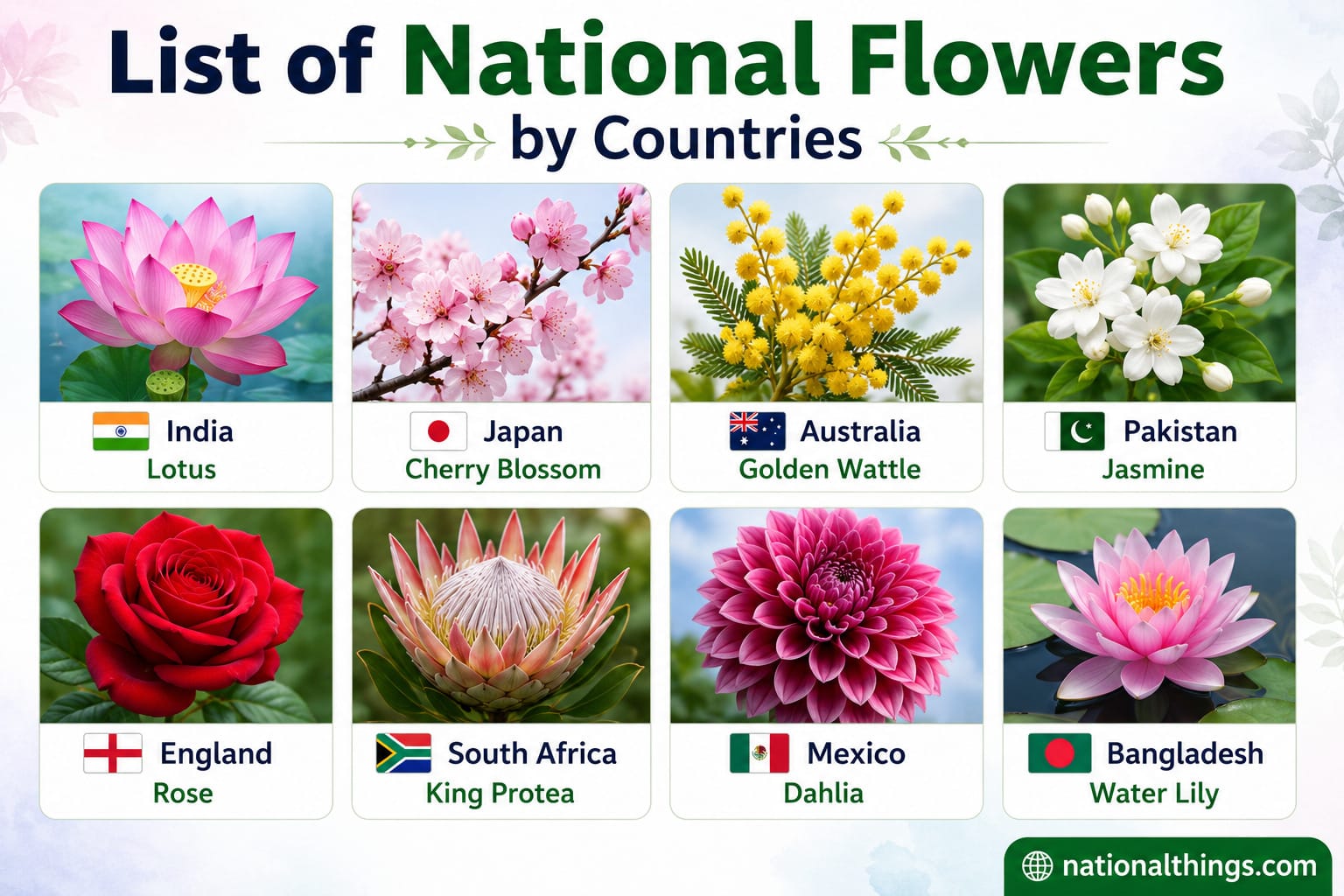
National flowers and trees connect state identity with local ecology, farming, medicine, food, and traditional life. Governments may select them to support conservation or cultural education.
South Africa officially recognizes the king protea as its national flower and the real yellowwood as its national tree. Botswana selected the sengaparile flower and morula tree after national consultation. The Botswana government explained that these species carry cultural and practical value and can support conservation awareness.
Many countries have a well-known plant without an easily verified legal declaration. The baobab is central to Senegalese identity. The argan tree is strongly linked with Morocco. Madagascar is closely associated with the traveller’s palm. These connections remain meaningful even when their exact legal status differs.
A national anthem is an official song performed during state ceremonies, school events, military occasions, and international sports competitions. African anthems often speak about freedom, unity, peace, work, land, sacrifice, or God.
Anthems can change. Niger adopted “L’Honneur de la Patrie” in 2023 to replace “La Nigérienne.” Nigeria restored “Nigeria, We Hail Thee” through the National Anthem Act 2024. It replaced “Arise, O Compatriots,” which had been used since 1978.
South Africa’s anthem is unusual because it combines sections from “Nkosi Sikelel’ iAfrika” and “Die Stem van Suid-Afrika.” It uses several languages and reflects the country’s effort to represent different communities.
A national motto is a short statement of a country’s guiding values. It often appears below a coat of arms or inside a state emblem.
Common themes include:
A country may have no clearly established official motto. A phrase used in speeches, tourism campaigns, or sports should not automatically be presented as the state motto.
Countries also use cultural and historic symbols that fall outside the main legal categories.
Examples include:
These symbols may carry deep public meaning without having the same legal protection as a flag or coat of arms.
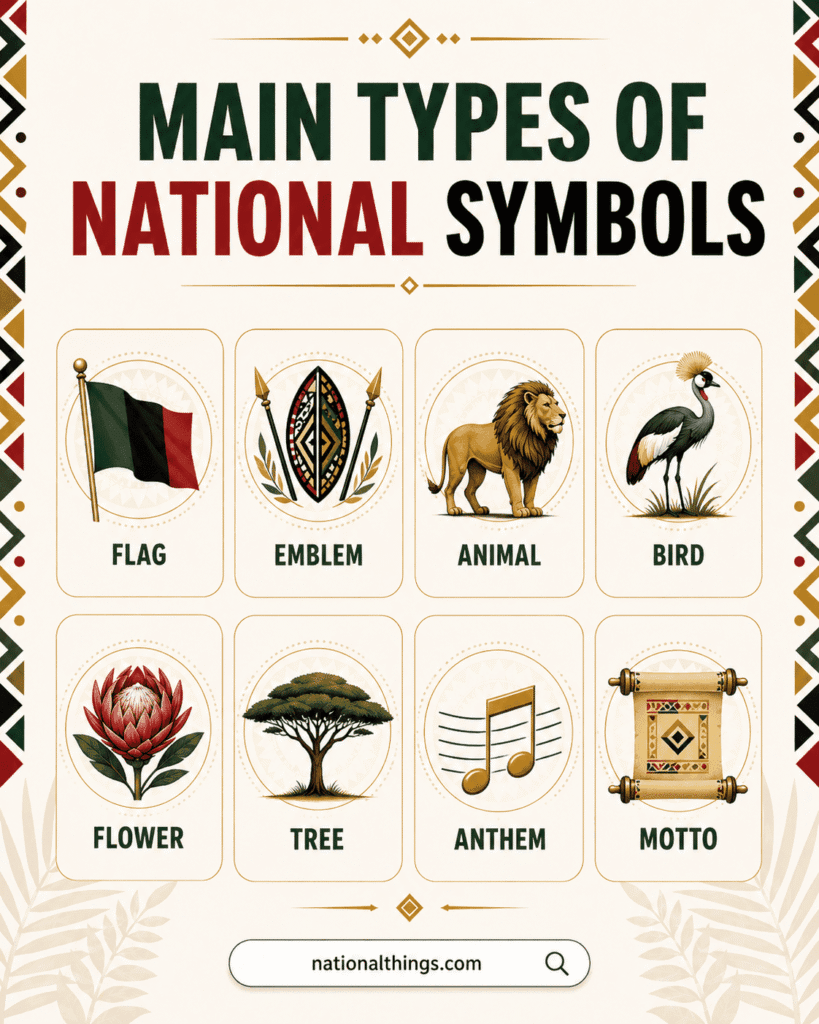
The following profiles focus on clearly established state symbols and carefully label common cultural associations. The African Union divides its members into geographic regions, but regional classifications can differ between publishers.
Here’s a complete guide on: 150 Countries and Their National Animals
Flag colors do not have one fixed meaning across Africa. The same color can represent religion in one country, vegetation in another, and political history in a third. Readers should check each government’s explanation instead of applying one general rule.
Red often recalls sacrifice, resistance, independence, or national struggle. Ghana connects it with blood shed for independence. Kenya links it with the freedom struggle. Guinea-Bissau uses it for blood shed during its independence campaign.
Red can also come from older royal or religious traditions. Tunisia and Morocco used red long before many modern Pan-African flags appeared.
Green may represent forests, agriculture, fertile land, hope, or Islam. Nigeria links it with forests and natural wealth. Kenya uses it for natural resources. In several North and West African flags, green also carries a religious meaning.
Its meaning must be read in national context. Green on the Moroccan flag does not serve exactly the same purpose as green on the Nigerian flag.
Yellow or gold often represents sunlight, mineral wealth, prosperity, or hope. Ghana’s gold band refers to mineral wealth. The yellow in many Pan-African flags also gives visual balance to red and green.
A yellow star may represent national unity, a bright future, or revolutionary leadership. The exact meaning depends on the country’s legal or historical description.
Black frequently represents African people, African identity, or the continent itself. Kenya uses black for its people. Ghana’s black star became a symbol of African freedom.
Black can also form part of a political or historic design without carrying one universal continental meaning.
Blue may represent water, the sky, peace, or the sea. Botswana uses light blue for rainwater, which has great value in its dry climate. Cabo Verde and Seychelles use blue in designs shaped by their island geography.
Blue also appears on Somalia’s flag. Its design has a historical link with the United Nations flag, while the white star represents Somali unity.
White commonly represents peace, honesty, purity, or unity. Nigeria uses white for peace and unity. Kenya uses thin white lines to separate the stronger black, red, and green bands.
White may also serve a practical design purpose by separating colors and making the flag easier to identify from a distance.
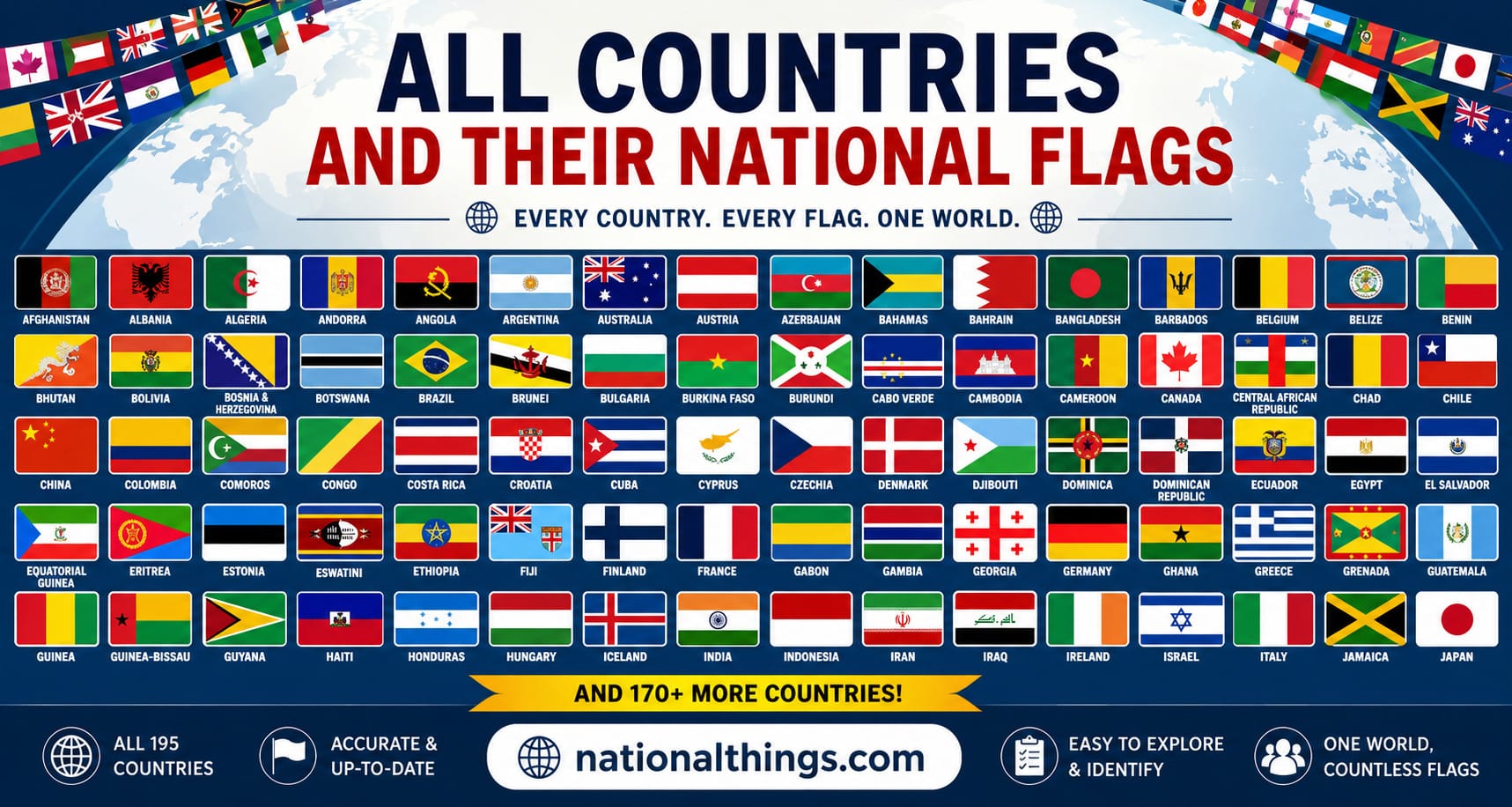
Here’s a detailed overview of the 196 countries and their national flags.
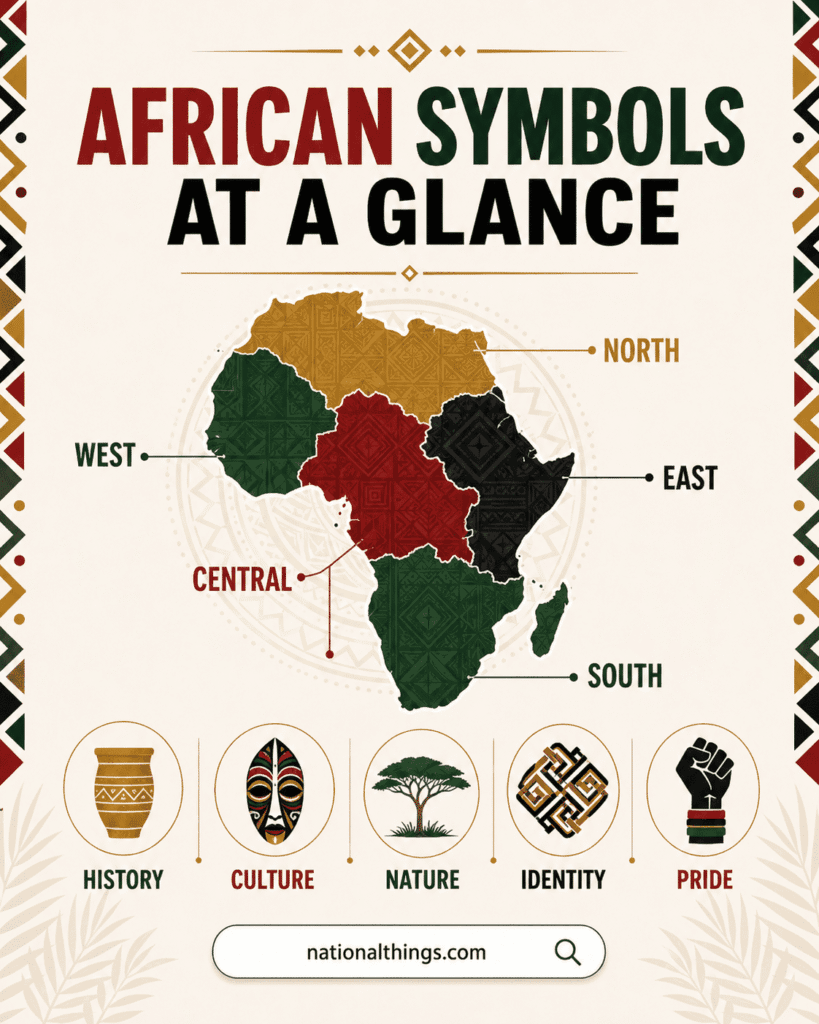
African countries often select animals that are native, visually powerful, culturally respected, or rare. The animal may appear on a flag, coat of arms, coin, stamp, sports badge, or conservation campaign.
Common examples include:
The use of an animal on a coat of arms does not always make it the legal national animal. It may act as a heraldic supporter or represent one part of the country’s character.
Pre-colonial kingdoms and communities shaped many present-day symbols. Traditional shields, spears, stools, crowns, drums, animals, and plants still appear in state emblems.
Kenya’s shield and spears draw from Maasai material culture. Lesotho uses the Basotho hat. Zimbabwe uses a stone bird linked with Great Zimbabwe. South Africa includes figures based on Khoisan rock art.
These objects connect modern states with histories that existed before European colonial rule.
Colonial rule introduced new borders, administrative seals, heraldic styles, and European languages. Some colonies used the flags and emblems of Britain, France, Portugal, Belgium, Spain, Italy, or Germany.
After independence, many governments replaced colonial symbols. However, some retained European heraldic structures, such as shields, scrolls, supporters, and Latin-style layouts. They filled those structures with local animals, crops, mountains, and tools.
The influence also remains visible in anthem languages. Many African anthems use English, French, Portuguese, Spanish, or Arabic alongside local languages.
Independence movements gave new meaning to red, green, gold, black, and stars. Ghana’s 1957 flag had a strong effect on later Pan-African designs. Its black star became a sign of African liberation.
Several new states adopted mottos based on unity, work, justice, and progress. These words addressed urgent post-independence goals. Governments needed to bring different regions and language groups into one national system.
Flags also marked a break with colonial authority. Raising a new flag became one of the central acts of independence ceremonies.
Modern governments continue to update national symbols. They may change an anthem, redesign an emblem, or legally regulate how symbols can be used.
South Africa adopted a new flag in 1994 and launched its present coat of arms in 2000 to represent democratic change. Namibia passed the National Symbols Act in 2018. Niger changed its anthem in 2023. Nigeria restored its independence-era anthem in 2024.
Equatorial Guinea’s declaration of Ciudad de la Paz as its capital in 2026 shows that even basic national reference information can change. Reliable symbol guides need regular fact-checking.
National symbols of African countries share several broad themes because many states faced similar struggles and development goals.
Common features include:
These similarities do not erase national differences. Senegal’s lion, Uganda’s crane, Botswana’s zebras, and Mauritius’s dodo carry meanings rooted in different histories and environments.
An official symbol normally has support from a law, constitution, government decree, gazette, or formal state website. A symbol can also gain official status through a long and undisputed state tradition.
An unofficial symbol may come from:
The difference becomes important with animals, birds, flowers, and trees. Many countries have clear official flags and anthems but no legally declared national animal.
A trustworthy guide should use phrases such as “widely associated,” “appears on the coat of arms,” or “official status is unclear” when evidence is limited. This wording protects readers from treating popular claims as constitutional facts.
Governments control national symbols because they represent state authority and national sovereignty. Misuse may be restricted by law.
Common uses include:
Commercial use may require permission. Botswana has a formal process for companies that want to use its flag or coat of arms. Namibia also regulates commercial use and protects national symbols from ridicule or improper presentation.
A national animal or bird can help people recognize a species and understand its ecological value. It can support school education, protected areas, tourism, and wildlife campaigns.
South Africa’s blue crane has received legal protection and conservation attention. Botswana selected wildlife and plant symbols partly to promote national awareness and conservation. These examples show how a national symbol can connect civic identity with environmental responsibility.
Symbolic status alone does not protect a species. Habitat loss, illegal hunting, pollution, climate pressure, and weak law enforcement can still threaten it. The dodo remains a national icon of Mauritius, but the species became extinct centuries ago.
Governments must support symbolic recognition with:
A species becomes more than a logo when conservation policies keep it alive in its natural environment.
Start with the country’s constitution, official gazette, presidency, parliament, ministry of information, or embassy. These sources provide the strongest evidence for flags, emblems, anthems, and mottos.
Use this order when checking a claim:
Do not rely on one tourism blog or social media graphic. Many websites copy information from each other without checking its legal origin.
Also check the publication date. Nigeria’s anthem information written before May 29, 2024 may now be outdated. Sources listing Malabo as the sole current capital of Equatorial Guinea may not reflect the decree issued on January 2, 2026.
The most widely used answer is 54 internationally recognized sovereign states that belong to the United Nations African Group. The African Union has 55 members because it also includes the Sahrawi Arab Democratic Republic.
No. Some governments officially name a national animal. Others place an animal on the coat of arms without calling it the national animal. Many popular online claims come from sports nicknames or tourism marketing rather than law.
Red, green, yellow, black, white, and blue appear often. Red commonly refers to sacrifice or independence. Green may represent land, forests, hope, or religion. Yellow can mean wealth or sunshine. Black may represent African people. White often means peace. Blue may represent water or the sky.
Africa has rich wildlife and long cultural traditions connected with animals. Governments use lions, elephants, birds, antelopes, and other species to express strength, freedom, courage, leadership, or natural heritage.
Most national animals have a natural or historic link with the country, but the connection can be cultural rather than based on the animal’s present range. A species may have become rare, locally extinct, or restricted to protected areas.
A coat of arms normally follows a heraldic structure with elements such as a shield, supporters, crest, and motto. A national emblem can use a simpler circular, symbolic, or non-heraldic design.
Yes. A country can change its flag, anthem, emblem, seal, or motto through a constitution, law, decree, or political transition. Recent examples include Niger’s 2023 anthem change and Nigeria’s 2024 restoration of “Nigeria, We Hail Thee.”
There is no objective winner. South Africa has one of the most detailed official sets because it recognizes an animal, bird, fish, flower, and tree. Mauritius stands out because of the extinct dodo. Zimbabwe uses an archaeological bird sculpture. Lesotho displays a traditional hat. Uganda places a crane directly on its flag.
The national symbols of African countries reveal far more than flag colors. They show how nations remember independence, cultural heritage, local wildlife, natural resources, and shared political values.
Flags and anthems usually have clear official status. Animals, birds, flowers, and trees require more careful checking. Some have legal recognition. Others appear on coats of arms or carry strong cultural importance without a formal declaration.
Africa should not be treated as one symbolic tradition. The black star of Ghana, Atlas imagery of Morocco, crane of Uganda, dodo of Mauritius, okapi of the Democratic Republic of the Congo, and Zimbabwe Bird each come from a different national story. Reliable sources and clear status labels help readers understand those stories without turning popular claims into false facts.
Explore More Country Reference Guides