
National Fruit of India: Mango
India is a land of rich culture, traditions, and natural diversity. Among its many treasures, fruits hold a special place…
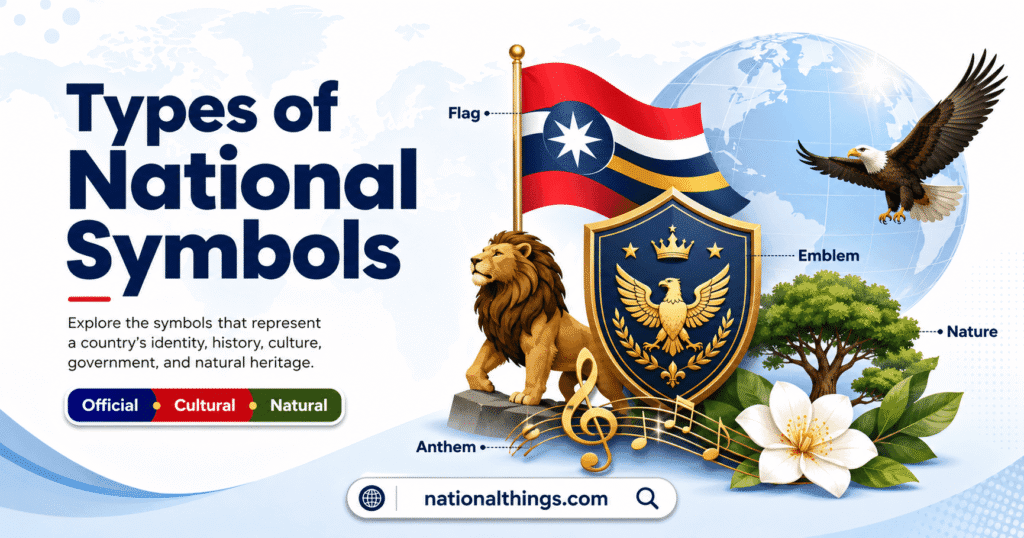
Types of National Symbols help people recognize a country through its flag, anthem, emblem, plants, animals, and traditions. But a familiar national image is not always an official symbol. Some symbols receive legal recognition, while others gain importance through history, public use, and shared culture.
A national flag may identify a country at an embassy. A national animal may represent its wildlife. A coat of arms may appear on legal documents. Each symbol has a different purpose, which is why understanding its official status, meaning, and correct use matters.
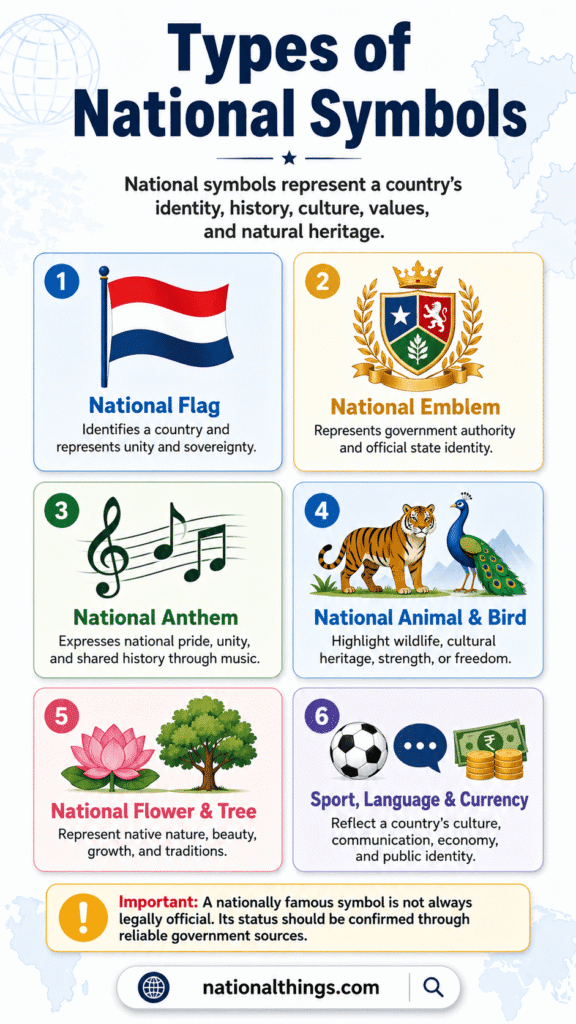
National symbols are objects, designs, songs, plants, animals, or ideas that represent a country and its people. They express a nation’s identity, history, and values in a form that people can quickly recognize.
A symbol may qualify as national when it meets one or more of these conditions:
The types of national symbols vary from one country to another. Most countries have a flag, anthem, and state emblem. Some also recognize a national animal, flower, tree, sport, language, colour, motto, or traditional dress.
A national symbol is different from a tourist attraction. The Eiffel Tower strongly represents France in travel and media, but the French Constitution names the blue, white, and red flag as the national emblem and La Marseillaise as the national anthem.
Countries use national symbols to create a clear and shared identity. A flag allows people to identify a country without reading its name. An anthem creates a common moment at state ceremonies. An emblem shows that a document or office has government authority.
National symbols serve several practical purposes:
These symbols can also carry emotional value. People may connect a flower with their natural landscape or an animal with strength and survival. However, the meaning should come from reliable historical or government sources. People often invent meanings for flag colours and symbols that the country has never officially approved.
National symbols did not all develop at the same time. Early kingdoms used royal seals, military standards, and coats of arms to identify rulers and armies. Medieval coats of arms helped distinguish people and institutions before they became symbols of cities, regions, and countries. Canada’s government describes coats of arms as visual identity cards that remain important in official state use.
Modern national symbols often appeared during revolutions, independence movements, or major political changes. France’s tricolour developed during the French Revolution. It combined the king’s white with the blue and red colours of Paris. The flag later became a sign of the French Republic.
India adopted its present national flag on 22 July 1947, shortly before independence on 15 August 1947. Its central navy blue wheel has 24 spokes and comes from the Lion Capital of Ashoka at Sarnath.
Canada followed a different path. It adopted its maple leaf flag by proclamation in January 1965 and first raised it on Parliament Hill on 15 February 1965. This shows that even well-established countries may introduce major national symbols long after their formation.
The main types of national symbols include visual signs, music, natural species, language, sport, and state objects. Their legal status differs by country, so a national symbol should never be called official without checking a government or legal source.
A national flag is the most visible sign of a country. Governments display it on public buildings, embassies, military sites, official vehicles, and during international meetings.
Flag designs may include:
India’s flag uses three equal horizontal bands and a navy blue wheel. Canada’s flag uses a stylized maple leaf between two red fields. Both designs are easy to identify, but their histories and official rules are different.
Here’s a complete guide on: List of All Countries and Their National Flags
A national emblem is an official design that represents the authority of the state. It may take the form of a coat of arms, seal, or special government mark.
Emblems commonly appear on:
South Africa describes its coat of arms as the highest visual symbol of the state. Its Great Seal gives authority to documents approved by the president. Its motto means “diverse people unite,” which connects the emblem with unity and shared belonging.
A national anthem is an official song used to represent a country. People hear it during national holidays, state visits, school events, military ceremonies, and international sports competitions.
An anthem may describe:
A patriotic song does not automatically become an anthem. Canada used “O Canada” for many years before legally proclaiming it the national anthem on 1 July 1980.
A national animal represents a country’s wildlife, history, or cultural character. Governments often choose animals that are native, widely known, or strongly linked with the national landscape.
Examples include animals associated with:
The beaver became an official symbol of Canada in 1975. Its importance comes partly from its major role in the Canadian fur trade. South Africa recognizes the springbok as its national animal.
Related Resources: 150 Countries and Their National Animals
A national bird usually represents the country’s natural environment or a valued human quality. Eagles often suggest power or freedom. Cranes may suggest grace. Small native birds may represent biodiversity or local identity.
A country may choose a bird because it is:
South Africa’s official list includes a national bird alongside its flag, anthem, animal, fish, flower, and tree. This shows how natural heritage can become part of a country’s formal identity.
Explore More: National Birds of All Countries
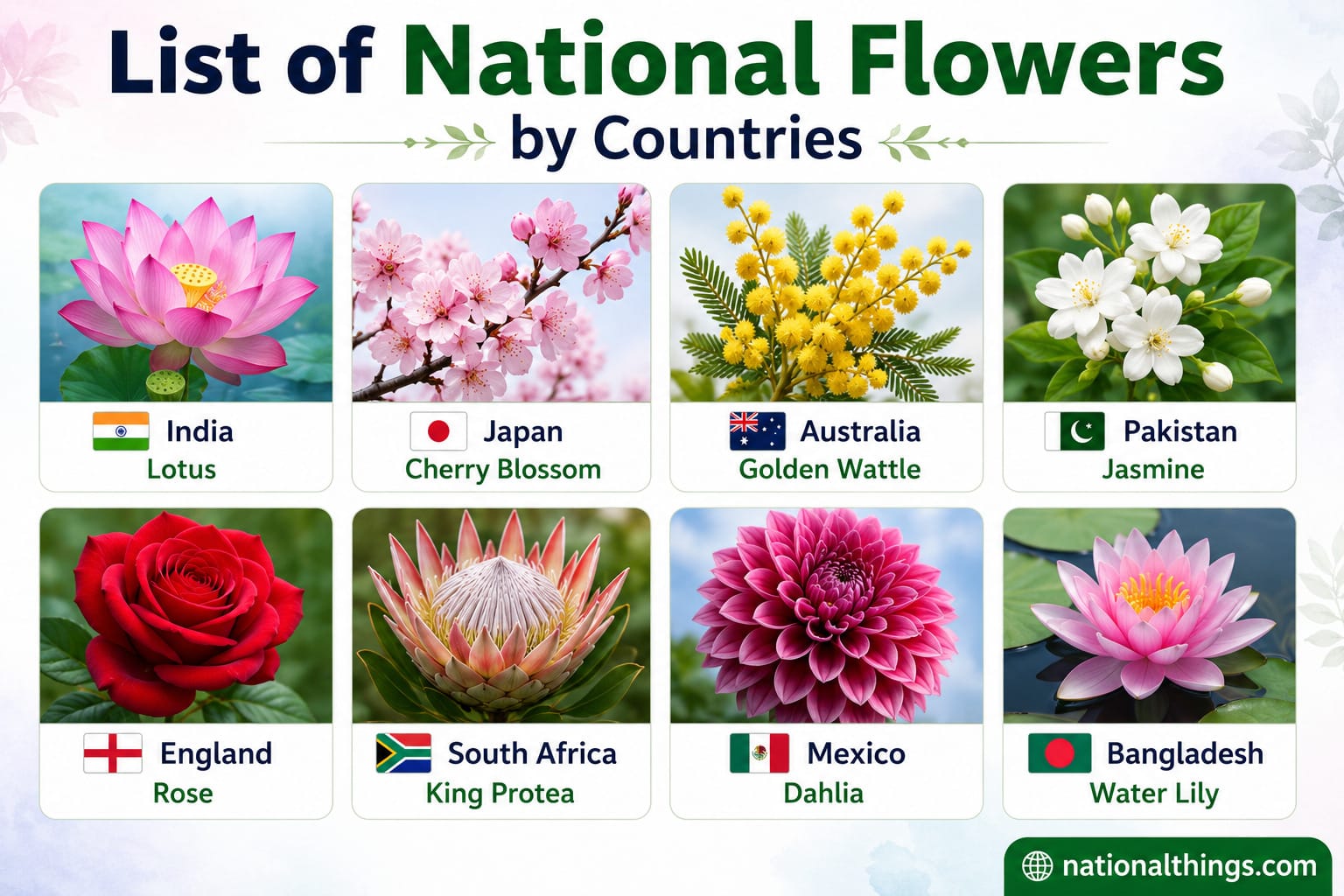
A national flower represents the plant life, beauty, or cultural traditions of a country. It may appear in festivals, artwork, coins, stamps, tourism campaigns, and public gardens.
Governments may select a flower because of its:
A flower can be widely associated with a country without having legal recognition. Readers should check whether the government calls it an official floral emblem or simply a popular cultural symbol.
Explore More: List of All Countries and Their National Flowers
A national tree often represents the country’s forests, ecology, agriculture, or long history. Trees may also carry economic value through fruit, wood, medicine, or traditional crafts.
Canada officially designated the maple tree as its national arboreal emblem in 1996. The government recognizes the maple genus rather than one single maple species. This is an important detail because ten maple species are native to Canada.
A national sport may receive formal recognition through law or may develop through strong public popularity. These two situations are not the same.
Canada provides a clear legal example:
In other countries, websites may call the most popular game a national sport even when no law or official order supports the claim.
A national language represents the linguistic identity or heritage of a country. It may differ from an official language.
The terms have separate meanings:
Some countries have one official language. Others recognize several. France’s Constitution states that French is the language of the Republic.
National currency is sometimes included in broad lists of national identity symbols. It is mainly an economic and legal instrument, but its name, symbol, coins, and banknotes also represent the state.
Currency may display:
The currency symbol alone should not always be treated as a formal national symbol. Its main function is to identify money in prices, banking, accounting, and international trade.
Official symbols receive recognition through a constitution, law, proclamation, government order, or another formal process. Unofficial symbols become strongly connected with a country through custom, media, tourism, or public tradition.
A symbol is likely official when:
An unofficial symbol can still be important. Canada explains that some elements of its identity have formal status while other familiar symbols developed through collective pride and common use. Even Canada’s red and white colours are widely treated as national colours although the government notes that they are not formally declared as such in the 1921 proclamation.
This difference makes a List of national symbols more accurate. Writers should label each item as official, traditional, or widely recognized instead of placing every item in one category.
The following examples show how different symbols represent state authority, history, nature, and national identity.
| National Symbol | Main Purpose | Common Meaning | Example |
|---|---|---|---|
| National flag | Identifies the country | Unity and sovereignty | Canadian maple leaf flag |
| State emblem | Shows government authority | Law and state power | South African Coat of Arms |
| National anthem | Represents the country through music | Pride and shared identity | La Marseillaise |
| National animal | Represents wildlife or history | Strength or heritage | Canadian beaver |
| National bird | Highlights natural heritage | Freedom or grace | South African national bird |
| National flower | Represents native plant life | Beauty and culture | National floral emblem |
| National tree | Connects identity with the land | Growth and endurance | Canadian maple |
| National sport | Represents sporting culture | Skill and shared passion | Hockey and lacrosse in Canada |
| National language | Expresses linguistic identity | Culture and communication | French in France |
| National currency | Supports trade and payments | Economic identity | National coins and banknotes |
The chart gives a general overview. A symbol’s exact meaning, legal status, and official title must still be checked country by country.
Countries use several methods to select national symbols. There is no single global process.
Common selection methods include:
Selection can involve historians, artists, scientists, Indigenous communities, cultural organizations, lawmakers, and members of the public. A good process checks the symbol’s historical accuracy, cultural fairness, visual clarity, and public meaning.
National symbols help people share a sense of belonging even when they speak different languages or come from different regions. A simple image can connect history, geography, and public memory.
They support cultural education in several ways:
Natural symbols may also support conservation. When a rare bird or plant becomes nationally recognized, schools, environmental groups, and tourism bodies can use it to teach people about habitat protection. However, symbolic status alone does not protect a species. Effective conservation still needs laws, scientific monitoring, and habitat management.
Flags, anthems, and emblems often record major political changes. A new government may redesign a coat of arms after independence, revolution, unification, or the end of an old political system.
South Africa introduced its present coat of arms on 27 April 2000. The new design aimed to reflect democratic change and a new national identity. Its symbols include human figures, elephant tusks, wheat, a protea, a secretary bird, and a rising sun.
France’s tricolour also shows how symbols can change with political systems. The flag developed during the Revolution, disappeared during periods of restored monarchy, and later returned as a sign of republican unity.
National symbols can therefore unite people, but they can also become subjects of debate. A design may represent pride to one group and exclusion to another. Governments need historical evidence and broad consultation when they adopt or change a symbol.
National symbols appear in both official and public settings. Their use often follows legal rules or established etiquette.
Common uses include:
Rules differ widely. India’s Flag Code explains how citizens, schools, private organizations, and government bodies may display the national flag. It also prohibits disrespectful uses such as allowing it to touch the ground or placing another flag above it.
The Types of National Symbols depend on each country’s political history, environment, and legal system. No universal list applies to every nation.
France places strong constitutional importance on republican symbols. Its Constitution identifies the national flag, anthem, language, and motto. Canada formally recognizes a wider collection that includes a flag, anthem, beaver, maple tree, horse, sports, tartan, and coat of arms. South Africa lists state symbols alongside an animal, bird, fish, flower, and tree.
This variety becomes clearer when viewed at the global level. The United Nations grew from 51 member states in 1945 to 193 member states today. Each state has its own political history and approach to national identity. This official UN figure shows why a complete worldwide national symbols list requires country-level research rather than one general template.
Countries can be compared through several patterns:
The main categories are the national flag, state emblem, national anthem, animal, bird, flower, tree, motto, sport, language, and national colours. Some lists also include currency, traditional clothing, food, monuments, and national heroes.
The flag, anthem, and state emblem usually hold the strongest official status. Governments use them in ceremonies, diplomatic work, legal records, and public institutions.
No. Some receive legal recognition, while others become popular through culture and long public use. Writers should clearly separate official symbols from unofficial cultural icons.
A national flag identifies the country through a standard design. A national emblem represents the legal authority and identity of the state. It often appears on passports, court papers, laws, and government offices.
Yes. A country may recognize different species as its national animal, bird, fish, or marine animal. Each category can have separate official status.
Yes. Governments may change a flag, anthem, emblem, or motto after independence, constitutional reform, unification, or a major political transition. The change normally requires legislation, constitutional action, proclamation, or another formal process.
Check the country’s constitution, national laws, official government portal, presidential office, parliament, national archive, or cultural ministry. Look for words such as official, adopted, proclaimed, designated, or recognized by law.
You May Also Like