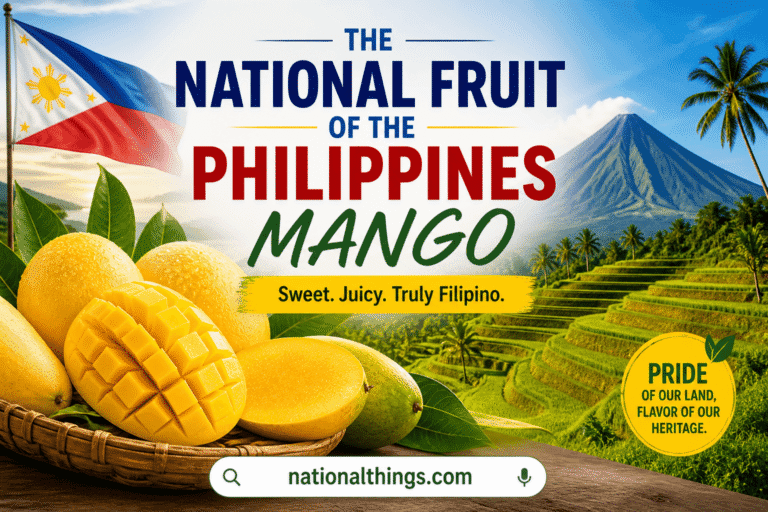
National Fruit of the Philippines: Meaning, History, and Importance
National Fruit of the Philippines reflects the country’s rich food culture and strong agricultural roots. Mango, especially the Carabao variety,…
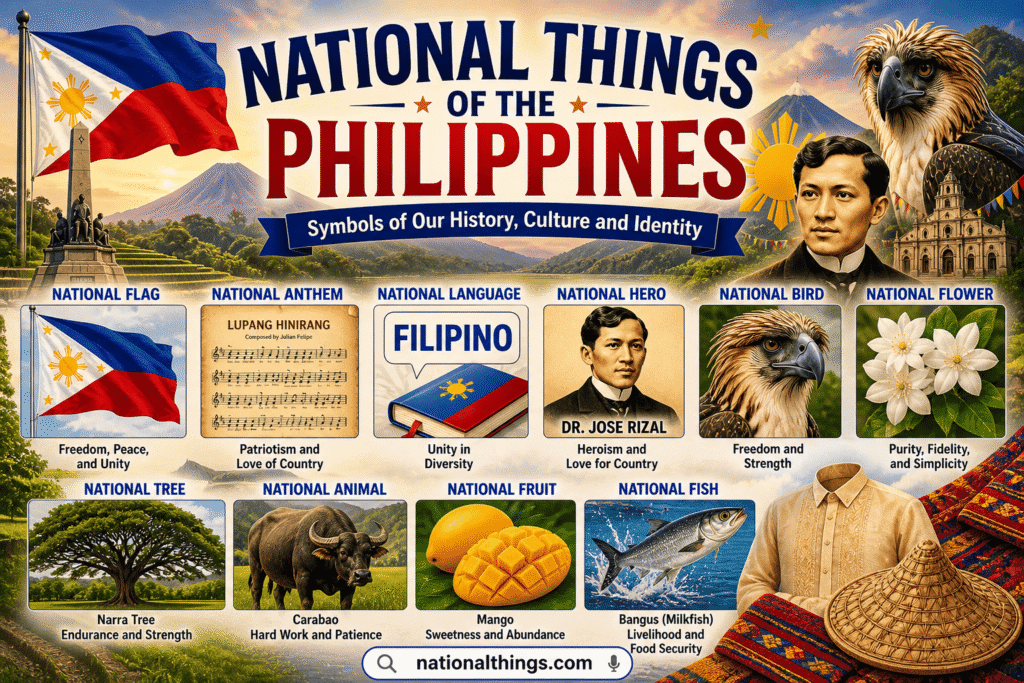
The national symbols of the Philippines represent the country’s history, independence, culture, and natural heritage. Located in Southeast Asia, the Philippines has several officially recognized symbols, including the Philippine flag, sampaguita flower, narra tree, Philippine eagle, and arnis martial art. Other familiar symbols, such as the carabao, mango, and jeepney, are important to Filipino culture but do not have the same official status.
Each symbol reflects a different part of the nation’s identity. Some represent freedom and unity, while others highlight traditional customs and natural resources. Below are the names, meanings, historical backgrounds, and official status of Philippine national symbols.
The Philippines recognizes national symbols through its Constitution, Republic Acts, and official proclamations. The following chart identifies the principal symbols and distinguishes their legal recognition from traditional cultural associations.
| National Symbol | Name | Official Status | Legal Basis |
|---|---|---|---|
| National Flag | Philippine Flag | Official | RA 8491 |
| National Coat of Arms | Philippine Coat of Arms | Official | RA 8491 |
| National Great Seal | Great Seal of the Philippines | Official | RA 8491 |
| National Anthem | Lupang Hinirang | Official | RA 8491 |
| National Motto | Maka-Diyos, Maka-tao, Makakalikasan at Makabansa | Official | RA 8491 |
| National Language | Filipino | Official | 1987 Constitution |
| National Flower | Sampaguita | Official | Proclamation No. 652 |
| National Tree | Narra | Official | Proclamation No. 652 |
| National Bird | Philippine Eagle | Official | Proclamation No. 615 |
| National Gem | Philippine Pearl | Official | Proclamation No. 905 |
| National Sport and Martial Art | Arnis | Official | RA 9850 |
| National Sign Language | Filipino Sign Language | Official | RA 11106 |
| National Animal | Carabao | Unofficial | No established national designation |
| National Fruit | Mango | Unofficial | No established national designation |
| National Leaf | Anahaw | Unofficial | No established national designation |
| National Fish | Bangus | Unofficial | No established national designation |
| National Food | Adobo | Unofficial | No established national designation |
| National Vehicle | Jeepney | Unofficial | No established national designation |
Important: Official symbols have a recognized legal foundation. Unofficial symbols may be widely accepted in schools and communities without being formally designated by the government.
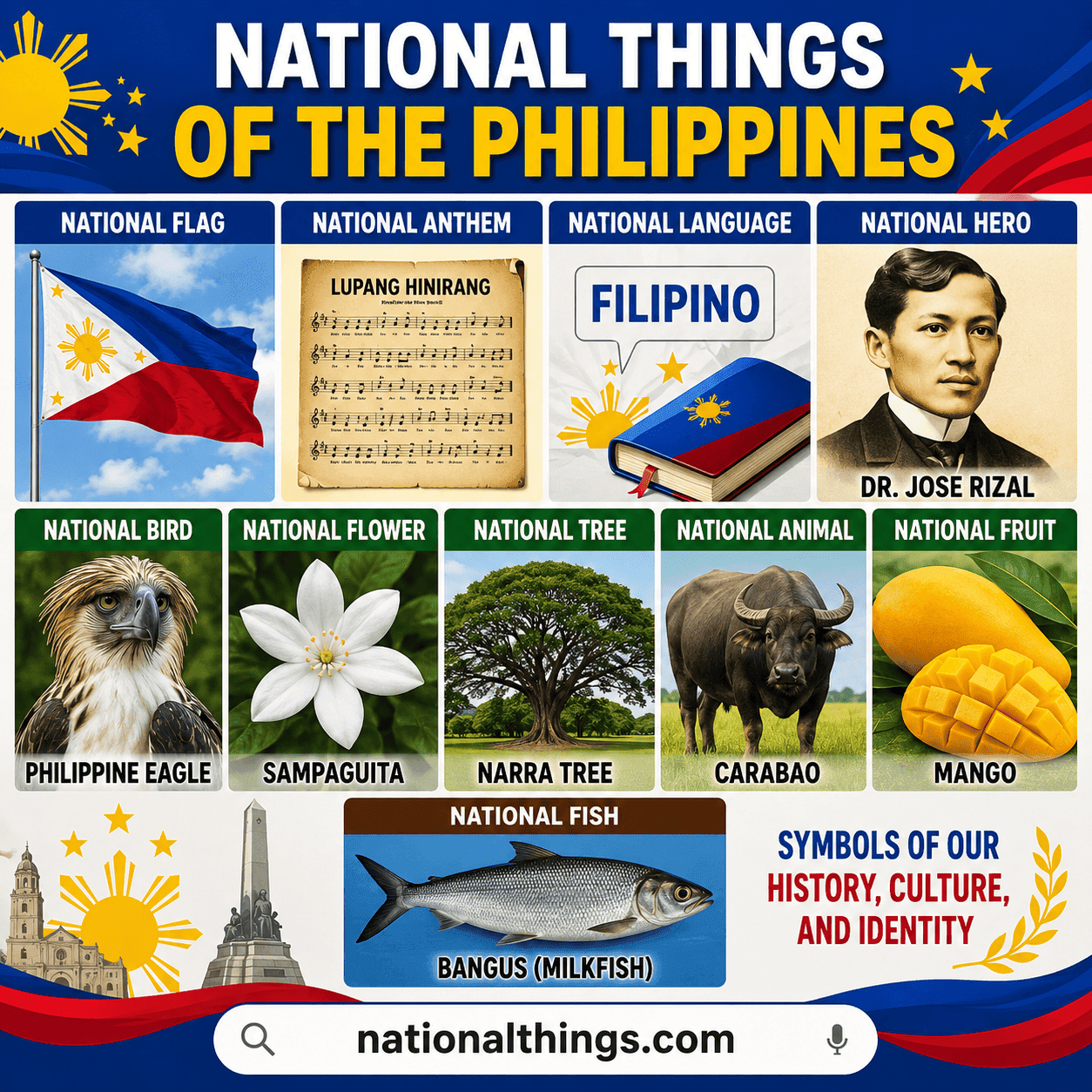
The official national symbols of the Philippines include government emblems, natural treasures, cultural traditions, and recognized forms of communication. Their legal foundations come from the Constitution, national legislation, or executive proclamations.
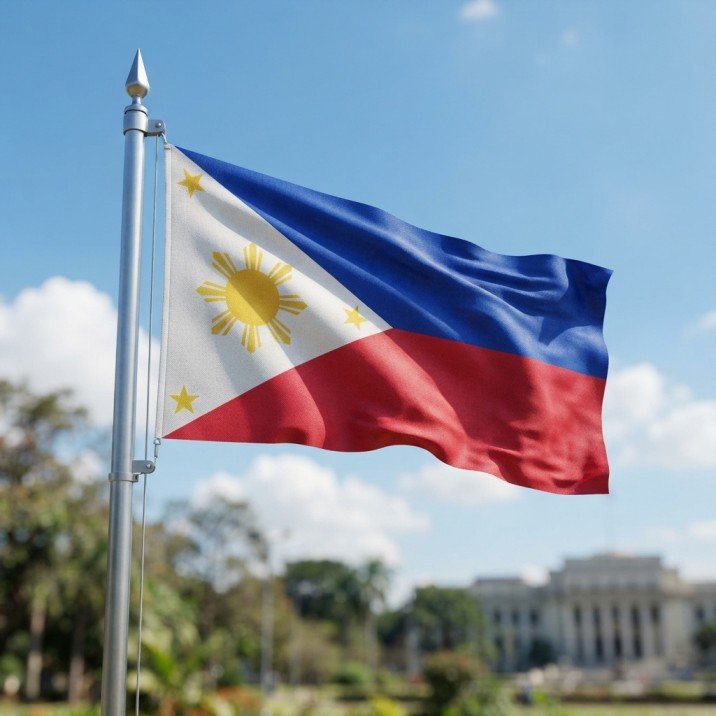
The Philippine flag features two horizontal stripes, blue above red, and a white triangle at the hoist. Inside the triangle are a golden sun with eight rays and three golden stars.
Its main elements represent:
The flag was first unfurled during the declaration of Philippine independence on June 12, 1898. Republic Act No. 8491 establishes rules for its design, display, and respectful use.
During wartime, the flag is displayed with the red stripe above the blue stripe.
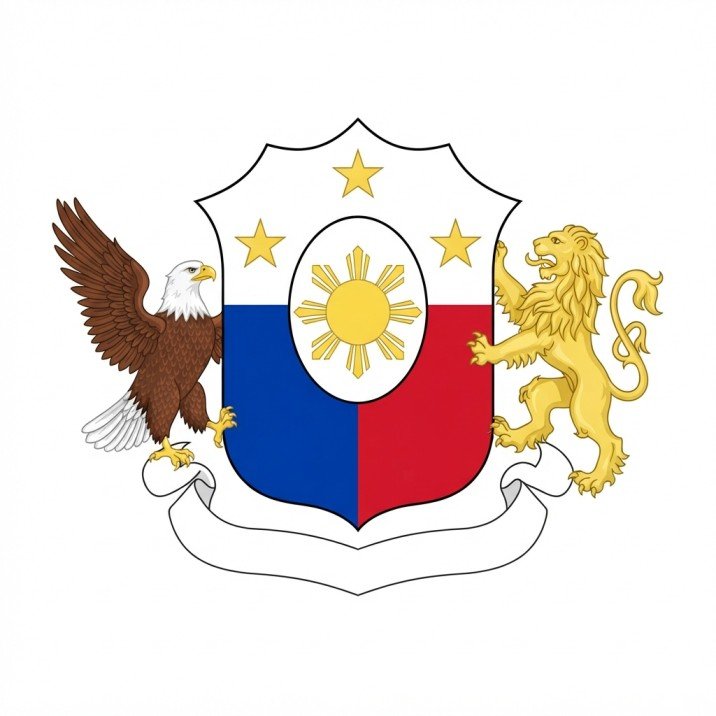
The coat of arms of the Philippines is a government emblem reflecting the country’s history and sovereignty. Its shield includes a golden sun, three stars, an American eagle, and a Spanish lion.
The sun and stars represent the Filipino nation, while the eagle and lion reflect historical connections with the United States and Spain.
A white scroll below the shield carries the words Republika ng Pilipinas.
The coat of arms appears in official government contexts and is regulated under Republic Act No. 8491.
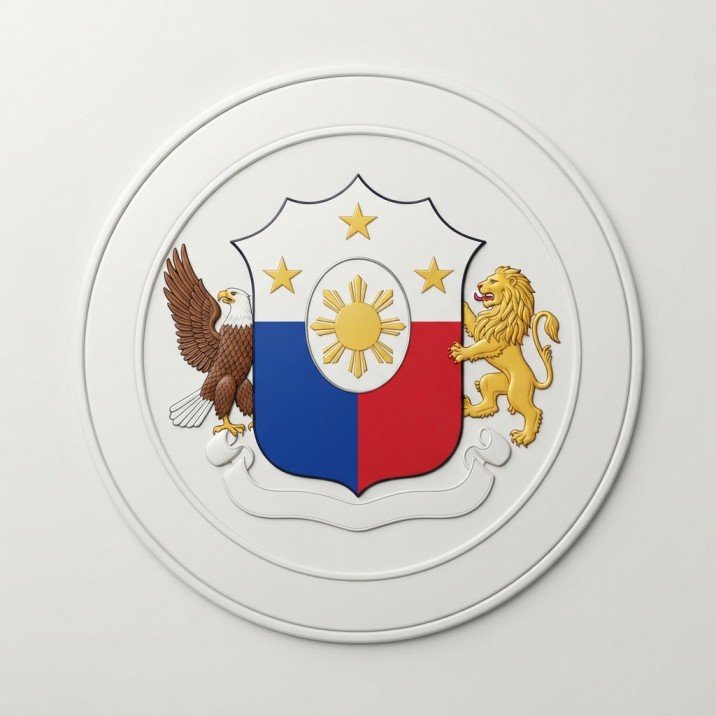
The Great Seal of the Philippines authenticates important government documents and official state acts. Its central design incorporates the national coat of arms.
Unlike the coat of arms alone, the Great Seal includes surrounding official inscriptions and the national motto.
It is used for specified government purposes rather than as a general decorative symbol. Its design and use are governed by Republic Act No. 8491.
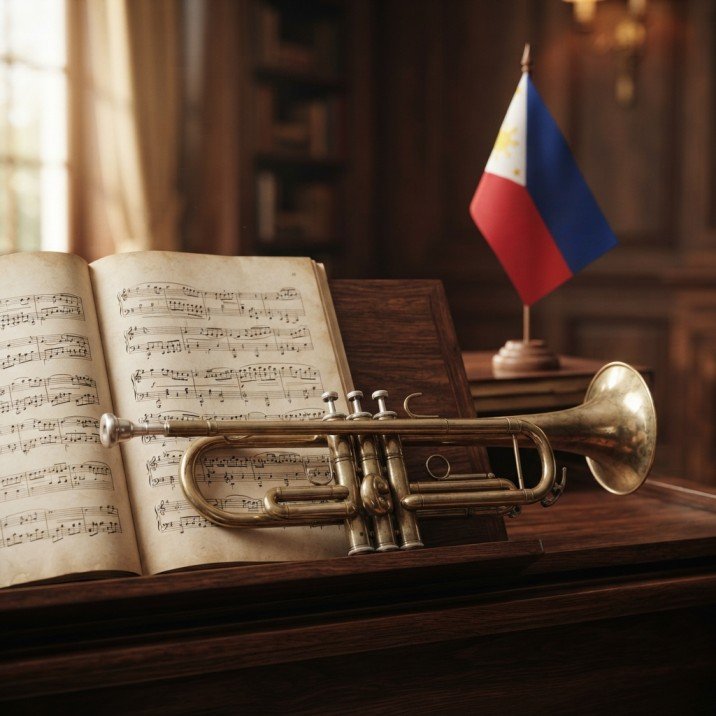
The Philippine national anthem is Lupang Hinirang, commonly translated as Chosen Land. It expresses love for the homeland, freedom, and the willingness to defend the country.
Julián Felipe composed its music in 1898. José Palma later wrote the Spanish poem that became the basis of its lyrics.
The anthem developed through different language versions before the adoption of its Filipino wording.
Under Republic Act No. 8491, the national anthem must be sung in the national language, and the law prescribes its proper performance.
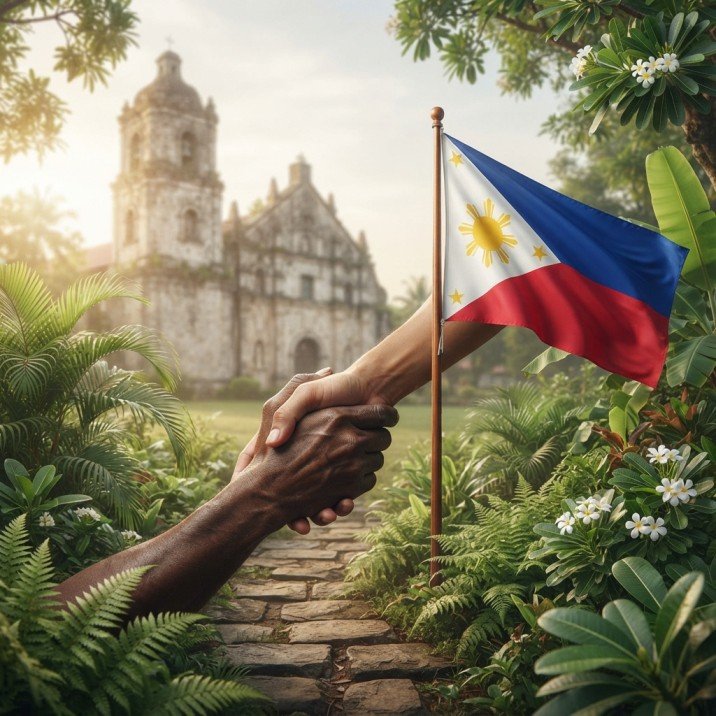
The official national motto of the Philippines is:
Maka-Diyos, Maka-tao, Makakalikasan at Makabansa
Its meaning in English is commonly expressed as For God, People, Nature, and Country.
The motto emphasizes four national values:
The motto is established under Republic Act No. 8491 and appears in the national Great Seal.
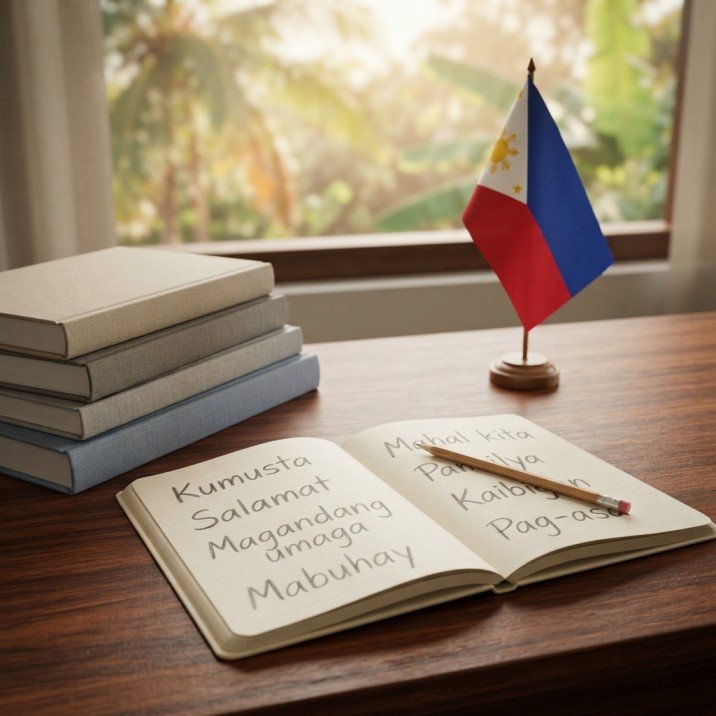
Filipino is the national language of the Philippines under Article XIV, Section 6 of the 1987 Constitution. It is used in education, communication, government, and cultural expression.
Filipino developed primarily from Tagalog and continues to incorporate words and expressions from other Philippine and foreign languages.
The Constitution also identifies Filipino and English as official languages for communication and instruction, subject to the relevant constitutional provisions.
The Philippines has many regional languages, including Cebuano, Ilocano, Hiligaynon, and Waray. These languages remain important parts of the country’s cultural heritage.
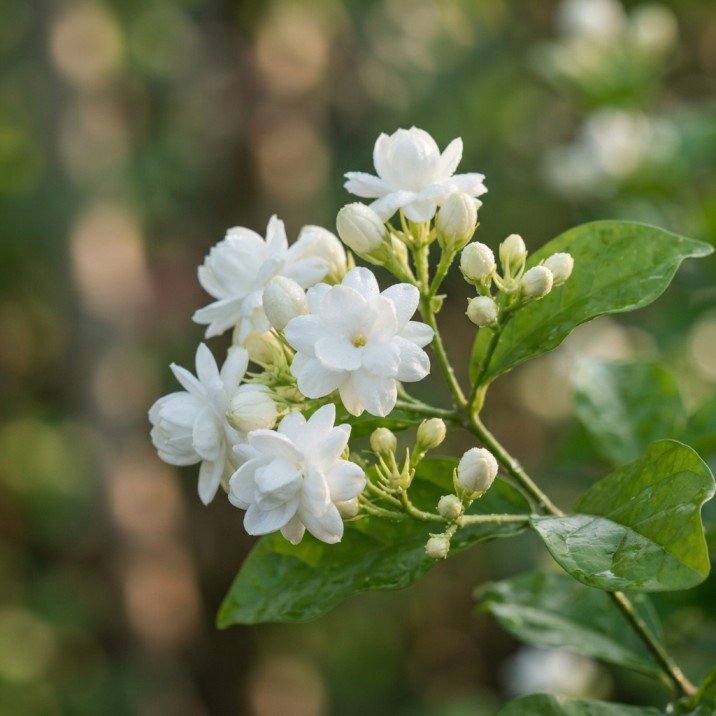
The sampaguita (Jasminum sambac) is the national flower of the Philippines. It has small white blossoms, a sweet fragrance, and glossy green leaves.
Sampaguita is commonly associated with purity, humility, sincerity, and devotion.
Its flowers are often arranged into garlands used during religious ceremonies, celebrations, and occasions honoring guests.
Governor-General Frank Murphy designated sampaguita as the national flower through Proclamation No. 652 on February 1, 1934.
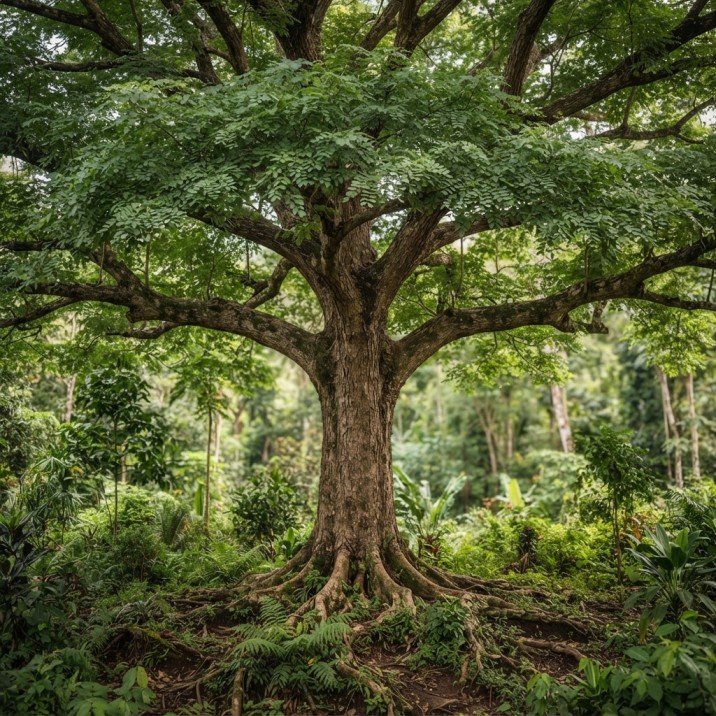
The narra tree (Pterocarpus indicus) is the national tree of the Philippines. It is known for its strong hardwood, broad crown, and clusters of small yellow flowers.
Narra is commonly associated with strength, endurance, and resilience.
Its timber has traditionally been valued for furniture, flooring, and decorative woodwork.
Like Sampaguita, Narra received its national designation through Proclamation No. 652 in 1934.
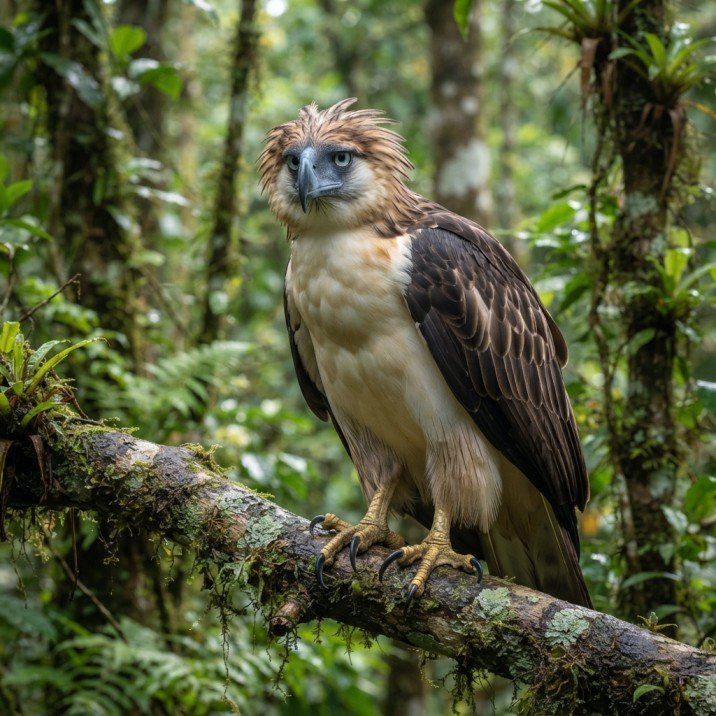
The Philippine eagle (Pithecophaga jefferyi) is the country’s national bird. It is a large forest-dwelling bird of prey with a powerful hooked beak, broad wings, and distinctive long crest feathers.
The eagle represents strength, freedom, and the importance of protecting Philippine wildlife.
It is endemic to the Philippines and inhabits forests on islands, including Luzon, Samar, Leyte, and Mindanao.
President Fidel V. Ramos declared it the national bird through Proclamation No. 615 on July 4, 1995.
The Philippine eagle is critically endangered. Habitat destruction and hunting have contributed to its decline, making conservation essential to its survival.
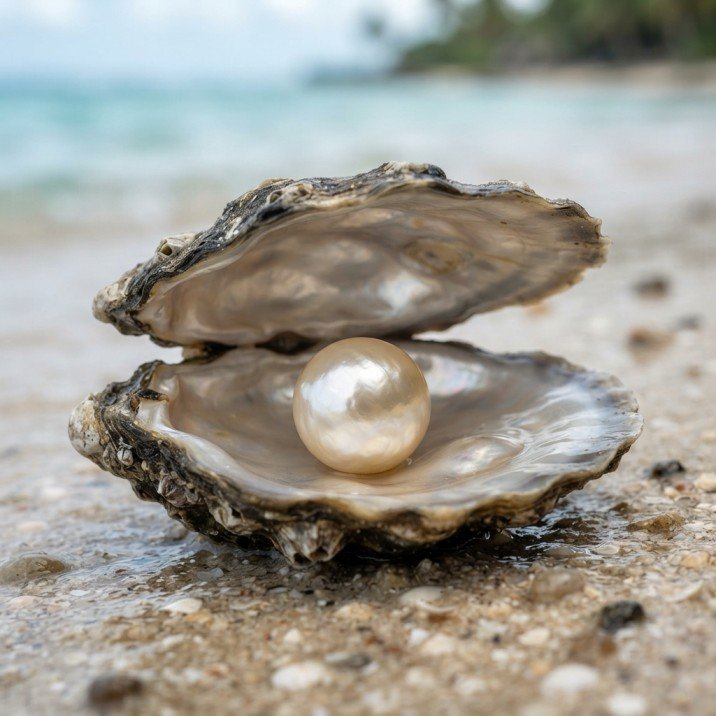
The Philippine pearl, particularly the South Sea pearl associated with Pinctada maxima, is the national gem of the Philippines.
South Sea pearls are valued for their size, luster, and natural beauty. They may appear in white, cream, and golden shades.
Pearls represent the country’s marine resources and its connection to the surrounding seas.
President Fidel V. Ramos designated the Philippine pearl as the national gem through Proclamation No. 905 in 1996.
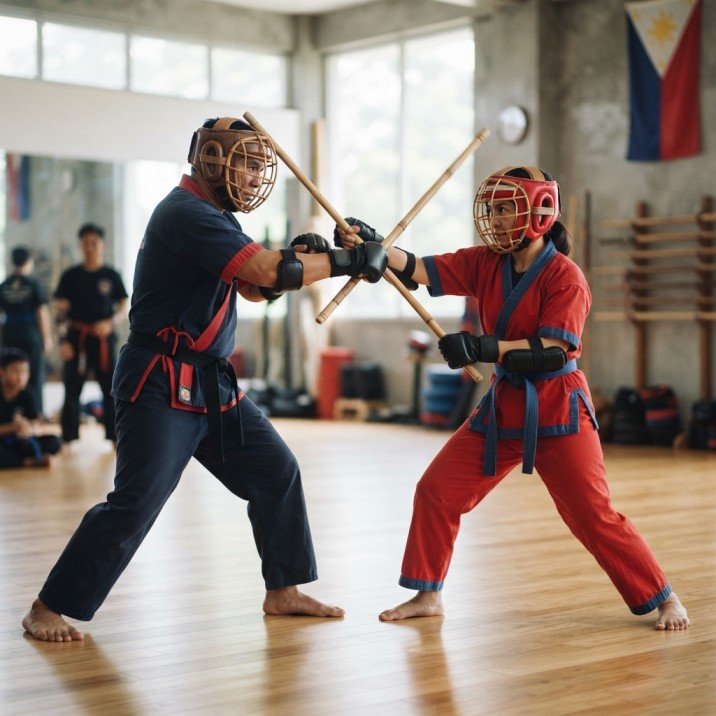
Arnis, also known as eskrima or kali, is the national martial art and sport of the Philippines. It involves defensive and offensive techniques using sticks, bladed weapons, and empty-hand movements.
Arnis developed through Filipino fighting traditions and is practiced today as both a martial art and competitive sport.
Its techniques emphasize coordination, timing, movement, and self-defense.
Republic Act No. 9850, approved on December 11, 2009, declared arnis the Philippine national martial art and sport.

Filipino Sign Language (FSL) is the national sign language of the Philippines. It is a natural visual language used by the Filipino Deaf community.
FSL uses hand movements, facial expressions, and body positioning to communicate meaning. It has its own linguistic structure and is not simply spoken Filipino represented through gestures.
Republic Act No. 11106, signed in 2018, recognized FSL as the national sign language of the Filipino Deaf and the official sign language of government transactions involving Deaf people.
This recognition supports language rights, accessibility, education, and equal participation in public life.
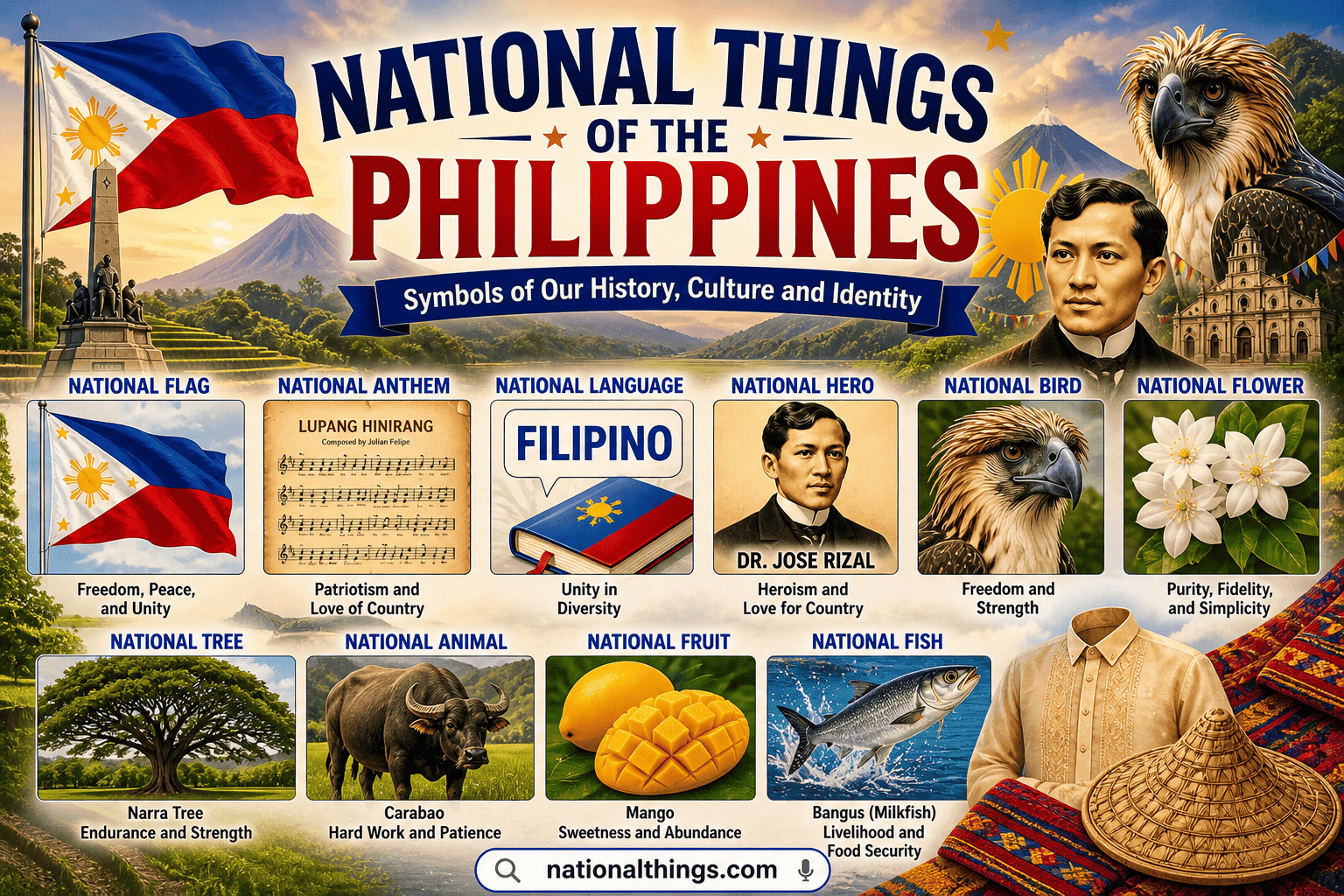
Several Philippine cultural symbols are popularly described as national symbols despite lacking an established legal designation in that category. They remain important because they reflect Filipino traditions, agriculture, food, transportation, and everyday life.
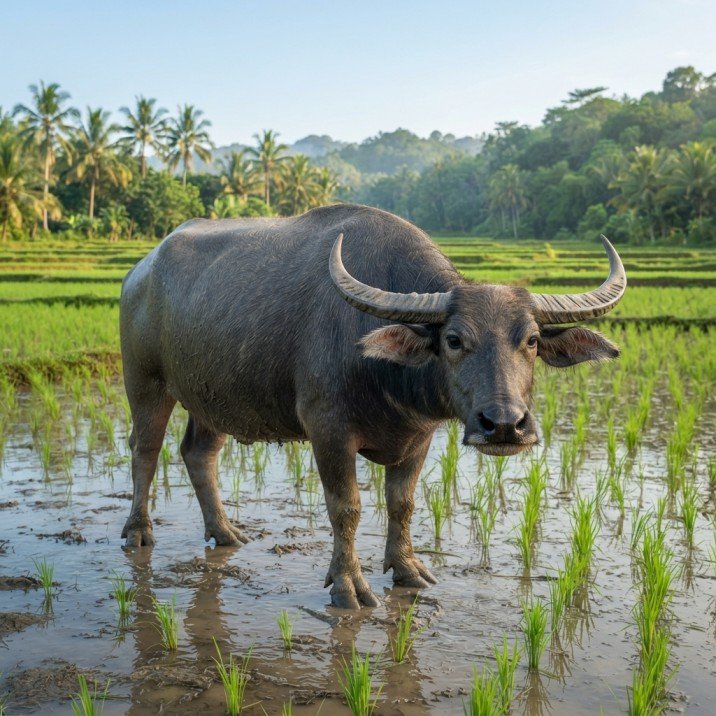
The carabao, a domestic water buffalo, is widely regarded as the unofficial national animal of the Philippines. It has long helped farmers plow rice fields and transport agricultural materials.
Carabaos are commonly associated with hard work, patience, and perseverance.
Although they are important cultural symbols, no established national law formally designates the carabao as the national animal.
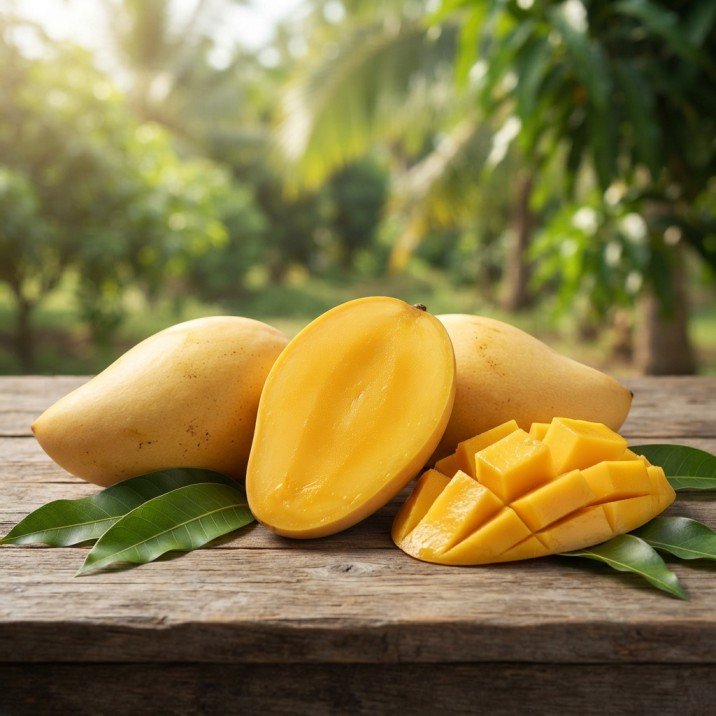
The mango, particularly the Philippine Carabao mango, is commonly called the country’s national fruit.
Philippine mangoes are known for their sweet flavor, smooth flesh, and golden-yellow color when ripe.
They are eaten fresh and used in desserts, juices, dried-fruit products, and traditional dishes.
Despite their popularity, mangoes do not have an established official designation as the Philippine national fruit.

Anahaw, a fan palm traditionally identified as Saribus rotundifolius (formerly Livistona rotundifolia), is popularly associated with the national leaf of the Philippines.
Its broad, rounded leaves are used in traditional roofing, decorations, and handicrafts.
Anahaw reflects the practical use of local plants in Filipino communities, but its national-leaf designation is traditional rather than formally established.
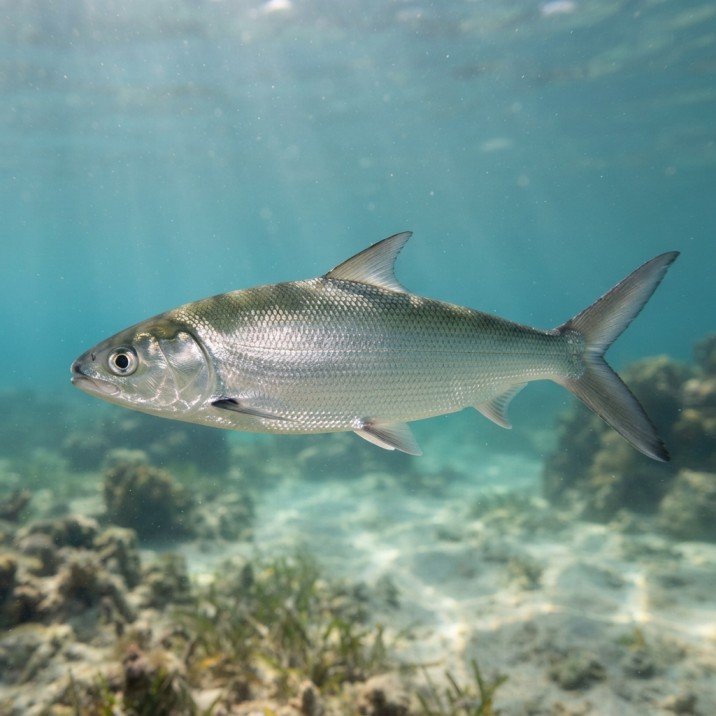
Bangus, or milkfish (Chanos chanos), is often called the unofficial national fish of the Philippines.
It is an important food fish raised in aquaculture and prepared in dishes such as grilled bangus, fried bangus, and sinigang.
Bangus is especially associated with Philippine fish farming and coastal food traditions. However, its national-fish title is not supported by an established formal designation.
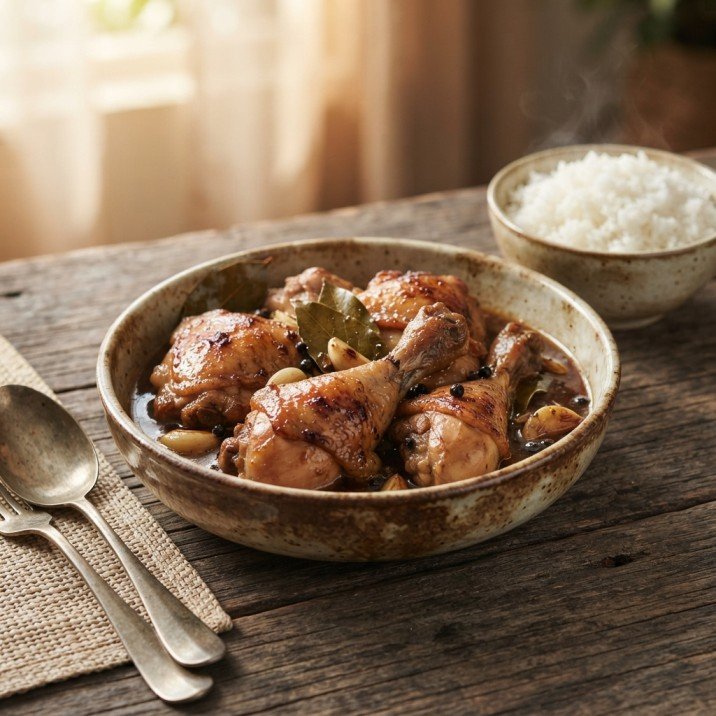
Adobo is one of the best-known dishes in Filipino cuisine and is frequently described as the country’s unofficial national food.
It usually involves meat cooked with vinegar, soy sauce, garlic, peppercorns, and bay leaves, although recipes vary by region and household.
Adobo represents the diversity of Filipino home cooking. Its popularity does not mean that it has been formally declared the national dish.
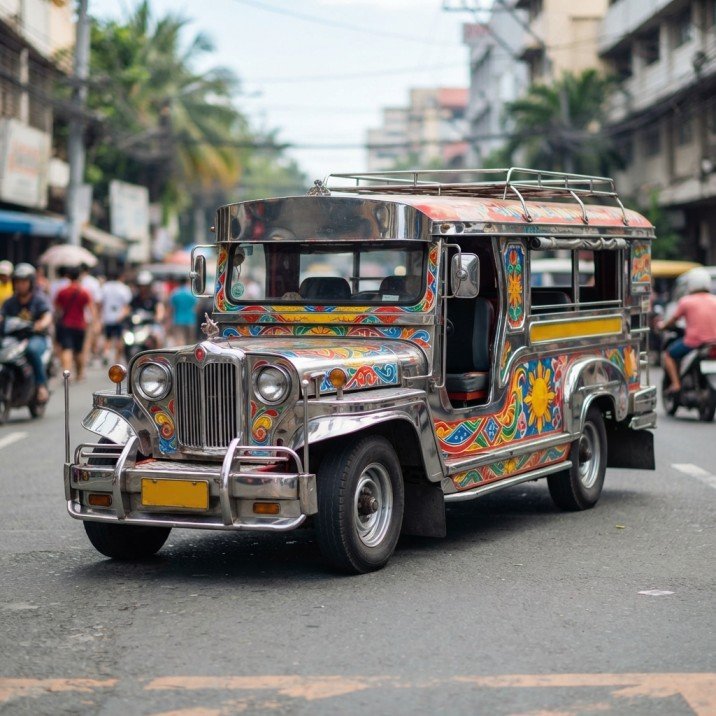
The jeepney is a recognizable form of public transportation in the Philippines. Traditional jeepneys developed from modified military jeeps after World War II.
Their colorful paintwork, chrome details, and personalized decorations make them distinctive features of Philippine streets.
Jeepneys reflect local creativity, transportation history, and everyday community life.
They are widely considered cultural icons, but they do not hold an established official national-vehicle designation.

The bahay kubo, or nipa hut, is a traditional Filipino rural house. It is commonly constructed using bamboo, wood, and woven plant materials.
Many examples stand on raised posts, allowing air to circulate underneath and helping protect the living area from ground moisture.
The bahay kubo represents traditional rural architecture, resourcefulness, and adaptation to the tropical climate.
It is a familiar cultural symbol rather than a formally designated national house.
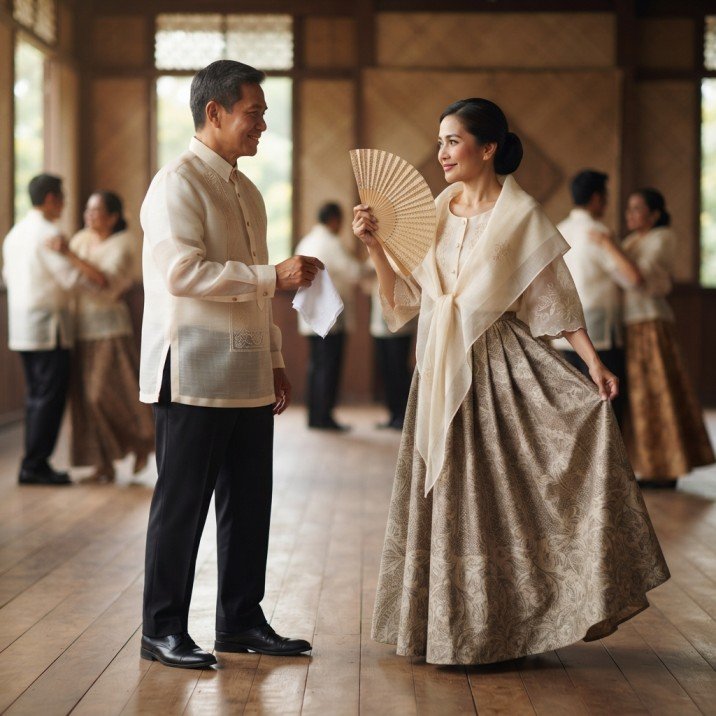
Cariñosa is a traditional Philippine folk dance often associated with courtship. Dancers perform graceful movements, sometimes using fans or handkerchiefs.
The dance reflects historical Spanish influence and Filipino interpretations of courtship customs.
Although cariñosa is sometimes called the national dance, it does not have an established official designation in that category.
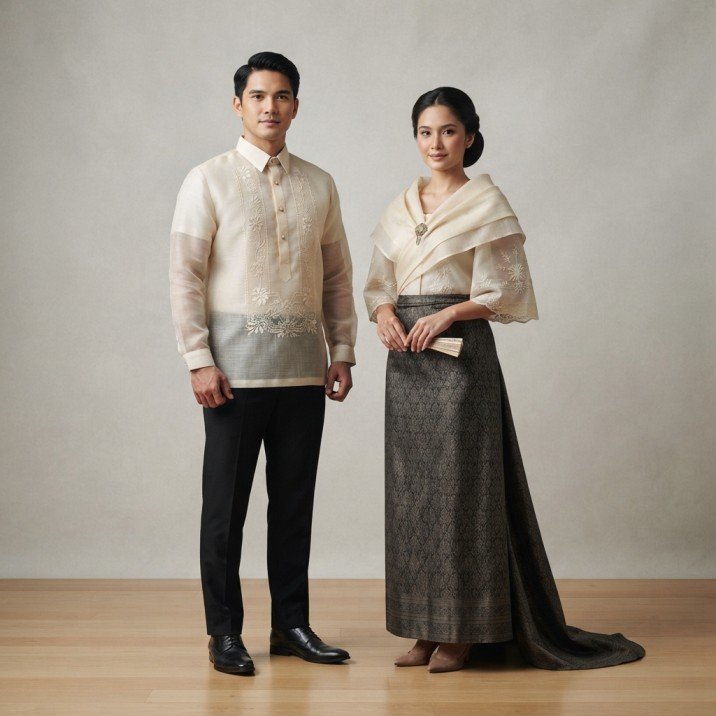
The Barong Tagalog and Baro’t Saya are traditional forms of Filipino clothing.
The Barong Tagalog is a formal embroidered shirt commonly worn by men. The Baro’t Saya combines a blouse and skirt and has several historical and regional variations.
These garments reflect Filipino craftsmanship, identity, and changing clothing traditions.
They are widely recognized as national attire in a cultural sense, but this should not be confused with a general legal designation of a single official national costume.
A Philippine national symbols chart helps students identify familiar symbols and remember their names. The chart below separates legally recognized symbols from cultural associations commonly taught in schools.
| Symbol | Name | Status |
|---|---|---|
| Flag | Philippine Flag | Official |
| Bird | Philippine Eagle | Official |
| Flower | Sampaguita | Official |
| Tree | Narra | Official |
| Gem | Philippine Pearl | Official |
| Sport | Arnis | Official |
| Language | Filipino | Official |
| Animal | Carabao | Unofficial |
| Fruit | Mango | Unofficial |
| Leaf | Anahaw | Unofficial |
| Fish | Bangus | Unofficial |
| Food | Adobo | Unofficial |
| Vehicle | Jeepney | Unofficial |
| House | Bahay Kubo | Unofficial |
For classroom posters and picture worksheets, the legal-status labels should remain visible. A familiar cultural association is not necessarily an official national designation.
Philippine national symbols express ideas connected with independence, cultural identity, public values, and the natural environment. Their meanings come from a combination of legal descriptions, historical events, and cultural interpretations.
| Symbol | Common Meaning or Association |
|---|---|
| Philippine Flag | Independence, courage, and national unity |
| Coat of Arms | Sovereignty and historical identity |
| Sampaguita | Purity, humility, and devotion |
| Narra | Strength and resilience |
| Philippine Eagle | Freedom, strength, and wildlife protection |
| Philippine Pearl | Natural beauty and marine heritage |
| Arnis | Filipino martial traditions and discipline |
| Carabao | Hard work and agricultural life |
| Jeepney | Creativity and everyday Filipino culture |
| Bahay Kubo | Traditional living and resourcefulness |
Some meanings, particularly elements of the flag, are defined by law or established historical interpretation. Others, such as the carabao representing hard work, are cultural associations rather than legally prescribed meanings.
Philippine national symbols developed during different periods of the country’s political and cultural history. Some emerged during the independence movement, while others received official recognition through later government actions.
Important milestones include:
These developments show how Philippine national symbols reflect both the country’s independence history and later recognition of cultural and social traditions.
A Philippine national symbol becomes officially recognized through a valid legal or governmental act. The authority may come from the Constitution, an enacted Republic Act, or an executive proclamation issued under appropriate legal authority.
The main forms of recognition include:
A proposal introduced in Congress does not automatically become law. Likewise, a symbol appearing on school posters or being widely described as national does not establish an official designation.
This distinction explains why symbols such as sampaguita and the carabao have different legal statuses despite both being familiar to Filipinos.
The Philippines honors many historical figures for their contributions to independence and nation-building. However, widespread recognition as a national hero is not the same as a formal designation under a specific law or proclamation.
José Rizal is widely regarded as a national hero because of his writings, reform advocacy, and execution in 1896. His life and works are commemorated through laws, monuments, and national observances.
Andrés Bonifacio is also honored for his leadership in the Katipunan and the Philippine Revolution against Spanish colonial rule.
The National Heroes Committee recommended several historical figures for national-hero recognition in 1995. The recommendations did not themselves establish a comprehensive legally designated list.
Although Rizal and Bonifacio receive substantial official recognition, historians distinguish these honors from a specific formal proclamation naming them national heroes.
Claims concerning individual executive declarations, including reported recognition of Benigno Aquino Jr., require confirmation from the actual legal instrument.
Several cultural objects and traditions have been proposed for formal recognition as Philippine national symbols. Some proposals advanced through Congress but did not become law.
Notable examples include:
House Bill No. 3926, introduced in 2014, sought to recognize numerous Philippine national symbols. Its introduction did not make those proposed designations official.
The latest legislative status of these proposals should be checked against enacted laws and official government records before any of them is described as formally recognized.
Some Philippine national symbols are frequently misunderstood because school traditions, cultural popularity, and legal designations are treated as interchangeable. Several distinctions are especially important.
Another source of confusion is the total number of official symbols. Different lists may count the flag, anthem, coat of arms, Great Seal, motto, and language separately or use different criteria for inclusion.
For accuracy, it is better to identify each symbol and its legal foundation than rely on an unexplained total.
National symbols help Filipinos express their shared identity while remembering important parts of their history. They connect independence, cultural traditions, language, and the natural environment with everyday national life.
The Philippine flag and anthem are central to school ceremonies and public commemorations. Symbols such as the Philippine eagle and narra also draw attention to the country’s distinctive wildlife and natural resources.
Cultural symbols, including the jeepney, bahay kubo, and traditional clothing, preserve connections with Filipino communities and earlier ways of life.
Together, these symbols reflect the Philippines as a country shaped by Indigenous traditions, regional cultures, colonial history, and the struggle for independence.
Officially recognized symbols include the Philippine flag, coat of arms, Great Seal, anthem, motto, Filipino language, sampaguita, narra, Philippine eagle, Philippine pearl, arnis, and Filipino Sign Language.
A commonly used reference list contains 12 principal symbols, counting government emblems and language designations separately. The total depends on the categories included and should not be treated as a universally fixed legal count.
The carabao (water buffalo) is widely recognized as the unofficial national animal of the Philippines, representing hard work, strength, and perseverance.
The Philippine national flag is one of the country’s most important symbols, representing independence, freedom, unity, and patriotism.
Sampaguita (Jasminum sambac) is the official national flower of the Philippines, symbolizing purity, humility, and devotion.
The Philippine flag, Philippine eagle, sampaguita, narra tree, carabao, jeepney, and bahay kubo represent the country’s identity, nature, and culture.
Arnis is the official national martial art and sport of the Philippines under Republic Act No. 9850. Basketball remains extremely popular but does not hold the same legal designation.
Official national symbols have a recognized legal foundation, such as a law or proclamation. Unofficial symbols gain recognition through culture and tradition. Sampaguita is officially designated, while the carabao is commonly associated with national identity.
José Rizal is widely honored as a Philippine national hero, and his contributions receive extensive official recognition. However, historians distinguish this recognition from a specific formal law proclaiming him the sole national hero.