National Emblems of All Countries: List of World Coat of Arms
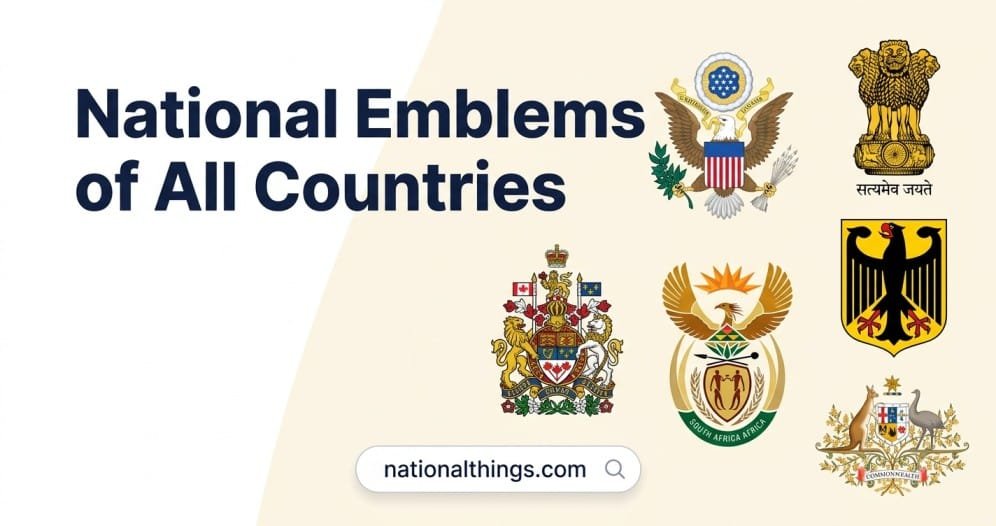
National Emblems of All Countries include official designs used to identify and represent nations around the world. These emblems appear on government documents, passports, official buildings, public records, and state publications. Their designs vary from country to country, featuring elements such as heraldic shields, eagles, lions, stars, and traditional patterns. Some nations use a coat of arms as their national emblem, while others have a distinct official design. This worldwide list covers national emblems across Asia, Europe, Africa, North America, South America, and Oceania, with country names and details about their official emblems.
Contents
25mn read
What are National Emblems?
A national emblem is an official design that represents a country’s identity, government, or heritage. Governments use these designs on official documents, public buildings, passports, and other state materials.
A national emblem may contain a shield, an eagle, a lion, a star, a plant, a monument, or another meaningful element. Its design and legal status depend on the country’s laws and traditions.
The terms national emblem, coat of arms, and state seal do not always mean the same thing. India has a State Emblem based on the Lion Capital of Ashoka. The United States uses the Great Seal to authenticate official government documents. Australia has a Commonwealth Coat of Arms. Each design has a specific official purpose.
What are National Emblems
National Emblems of Asian Countries
Asian countries use different national emblems to represent their governments and national identities. Many feature shields, animals, plants, stars, or traditional designs.
National Emblems of Asian Countries
National Emblems of East Asian Countries
East Asian countries include China, Japan, Mongolia, North Korea, and South Korea. Their official emblems and state symbols reflect different national traditions and government systems.
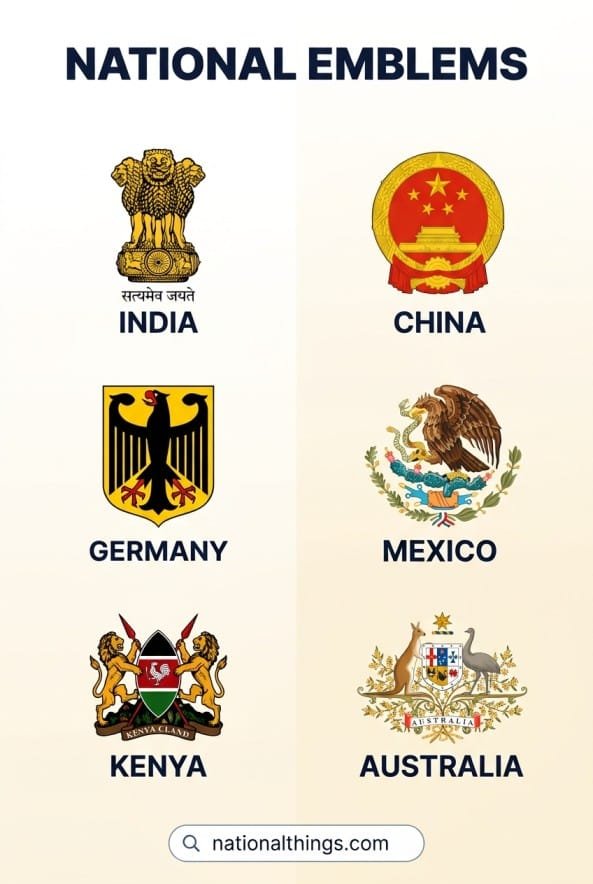
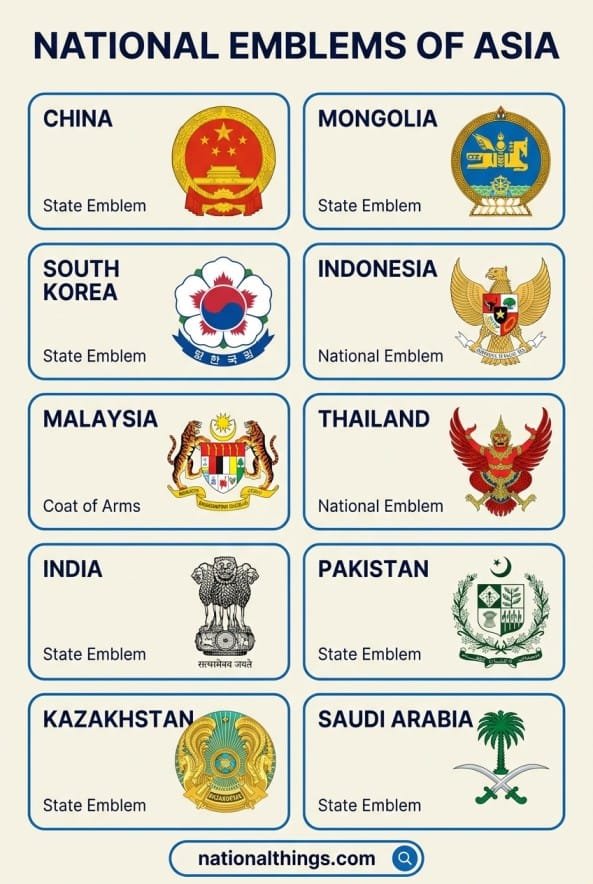
China: The national emblem features Tiananmen Gate, five stars, a cogwheel, and ears of grain. The design represents the state and the country’s political history.
Japan: Japan has no separately designated national emblem equivalent to those used by many countries. The sixteen-petaled chrysanthemum seal is associated with the imperial household.
Mongolia: The State Emblem features the Soyombo symbol, a horse, a wheel, and other traditional elements representing national identity and freedom.
North Korea: The national emblem features a hydroelectric power station beneath a red star, surrounded by rice ears.
South Korea: The national emblem features a red-and-blue Taegeuk surrounded by five stylized petals, with the country’s name beneath it.
National Emblems of Southeast Asian Countries
Southeast Asian countries include Thailand, Indonesia, Malaysia, Vietnam, and the Philippines. Their emblems feature designs associated with national history, independence, and state authority.
Brunei: The emblem features a crescent, a parasol, wings, hands, and other elements associated with the sultanate.
Cambodia: The Royal Arms features royal insignia and traditional elements representing the monarchy.
Indonesia: Garuda Pancasila shows a mythical bird carrying a shield with five symbols representing the principles of Pancasila. A scroll displays the motto Bhinneka Tunggal Ika, meaning “Unity in Diversity.”
Laos: The national emblem features the Pha That Luang monument, a road, a water structure, and agricultural elements.
Malaysia: The coat of arms features a shield, two tigers, a crescent, and a star.
Myanmar: The State Seal features a map of the country between two chinthe, mythical lion-like creatures.
Philippines: The coat of arms features a shield with a sun and three stars, alongside a bald eagle and a lion in its upper sections.
Singapore: The coat of arms features a red shield with a white crescent and five white stars, supported by a lion and a tiger.
Thailand: The Garuda is Thailand’s national emblem and appears in official state contexts.
Timor-Leste: The national emblem features a central shield with a star and traditional elements associated with national identity.
Vietnam: The national emblem features a gold star on a red background, surrounded by rice ears and a cogwheel.
National Emblems of South Asian Countries
South Asian countries include India, Pakistan, Bangladesh, Nepal, Bhutan, Sri Lanka, the Maldives, and Afghanistan. Their emblems use distinctive designs connected with national heritage and government identity.
Afghanistan: State emblems have changed with political transitions. Designs used by different authorities have included a mosque, wheat ears, inscriptions, and other religious and national elements.
Bangladesh: The national emblem features a water lily surrounded by rice sheaves, four stars, and jute leaves.
Bhutan: The national emblem features a double diamond thunderbolt, or dorji, above a lotus, with two dragons surrounding the design.
India: The State Emblem is based on the Lion Capital of Ashoka at Sarnath. It shows three lions in the standard two-dimensional design and carries the motto Satyameva Jayate, meaning “Truth Alone Triumphs.”
Maldives: The emblem features a coconut palm, a crescent, and crossed national flags.
Nepal: The national emblem includes Mount Everest, green hills, a map of Nepal, rhododendrons, and joined hands.
Pakistan: The State Emblem features a crescent and star above a shield representing major agricultural products. A wreath surrounds the shield, and a scroll carries the national motto.
Sri Lanka: The national emblem features a lion holding a sword, surrounded by traditional decorative elements, including a lotus.
National Emblems of Central Asian Countries
Kazakhstan, Kyrgyzstan, Tajikistan, Turkmenistan, and Uzbekistan are the five Central Asian countries. Their emblems often feature traditional patterns, regional heritage, and national colors.
Kazakhstan: The national emblem features a shanyrak, the circular upper structure of a traditional yurt, with winged mythical horses and a star.
Kyrgyzstan: The national emblem features a falcon, mountains, a rising sun, and other elements associated with the country’s landscape.
Tajikistan: The national emblem features a crown, stars, mountains, a rising sun, and agricultural elements.
Turkmenistan: The emblem has a green eight-pointed star surrounding a circular design with a horse, cotton, wheat, and traditional carpet patterns.
Uzbekistan: The national emblem features the mythical bird Humo, mountains, a river, a rising sun, and agricultural elements.
National Emblems of Western Asian Countries
Western Asian countries include Saudi Arabia, Iraq, Iran, Jordan, Lebanon, and other nations. Their emblems reflect different historical traditions, cultural influences, and government institutions.
Armenia: The coat of arms features a shield with historical Armenian symbols, supported by an eagle and a lion.
Azerbaijan: The national emblem features an eight-pointed star surrounding a flame, with oak branches and wheat ears below.
Bahrain: The national emblem features a shield in the national colors with a serrated white division.
Georgia: The coat of arms features Saint George on horseback.
Iran: The national emblem is a stylized design representing the word Allah.
Iraq: The coat of arms features the Eagle of Saladin carrying a shield in the national colors.
Israel: The national emblem features a menorah surrounded by olive branches, with the country’s name beneath it.
Jordan: The coat of arms includes a crown, a shield, weapons, and royal elements.
Kuwait: The State Emblem features a falcon carrying a circular shield depicting a traditional sailing vessel.
Lebanon: The cedar tree is the country’s central national symbol, but it should not automatically be described as a separately designated national emblem.
Oman: The national emblem features a khanjar dagger crossed with two swords.
Palestine: Official state insignia include the Eagle of Saladin carrying a shield in the national colors.
Qatar: The national emblem features two crossed swords, a traditional sailing boat, palm trees, and a sea.
Saudi Arabia: The national emblem consists of a palm tree above two crossed swords.
Syria: State insignia have changed during political transitions; the applicable design depends on the authority and date.
Türkiye: The crescent and star appear in official national contexts, but Türkiye does not have a universally designated national coat of arms equivalent to those of many other countries.
United Arab Emirates: The national emblem features a golden falcon carrying a circular shield in the national colors.
Yemen: The national emblem features a golden eagle carrying a shield, with a scroll bearing the country’s name.
National Emblems of European Countries
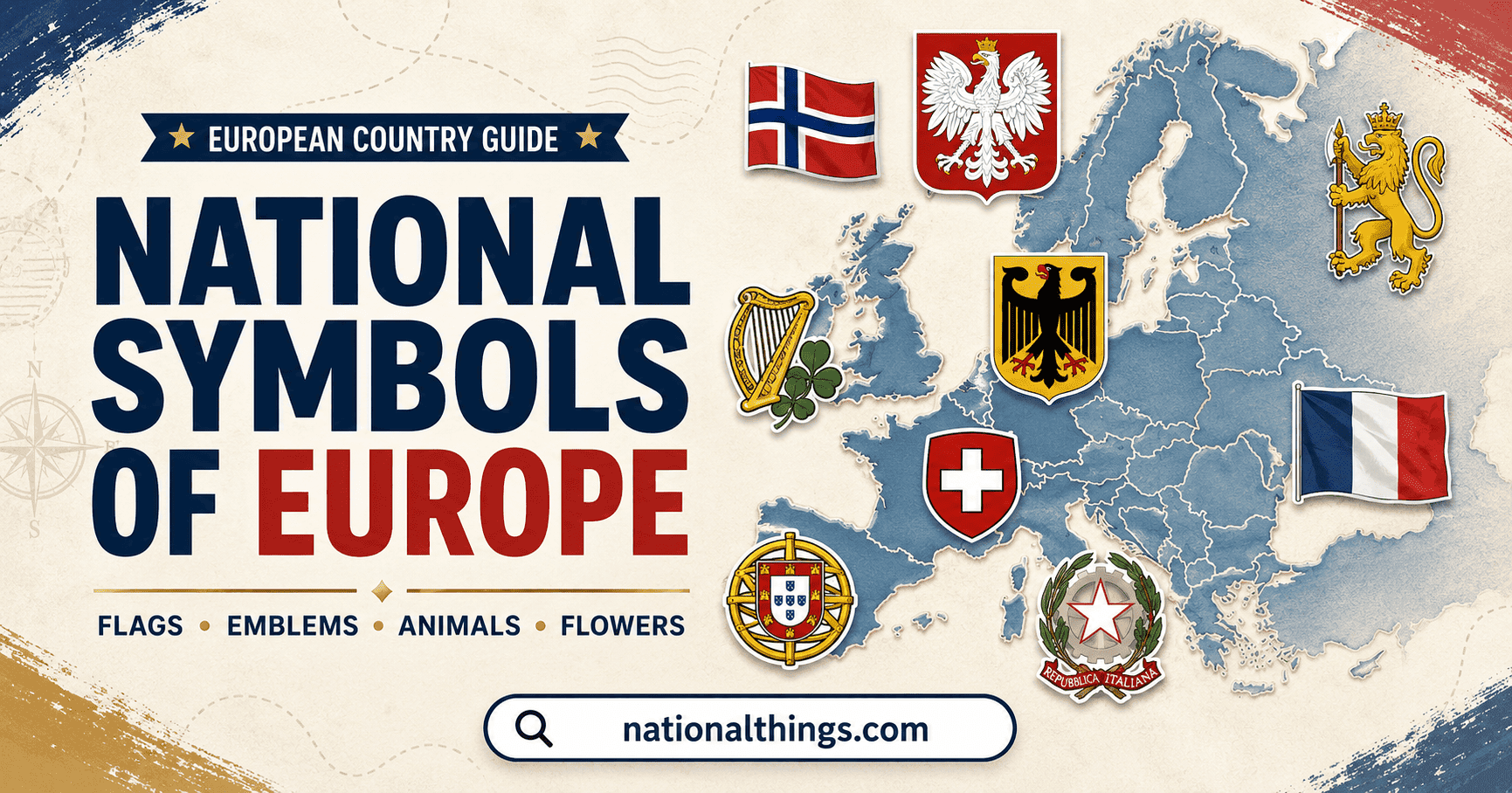
European countries have varied national emblems, including heraldic shields, crowns, eagles, lions, and other official designs. Each country’s emblem has its own form and legal status.
National Emblems of European Countries
National Emblems of Northern European Countries
Northern Europe includes countries such as Denmark, Finland, Iceland, Norway, and Sweden. Their official emblems include heraldic designs and symbols linked to national history.
Denmark: The coat of arms features three lions and nine hearts.
Estonia: The coat of arms features three blue lions on a golden shield, surrounded by oak branches.
Finland: The coat of arms features a crowned lion holding a sword.
Iceland: The coat of arms features a shield in the national colors, supported by four guardian figures.
Ireland: The harp is Ireland’s official state emblem.
Latvia: The coat of arms features a sun, stars, and heraldic lions and griffins.
Lithuania: The coat of arms features a mounted knight known as Vytis.
Norway: The coat of arms features a golden lion holding an axe on a red shield.
Sweden: Sweden has greater and lesser national coats of arms for different official uses.
United Kingdom: The Royal Arms represents the monarch and is used in designated royal and government contexts.
National Emblems of Western European Countries
Western European countries include France, Germany, Belgium, the Netherlands, and Luxembourg. Their official emblems and state insignia differ in design and historical background.
Austria: The federal coat of arms features a black eagle holding a hammer and sickle, with broken chains on its legs.
Belgium: The national coat of arms centers on a golden lion.
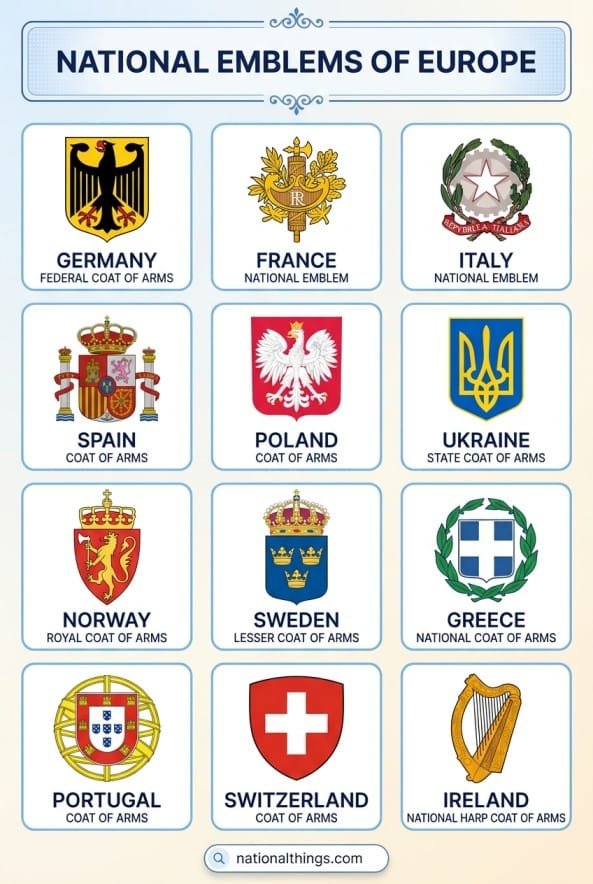
France: France uses republican insignia in official contexts, including the fasces and oak and laurel branches, rather than a single universally used national coat of arms.
Germany: The federal coat of arms features a black eagle on a golden shield.
Luxembourg: The coat of arms features a crowned red lion on a striped shield.
Netherlands: The royal coat of arms features a crowned lion holding a sword and arrows.
Switzerland: The national coat of arms is a white cross on a red shield.
National Emblems of Southern European Countries
Southern Europe includes Italy, Spain, Portugal, Greece, and several Balkan and Mediterranean countries. Their national emblems reflect distinct state traditions and historical influences.
Albania: The national emblem features a black double-headed eagle on a red shield.
Andorra: The coat of arms has four sections representing historical ecclesiastical and political traditions.
Bosnia and Herzegovina: The coat of arms features a shield with a yellow triangle and stars.
Croatia: The coat of arms features a red-and-white checkerboard shield topped by a crown of smaller shields.
Greece: The national emblem features a blue shield with a white cross surrounded by laurel branches.
Italy: The emblem of the Italian Republic features a five-pointed star, a cogwheel, an olive branch, and an oak branch.
Malta: The coat of arms features a shield in the national colors and a mural crown.
Montenegro: The coat of arms features a golden double-headed eagle holding a scepter and an orb.
North Macedonia: The state emblem features a rising sun above mountains and a landscape.
Portugal: The coat of arms features five small blue shields, castles, and an armillary sphere.
San Marino: The coat of arms features three towers on three peaks, a crown, and branches.
Serbia: The coat of arms features a double-headed eagle and a shield.
Slovenia: The coat of arms features Mount Triglav, two wavy lines, and three stars.
Spain: The coat of arms includes symbols associated with the country’s historic kingdoms and the Pillars of Hercules.
Vatican City: The coat of arms features two crossed keys and a papal tiara.
National Emblems of Eastern European Countries
Eastern European countries include Poland, Ukraine, Romania, Bulgaria, and other nations in the region. Many use heraldic symbols rooted in national history.
Belarus: The national emblem features a map of the country, a rising sun, grain ears, and a red star.
Bulgaria: The coat of arms features a crowned golden lion on a red shield.
Czechia: The coat of arms combines the historical arms of Bohemia, Moravia, and Silesia.
Hungary: The coat of arms features a shield with a double cross, a crown, and red-and-white stripes.
Moldova: The coat of arms features an eagle holding a cross, an olive branch, and a scepter.
Poland: The coat of arms features a white eagle with a golden crown on a red shield.
Romania: The coat of arms features a golden eagle holding a cross, a sword, and a mace.
Russia: The national coat of arms features a golden double-headed eagle carrying royal symbols.
Slovakia: The coat of arms features a double cross on three blue mountains.
Ukraine: The small coat of arms features the trident known as the Tryzub.
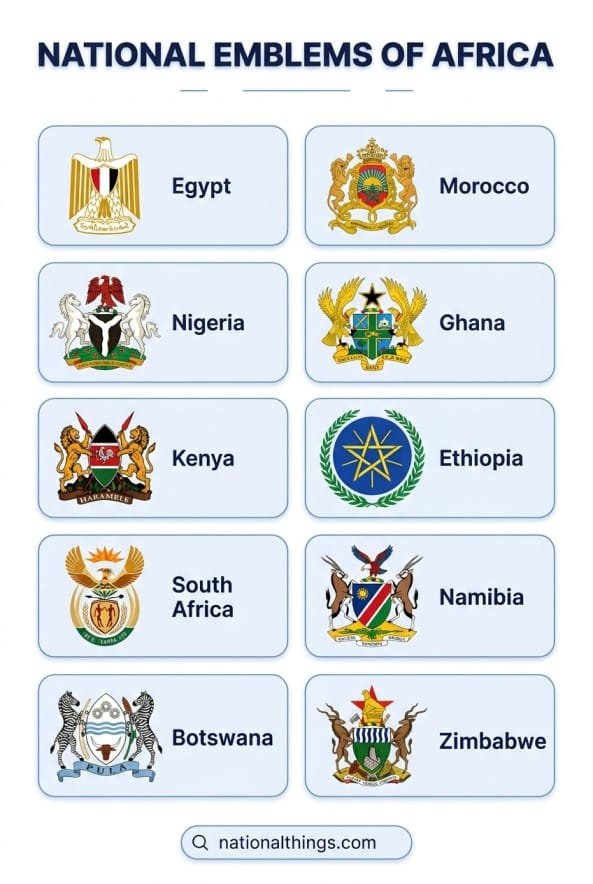
National Emblems of African Countries
African countries have a wide range of national emblems. Their designs may feature shields, wildlife, agricultural plants, stars, and other elements associated with national identity.
National Emblems of African Countries
National Emblems of Northern African Countries
Northern African countries include Egypt, Libya, Tunisia, Algeria, Morocco, and Sudan. Their official emblems feature designs shaped by national history and political traditions.
Algeria: The national emblem features a crescent, star, rising sun, mountains, and agricultural elements.
Egypt: The national emblem features the Eagle of Saladin carrying a shield in the national colors.
Libya: Official insignia have changed with political developments, so the current design must be identified by its legal and political context.
Morocco: The coat of arms features a shield with a rising sun over mountains, supported by two lions.
Sudan: The national emblem features a secretarybird and a scroll bearing the country’s name and motto.
Tunisia: The coat of arms features a ship, a lion holding a sword, and scales.
National Emblems of Western African Countries
Western African countries include Ghana, Nigeria, Senegal, Mali, and Côte d’Ivoire. Their national emblems use different symbols to represent the state and its heritage.
Benin: The coat of arms includes a shield with historical and national elements, supported by a leopard and other figures.
Burkina Faso: The national emblem uses a shield with crossed spears, a star, and other elements associated with the state.
Cabo Verde: The national emblem features a circle with a torch and a triangular arrangement.
Côte d’Ivoire: The national emblem centers on an elephant’s head.
The Gambia: The coat of arms features a shield supported by a lion and a woman and a man carrying tools.
Ghana: The coat of arms features a shield divided into four sections and supported by two eagles.
Guinea: The national emblem features a dove, a sword, and other elements representing peace and national identity.
Guinea-Bissau: The national emblem features a black star, a shell, and two palm branches.
Liberia: The coat of arms features a sailing ship, a palm tree, a plow, and a rising sun.
Mali: The national emblem features a mosque, a vulture, and other state elements.
Mauritania: The national seal features a crescent and star, with a palm tree and millet.
Niger: The national seal features a sun, a spear, crossed swords, and millet ears.
Nigeria: The coat of arms features a black shield with a white Y-shaped band, two white horses, and an eagle.
Senegal: The coat of arms combines a lion, a baobab tree, and a star.
Sierra Leone: The coat of arms features a lion, agricultural tools, and other elements associated with the country.
Togo: The coat of arms features two lions holding bows and arrows, with a shield between them.
National Emblems of Central African Countries
Central African countries include Cameroon, Chad, Gabon, the Republic of the Congo, and the Democratic Republic of the Congo. Their official emblems have distinct designs representing their respective nations.
Cameroon: The national emblem features a shield with a map of the country, a star, and a balance.
Central African Republic: The national emblem features a shield with a star, an elephant, and other national elements.
Chad: The coat of arms includes a shield, a rising sun, and a wreath.
Republic of the Congo: The coat of arms features a lion and other elements associated with national identity.
Democratic Republic of the Congo: The coat of arms features a leopard’s head, an elephant tusk, and a spear.
Equatorial Guinea: The coat of arms features a silk-cotton tree, six stars, and a scroll with the national motto.
Gabon: The coat of arms features a shield with a ship, a golden sun, and two panthers.
São Tomé and Príncipe: The coat of arms features a falcon and a parrot supporting a shield.
National Emblems of Eastern African Countries
Eastern African countries include Kenya, Ethiopia, Tanzania, Uganda, Rwanda, and other nations. Their national emblems may feature wildlife, shields, plants, and other national imagery.
Burundi: The coat of arms features a shield with three spears and a lion’s head.
Comoros: The national emblem features a crescent, stars, and a book within a circular design.
Djibouti: The national emblem features a shield, a spear, and a wreath.
Eritrea: The national emblem features a camel surrounded by a wreath.
Ethiopia: The national emblem features a blue circle with a yellow star and rays.
Kenya: The coat of arms features two lions supporting a shield, with a rooster holding an axe above it.
Madagascar: The national emblem features a map of the island, a red sun, and agricultural elements.
Mauritius: The coat of arms features a dodo and a sambar deer supporting a shield.
Rwanda: The national emblem includes a traditional basket, a sun, and other elements representing national unity and development.
Seychelles: The coat of arms features a giant tortoise, a palm tree, and a shield.
Somalia: The coat of arms features a shield with a white star, supported by two leopards.
South Sudan: The coat of arms features an African fish eagle holding crossed tools.
Tanzania: The coat of arms features a shield with a torch, a spear, and other national elements.
Uganda: The coat of arms features a shield, a drum, a rising sun, and antelopes.
National Emblems of Southern African Countries
Southern African countries include South Africa, Botswana, Namibia, Lesotho, and Eswatini. Their emblems feature varied designs connected to national history and identity.
Angola: The national emblem features a star, a machete, a cogwheel, and agricultural elements.
Botswana: The coat of arms features zebras supporting a shield with water waves, agricultural tools, and a bull’s head.
Eswatini: The coat of arms features a shield, a lion, and an elephant.
Lesotho: The coat of arms features a crocodile above a shield supported by horses.
Malawi: The coat of arms features a lion and a leopard supporting a shield with a rising sun.
Mozambique: The national emblem features a star, a book, a hoe, and a rifle within a design containing agricultural elements.
Namibia: The coat of arms features an African fish eagle above a shield with a desert landscape and two oryx.
South Africa: The national coat of arms features a secretarybird above a shield, with supporting elements representing national identity and unity.
Zambia: The coat of arms features an African fish eagle above a shield with wavy black-and-white lines.
Zimbabwe: The coat of arms features two kudus supporting a shield, with a star and other national elements.
National Emblems of North American Countries
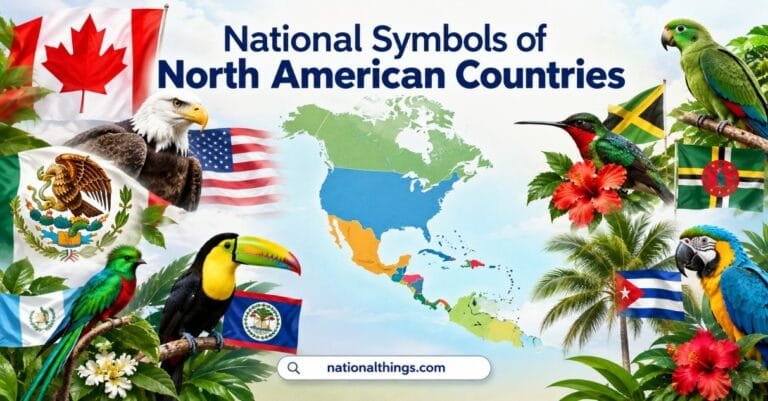
North America includes Canada, the United States, Mexico, and countries in Central America and the Caribbean. Each sovereign country has its own official state symbols and emblem traditions.
National Emblems of North American Countries
National Emblems of Northern American Countries
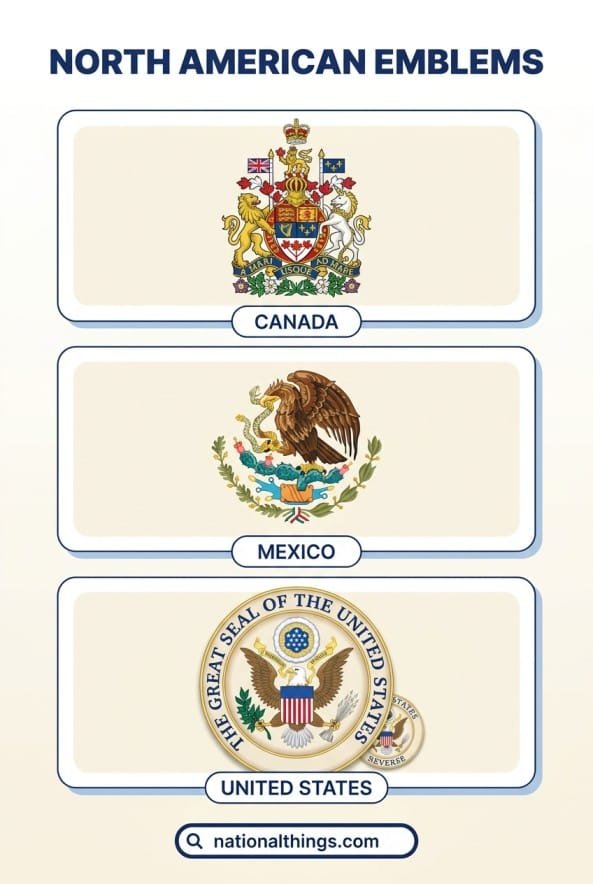
Canada, the United States, and Mexico are the major countries in the northern part of North America. Their official emblems and state insignia have different designs and legal roles.
Canada: The coat of arms features a shield with historical heraldic designs, supported by a lion and a unicorn.
Mexico: The national coat of arms features an eagle holding a snake while standing on a prickly pear cactus.
United States: The Great Seal features a bald eagle holding arrows and an olive branch, with a shield on its body and stars above.
National Emblems of Central American Countries
Central American countries include Belize, Guatemala, Honduras, El Salvador, Nicaragua, Costa Rica, and Panama. Their national emblems often incorporate elements associated with independence, geography, and national history.
Belize: The coat of arms features a shield supported by two woodcutters, with a mahogany tree above.
Costa Rica: The national coat of arms features three volcanoes, two oceans, and ships.
El Salvador: The national emblem features a triangle containing five volcanoes, a rising sun, and other elements.
Guatemala: The coat of arms includes a quetzal, crossed rifles, swords, and a scroll.
Honduras: The coat of arms features a triangle, mountains, tools, and other national elements.
Nicaragua: The coat of arms features a triangle containing five volcanoes, a rainbow, and a rising sun.
Panama: The coat of arms contains a shield divided into sections with symbols of national life and history.
National Emblems of Caribbean Countries
Caribbean countries include Jamaica, Cuba, Haiti, the Dominican Republic, and several island nations. Their official emblems feature distinctive designs linked to their national histories and identities.
Antigua and Barbuda: The coat of arms features a shield with a rising sun, a sugar mill, and supporting deer.
The Bahamas: The coat of arms features a ship and a rising sun, supported by a marlin and a flamingo.
Barbados: The coat of arms features a bearded fig tree and two supporters.
Cuba: The coat of arms features a key, a rising sun, and landscape elements.
Dominica: The coat of arms features a shield supported by two sisserou parrots.
Dominican Republic: The coat of arms features a Bible, a cross, and a shield in the national colors.
Grenada: The coat of arms features a shield divided into four sections, supported by an armadillo and a pigeon.
Haiti: The coat of arms features weapons, flags, a palm tree, and a cap of liberty.
Jamaica: The coat of arms features a shield with a red cross and pineapples, supported by a man and a woman.
Saint Kitts and Nevis: The coat of arms features a shield with a sailing vessel, a flower, and other national elements.
Saint Lucia: The coat of arms features a shield divided into sections with a rose, a fleur-de-lis, and supporting figures.
Saint Vincent and the Grenadines: The coat of arms features two women and a central altar.
Trinidad and Tobago: The coat of arms features a shield, two hummingbirds, and three ships.
National Emblems of South American Countries
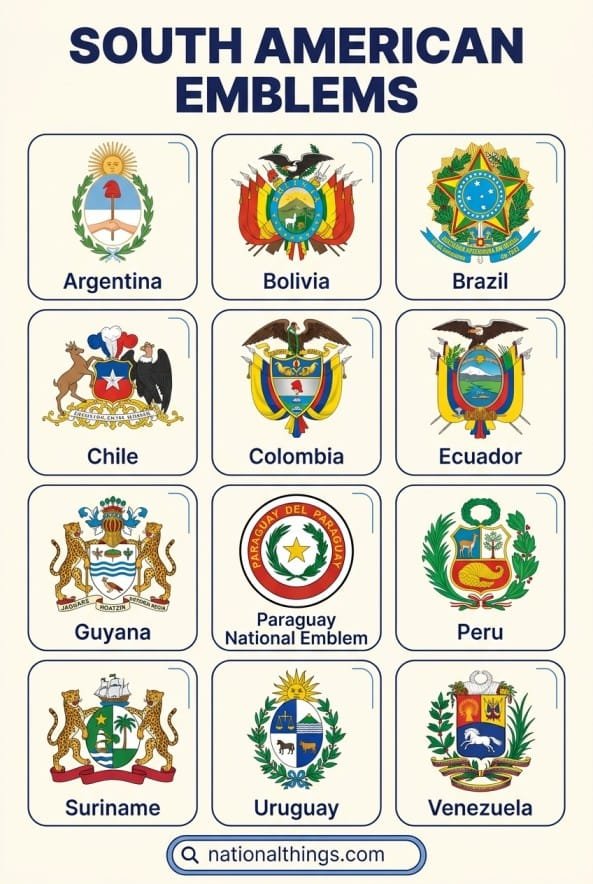
South America includes countries such as Argentina, Brazil, Chile, Colombia, Peru, and Uruguay. Their national emblems feature different heraldic designs and symbols associated with their states.
National Emblems of South American Countries
National Emblems of South American Countries A–G
Argentina: The coat of arms features two hands holding a pike topped by a Phrygian cap, with a rising sun and laurel branches.
Bolivia: The coat of arms features Mount Potosí, an alpaca, a sheaf of wheat, a palm tree, and other national elements.
Brazil: The coat of arms features a blue circle with stars, surrounded by a large star and branches representing coffee and tobacco.
Chile: The coat of arms features a shield divided into blue and red sections, with a star and two animal supporters.
Colombia: The coat of arms features a condor above a shield containing a pomegranate, a Phrygian cap, and a representation of the country’s oceans.
Ecuador: The coat of arms features Mount Chimborazo, a river, a steamship, and a condor.
Guyana: The coat of arms features a shield with a water lily, three wavy lines, and a bird, supported by two jaguars.
National Emblems of South American Countries P–V
Paraguay: Paraguay uses distinct designs on the front and reverse of its national seal. The front features a star surrounded by a palm branch and an olive branch.
Peru: The coat of arms features a vicuña, a cinchona tree, and a cornucopia filled with coins.
Suriname: The coat of arms features two Indigenous supporters, a shield divided into sections, and a star.
Uruguay: The coat of arms features a sun above a shield containing a horse, scales, Mount Montevideo, and a bull.
Venezuela: The coat of arms features a shield with a horse and agricultural elements.
National Emblems of Oceanian Countries
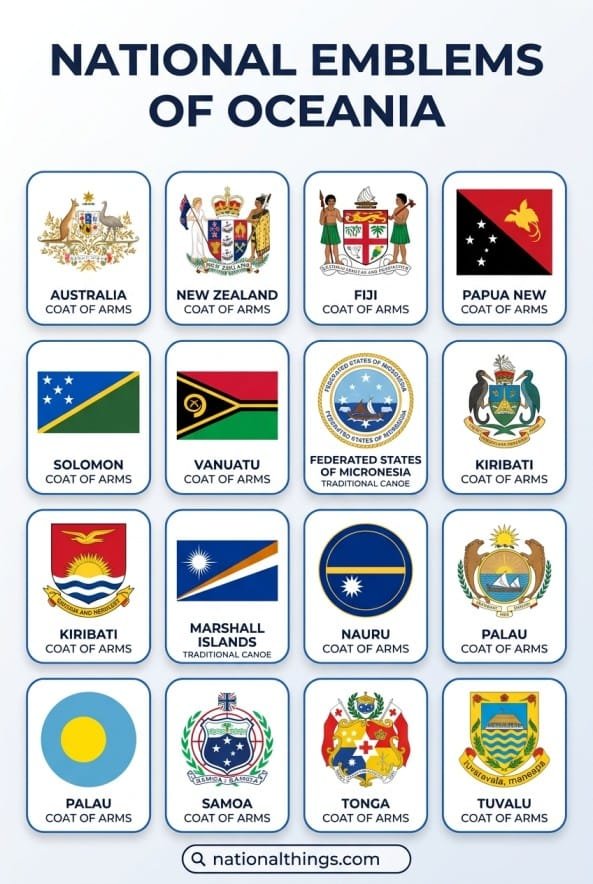
Oceania includes Australia, New Zealand, Papua New Guinea, Fiji, Samoa, and other Pacific nations. Their official emblems reflect different national histories, cultural traditions, and government systems.
National Emblems of Oceanian Countries
National Emblems of Australia and New Zealand
Australia: The Commonwealth Coat of Arms features a shield with the badges of Australia’s six states, supported by a kangaroo and an emu. A seven-pointed Commonwealth Star appears above the shield.
New Zealand: The coat of arms features a shield supported by a European woman and a Māori man, with a crown above.
National Emblems of Melanesian Countries
Fiji: The coat of arms features a shield with a lion, a cacao pod, sugar cane, coconuts, and a dove.
Papua New Guinea: The national emblem features a bird of paradise above a traditional drum and spear.
Solomon Islands: The coat of arms features a shield with a frigatebird, an eagle, a turtle, and traditional weapons.
Vanuatu: The national emblem features a Melanesian warrior holding a spear, supported by boar tusks and leaves.
National Emblems of Micronesian Countries
Federated States of Micronesia: The national seal features a blue field, four white stars, and official text around the design.
Kiribati: The coat of arms features a frigatebird above a rising sun and wavy lines representing the ocean.
Marshall Islands: The national seal features a traditional navigation design, a star, and official text.
Nauru: The coat of arms features a shield divided into sections with a frigatebird, phosphate minerals, and a plant.
Palau: The national seal features a traditional meeting house, representing the country’s political and cultural heritage.
National Emblems of Polynesian Countries
Samoa: The coat of arms features a shield with a cross, stars, and other elements associated with national identity.
Tonga: The coat of arms features a shield divided into sections, a crown, and other royal elements.
Tuvalu: The coat of arms features a shield with a traditional meeting house, supported by cultural and decorative elements.
Countries Without a Formally Designated National Emblem
Some countries do not have a separate official design formally named a national emblem. They may use a coat of arms, a government seal, or another form of official insignia instead.
Japan is one example: its chrysanthemum seal is associated with the imperial household, rather than serving as a separately designated national emblem. France also uses republican insignia without a single national coat of arms equivalent to those of many European countries.
Political changes can affect official state designs. Afghanistan, Libya, and Syria require particular care because their insignia have changed during periods of political transition. The legal status and date of a design are essential to describing it accurately.
How National Emblems Differ Across Countries
National emblems vary in shape, design, and official purpose. Common elements include shields, birds, stars, plants, monuments, and traditional objects, but their meanings depend on each country’s history and official explanations.
Shields often display heraldic designs or identify a country’s state insignia.
Birds and animals may reflect national history, heraldic traditions, or documented cultural meanings.
Stars can represent political ideals, unity, or historical traditions.
Plants and crops may refer to agriculture, natural resources, or national heritage.
Buildings and monuments can identify important places or events in national history.
Tools and weapons may represent labor, defense, independence, or other documented ideas.
The legal purpose also differs. India’s State Emblem is based on an ancient sculpture. The United States uses its Great Seal for official government authentication. Australia’s Commonwealth Coat of Arms represents the Commonwealth and its states. These are related forms of official insignia, but they do not have identical legal roles.
Trusted and External Resources
Explore reliable references to learn more about national emblems,
coats of arms, and official country insignia.
Verification note: National emblems and official coats of arms
may change. For the latest approved design, check the relevant country’s
official government, presidency, or heraldic authority website.
Conclusion
National emblems and equivalent state insignia represent countries through official designs linked to government, history, and national identity. Their forms range from heraldic shields and eagles to monuments, stars, and traditional cultural elements.
Understanding these designs requires attention to each country’s official terminology and legal status. A coat of arms, state seal, and national emblem may serve related purposes, but they are not automatically interchangeable. Reliable country-by-country descriptions help readers understand what each design represents and how the country officially uses it.