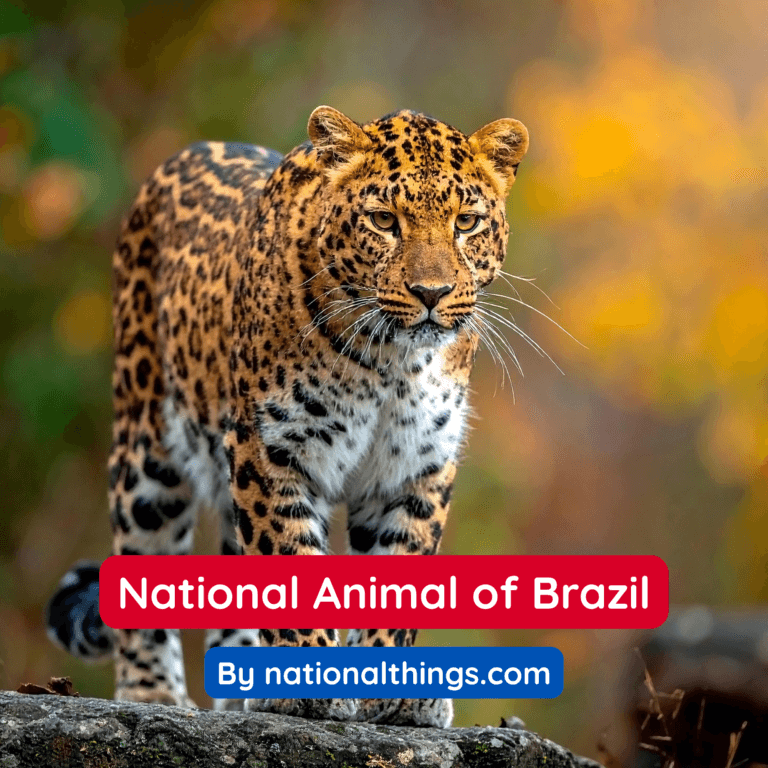
National Animal of Brazil: Onça-pintada
Every country has symbols that represent its culture, nature, and identity. For Brazil, one of the most important symbols is…
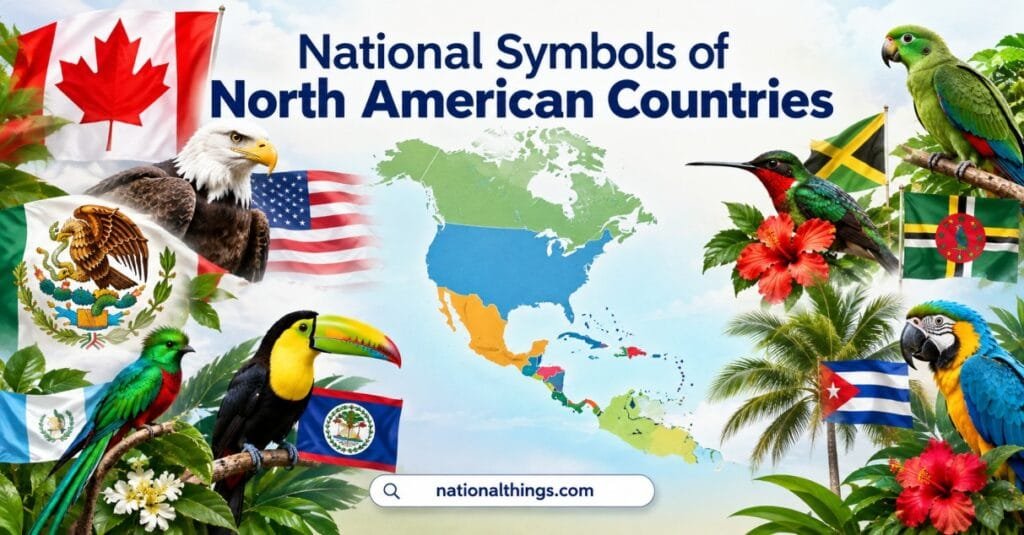
National symbols of North America tell stories about identity, history, land, independence, and culture. A maple leaf can represent Canada, an eagle and cactus can identify Mexico, and a Sisserou parrot can represent Dominica. These symbols are not simply decorative images. Many have links to national history, natural life, Indigenous heritage, or independence.
North America has 23 sovereign countries under the geographic classification used in this article. They include Canada, the United States, Mexico, the seven countries of Central America, and 13 sovereign Caribbean countries. The International Organization for Migration also describes the wider Central America, North America, and Caribbean region as containing 23 countries.
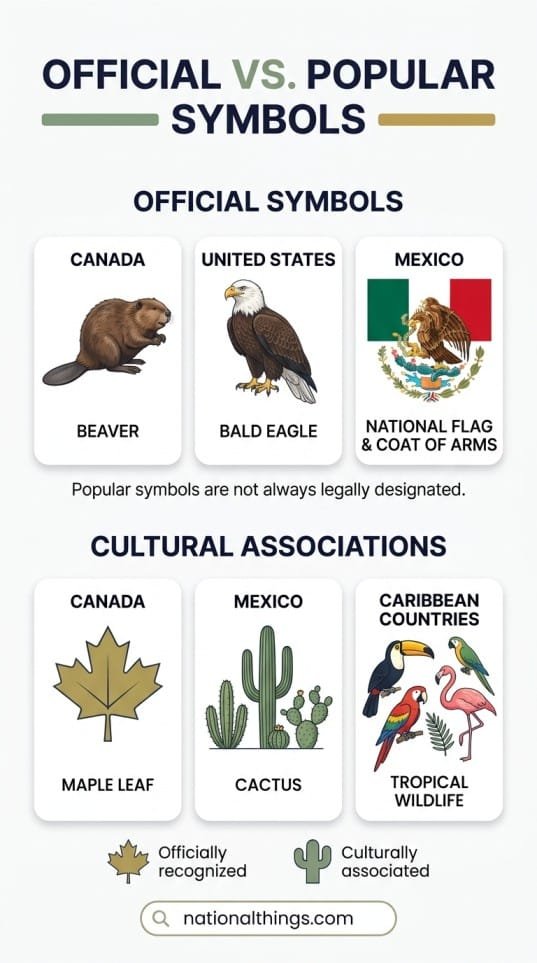
The important point is that countries do not all use the same types of symbols. Some have officially designated national animals, birds, flowers, or trees. Others have symbols that are famous among their people but do not have the same legal status. This article separates official symbols from popular and cultural symbols so the information remains clear.
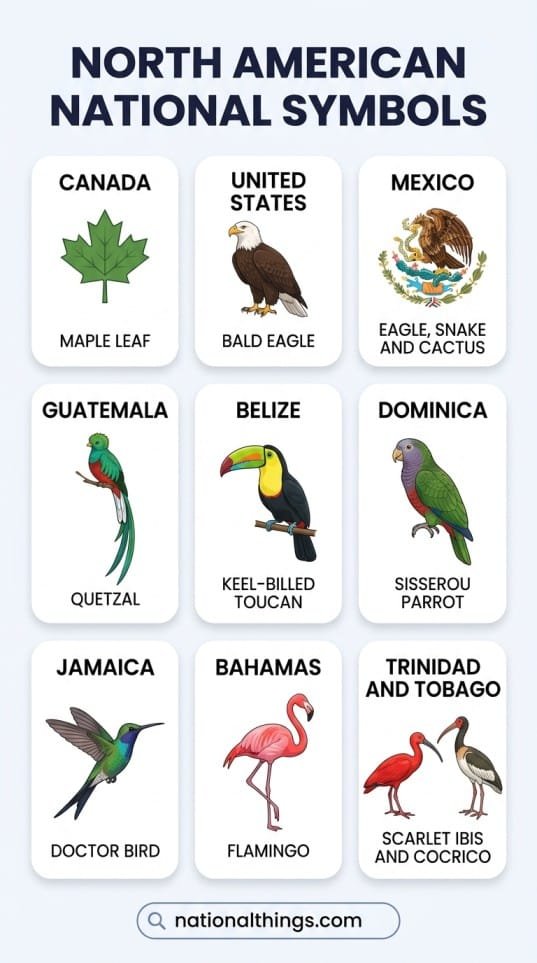
A national symbol is an object, image, living species, song, phrase, or design that represents a country and its people. Governments may formally recognize some symbols through laws, proclamations, constitutions, or official declarations. Other symbols become important through long public use.
Common categories include:
The legal status matters. Canada, for example, officially recognizes the beaver as a national symbol under the National Symbol of Canada Act, while the maple leaf has become one of the country’s best-known symbols through both official and historical use.
Mexico provides another clear example. Its law identifies the flag, coat of arms, and national anthem as the country’s three national patriotic symbols.
The 23 sovereign countries covered here are:
For practical geographic organization, these countries can be grouped into Northern North America, Central America, and the Caribbean. Different statistical systems use somewhat different regional boundaries. For example, the UN statistical system places Mexico in Central America, while many school and general geography sources group Canada, the United States, and Mexico together as the three large countries of northern North America.
North America also contains many non-sovereign territories and dependencies. Greenland, Puerto Rico, Bermuda, Aruba, Curaçao, and the U.S. Virgin Islands are geographically associated with North America, but they are not counted as independent sovereign countries in the 23-country list.
Central America and the Caribbean are also important parts of the continent. They are sometimes discussed separately because of their distinct geography, history, and cultures, but their countries are geographically part of North America.
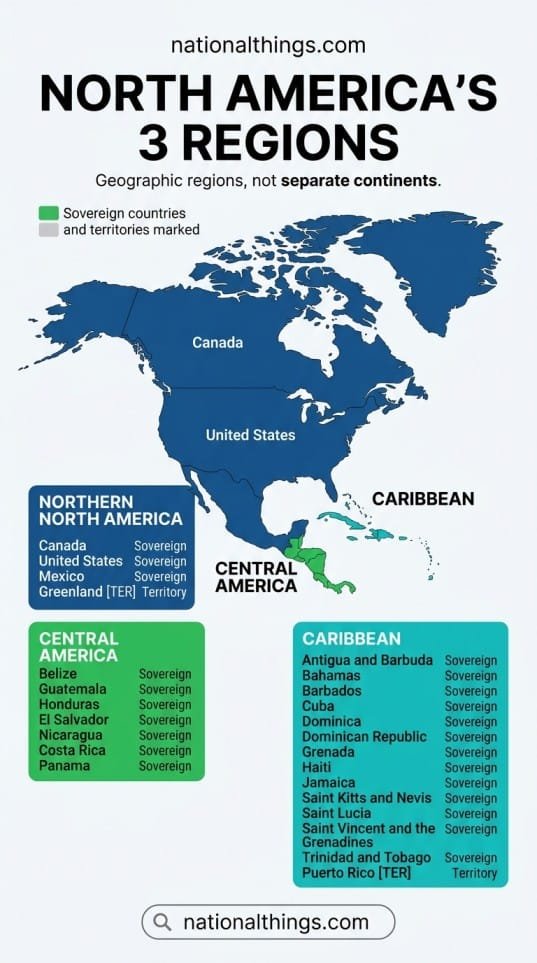
The national symbols of North America become easier to understand when the continent is divided into its major geographic regions. The northern countries contain large temperate and Arctic environments, Central America has strong Indigenous and tropical influences, and the Caribbean has extensive island, African, Indigenous, European, and maritime traditions.
Canada, the United States, and Mexico occupy the northern and mainland part of the continent. Their symbols show three very different historical traditions.
Indigenous heritage remains important in all three countries. European colonization also influenced their flags, coats of arms, languages, and political symbols. Wildlife and plants play a particularly strong role in national identity.
Canada’s most recognizable national symbol is the maple leaf, which appears at the centre of its red and white national flag. The flag was first raised on Parliament Hill on February 15, 1965. The maple tree was later proclaimed Canada’s national arboreal emblem in 1996.
Important Canadian symbols include:
The beaver has an especially interesting history. It became an official symbol in 1975, but Canadians had used it as a national emblem long before then. Its importance grew during the fur trade, when beaver pelts became a major part of Canada’s early economic history.
The United States uses a combination of constitutional, governmental, military, historical, and natural symbols. Its best-known symbols include the national flag and the Great Seal of the United States.
Key symbols include:
The bald eagle became the national bird in 1782. The American bison received national mammal status much later, in 2016. The distinction is important because a national bird, national mammal, national flower, and national tree are separate designations.
State symbols should not be confused with national symbols. Each U.S. state has its own official bird, flower, tree, and other symbols.
Mexico has one of North America’s clearest examples of a national symbol carrying Indigenous historical meaning. The country’s three legally recognized patriotic symbols are the national flag, national coat of arms, and national anthem.
Key symbols include:
The imagery connects modern Mexico with the Mexica foundation story associated with Tenochtitlan. Government sources describe the eagle, cactus, and serpent as important parts of this national historical symbolism.
Central America contains seven sovereign countries in the commonly used geographic grouping: Belize, Guatemala, Honduras, El Salvador, Nicaragua, Costa Rica, and Panama.
Their symbols often combine Indigenous heritage, Spanish colonial history, tropical biodiversity, independence movements, agriculture, and regional geography. Birds are especially prominent among their national symbols.
Belize has symbols that strongly reflect its forest resources and multicultural history.
Major symbols include:
The mahogany tree has particular importance because timber played a major role in Belize’s economic history. The coat of arms therefore connects national identity with the country’s forest heritage.
Costa Rica’s national symbols reflect peace, biodiversity, agriculture, and national identity.
Important symbols include:
The Guanacaste tree is particularly significant because it represents the country’s natural heritage and is strongly associated with the landscape of Costa Rica.
El Salvador’s national symbols combine national history, agriculture, biodiversity, and Central American identity.
Major symbols include:
The coat of arms contains imagery connected with the country’s geography and independence history, while the izote and maquilishuat represent important elements of the country’s natural environment.
Guatemala has one of Central America’s most distinctive national animals: the resplendent quetzal.
Key symbols include:
The quetzal has deep importance in Maya traditions and modern Guatemalan identity. The ceiba also has Indigenous cultural importance, making Guatemala’s national symbolism strongly connected to its pre-colonial heritage.
Honduran symbols emphasize nature, national independence, and Central American heritage.
Major symbols include:
The five stars on the flag are especially important. They represent the five Central American countries that formed the former Federal Republic of Central America.
Nicaragua’s national symbols include several species closely connected with its tropical landscape.
Major symbols include:
The volcanoes and surrounding water shown in the coat of arms reflect Nicaragua’s geography. The country’s national flower and bird also demonstrate how natural species can become strong cultural markers.
Panama’s symbols connect geography, independence, biodiversity, and national identity.
Important symbols include:
The harpy eagle is particularly important because it is a powerful native bird associated with Panama’s forests. The country’s location between two oceans also appears in its national imagery.
The Caribbean contains 13 sovereign countries in the geographic grouping used here. Their symbols often reflect island geography, slavery and emancipation, independence, African heritage, Indigenous history, Christianity, agriculture, and marine ecosystems.
Major national symbols include:
The flag’s rising sun represents the dawn of a new era, while the coat of arms preserves links to sugar production and the country’s agricultural history.
The Bahamas uses symbols closely linked to its island geography and marine environment.
Major symbols include:
The flamingo is particularly associated with the Bahamas because large populations occur in the islands, especially on Great Inagua.
Barbados combines marine imagery, agriculture, national pride, and colonial history.
Important symbols include:
The coat of arms gives a useful example of how several symbols can appear together. The sugar cane reflects the island’s historic sugar industry, while the dolphin represents fishing.
Cuban symbols strongly reflect independence, national identity, tropical nature, and republican history.
Major symbols include:
The royal palm is especially recognizable across Cuba’s landscape and has become a powerful cultural image of the country.
Dominica is famous for its Sisserou parrot, which appears directly on the national flag.
Key symbols include:
The flag’s ten green stars represent the country’s ten parishes, while the Sisserou parrot represents national identity and aspiration.
The coat of arms also uses agricultural and maritime imagery. Its motto means “After God, the Earth,” placing the land and agriculture at the centre of the country’s identity.
The Dominican Republic has some of the most recognizable religious and historical imagery among Caribbean national symbols.
Major symbols include:
The Bible and cross on the coat of arms reflect the country’s Christian tradition. The palmchat is a particularly distinctive national bird because it is endemic to the island of Hispaniola.
Grenada’s symbols reflect its Caribbean landscape, agriculture, and spice-growing history.
Important symbols include:
The nutmeg on the flag is especially distinctive. Grenada has long been associated with nutmeg production, which explains the spice’s place in national imagery.
Haiti’s national symbols strongly reflect independence and the struggle to build a sovereign state.
Major symbols include:
The palm tree in the coat of arms carries a liberty-cap image and sits above a trophy of weapons. The design therefore connects national identity with the country’s revolutionary history.
Jamaica has a strong set of officially recognized national symbols connected with nature, independence, work, and national pride.
Major symbols include:
The doctor bird is endemic to Jamaica and is one of the country’s most distinctive natural symbols. The national motto also reflects Jamaica’s population and cultural diversity.
Saint Kitts and Nevis has a particularly detailed set of national symbols.
Important symbols include:
The two white stars on the flag represent hope and liberty. The government also identifies the Poinciana as the national flower and the brown pelican as the national bird.
Saint Lucia’s symbols emphasize island geography, cultural heritage, and the country’s distinctive national bird.
Major symbols include:
The coat of arms brings together African, French, and British historical influences. The Saint Lucia parrot is especially significant because it is endemic to the island.
Saint Vincent and the Grenadines uses symbols connected with island geography, tropical nature, and independence.
Major symbols include:
The three diamonds are one of the flag’s most distinctive features. They form a V pattern and give the flag a strong visual identity.
Trinidad and Tobago has a rich group of symbols reflecting African heritage, Caribbean wildlife, cultural diversity, and national creativity.
Major symbols include:
The steelpan has an important official status. Trinidad and Tobago’s National Musical Instrument Act 2024 formally recognized it as the national instrument. The coat of arms was also redesigned in 2024, replacing the ships associated with Christopher Columbus with a steelpan.
The Chaconia is the national flower and is native to Trinidad and Tobago. Its red colour also connects it visually with the country’s flag and other national emblems.
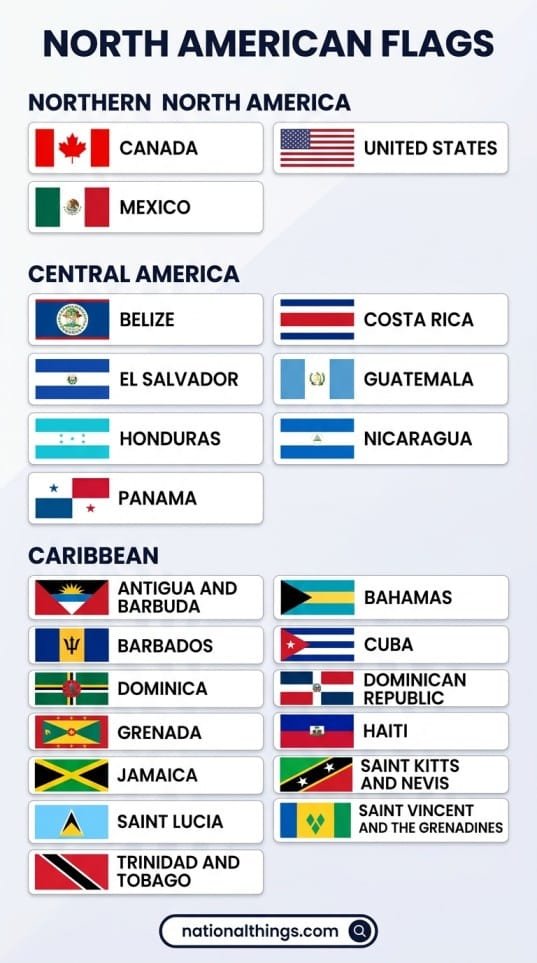
North American flags show several recurring ideas, but they do not all use the same historical language.
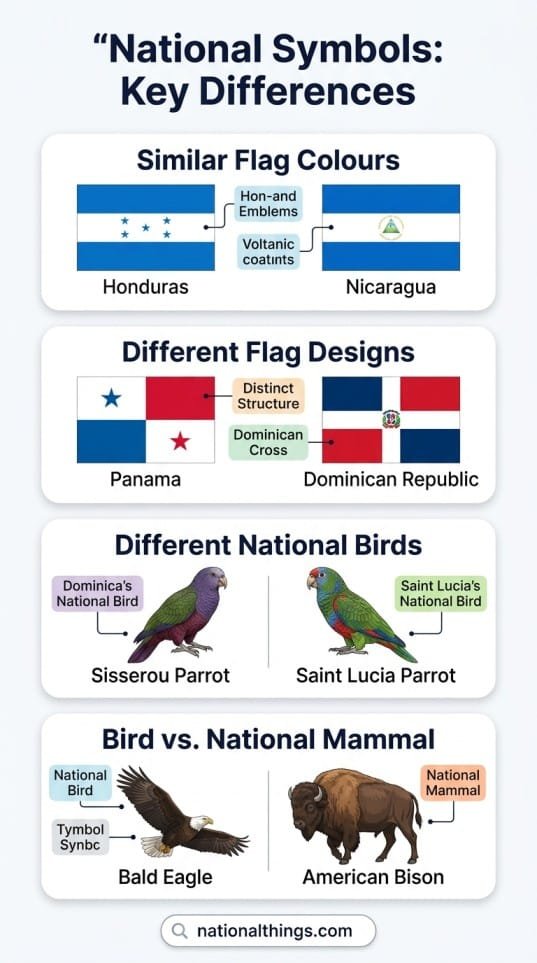
Several flags can look similar at first glance. The Dominican Republic and Panama both use red, white, and blue, but their layouts and symbols are different. Central American flags also share blue and white because of the historical influence of the former Federal Republic of Central America.
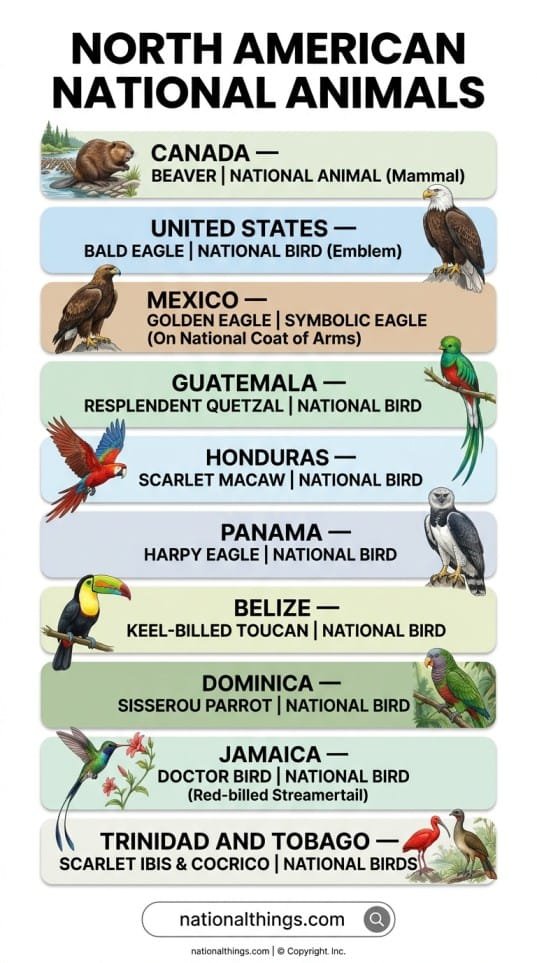
Animals and birds provide some of the clearest examples of how countries connect national identity with nature.
Examples include:
These examples also show why the term national animal should not be used loosely. A country may have an official national bird but no legally designated national animal. Another country may have a famous animal strongly associated with national identity without giving it a formal legal title.
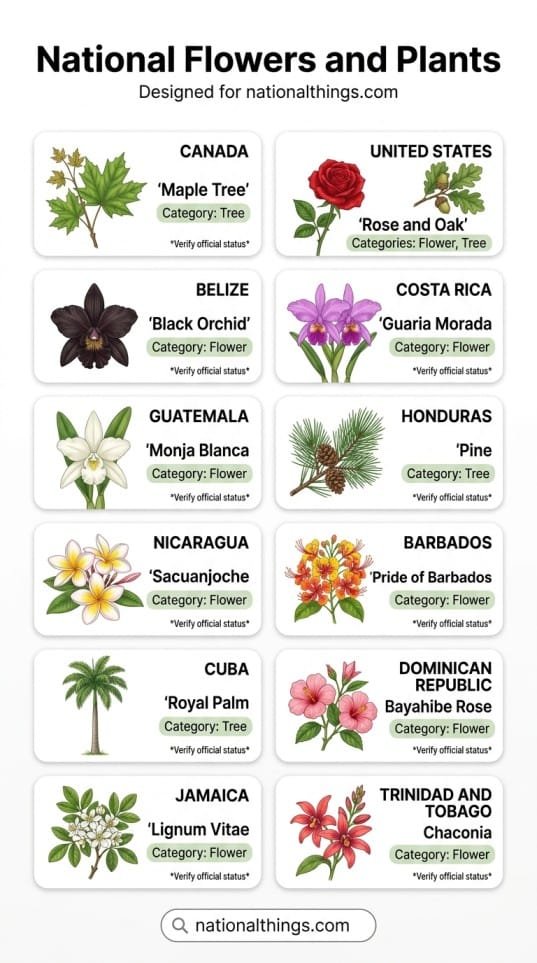
Plants are another major category of North American national symbolism. They often reflect local ecosystems, agriculture, Indigenous knowledge, or economic history.
Examples include:
A plant can have a powerful national association without being a formal national symbol. For this reason, a reliable article should always identify the official status instead of simply repeating a common internet label.
A national emblem is a broad term for an official design representing a country. A coat of arms is a specific type of heraldic design with established rules and elements. A state seal may serve a similar governmental purpose but is not automatically the same thing as a coat of arms.
North American coats of arms commonly include:
Mexico’s coat of arms is built around the eagle, serpent, cactus, rock, and water imagery. Canada’s arms use heraldic elements representing the country’s historical connections. Trinidad and Tobago’s coat of arms uses national birds and other symbols tied to the country’s history and environment.
These designs often contain more information than a flag because they can combine several historical events and cultural influences into one image.
National anthems and mottos communicate ideas that flags and animals cannot always express. Anthems often focus on freedom, national unity, independence, courage, peace, or loyalty.
Examples include:
Mottos also show national priorities. Saint Kitts and Nevis uses “Country Above Self,” while Jamaica uses “Out of Many, One People.” Dominica’s motto places the earth after God, reflecting the importance of land and agriculture. Trinidad and Tobago’s motto focuses on aspiration and achievement together.
Despite major cultural differences, several patterns appear across the continent.
Nature is a major source of national identity. Countries select birds, mammals, flowers, and trees that are native, visually distinctive, historically important, or closely connected with local life.
Indigenous heritage also appears in many symbols. Mexico’s eagle, cactus, and serpent imagery has pre-Hispanic roots. Guatemala’s quetzal has deep Maya associations. Other countries include Indigenous figures or references in their coats of arms and national histories.
Independence is another repeated theme. Flags, stars, weapons, shields, and anthems often preserve memories of independence struggles or the creation of modern states.
Agriculture and natural resources matter strongly in Central America and the Caribbean. Sugar cane, mahogany, bananas, nutmeg, palms, orchids, and tropical birds appear in many national symbols.
The differences are just as important as the similarities.
Canada’s symbolism often emphasizes the maple, northern landscape, and constitutional history. Mexico places greater emphasis on Indigenous historical imagery and the foundation of Tenochtitlan. The United States uses symbols connected with federal government, liberty, independence, and republican history.
Central American countries frequently combine Indigenous heritage, Spanish colonial history, mountains, volcanoes, tropical wildlife, and independence. Caribbean countries often give stronger visual importance to island landscapes, marine life, African heritage, slavery and emancipation, agriculture, and independence.
This is why two countries can use the same colour or a similar animal without having the same national meaning.
The safest way to describe a national symbol is to identify its status.
Canada provides a useful example because its government separately discusses official and unofficial symbols. The maple leaf is deeply associated with Canadian identity, while different symbols have different formal statuses.
This distinction prevents a common problem in national-symbol articles: presenting a popular internet claim as if a government officially declared it.
Some symbols create confusion because countries share colours, animals, historical influences, or ecosystems.
A shared symbol does not mean that two countries copied one another. Similar environments and connected histories can produce similar national imagery.
Central America is geographically treated as a subregion of North America. Its seven commonly listed sovereign states stretch from Belize and Guatemala to Panama.
The Caribbean also forms a subregion of North America in the geographic classification used here. Its 13 sovereign states are mainly island countries.
Mexico creates a classification issue because some statistical systems place it within Central America, while many school geography systems group it with Canada and the United States. The important point is to state the classification being used instead of presenting one system as the only possible system.
| Country | Major National Symbol | National Bird or Animal | Flower or Plant Symbol | Emblem, Anthem, or Motto |
|---|---|---|---|---|
| Canada | Maple leaf | Beaver | Maple tree | O Canada |
| United States | Stars and Stripes | Bald eagle, American bison | Rose, oak | Great Seal |
| Mexico | Eagle, serpent, cactus | Golden eagle imagery | Nopal cactus | Flag, coat of arms, anthem |
| Belize | Coat of arms | Baird’s tapir, keel-billed toucan | Black orchid, mahogany | Land of the Free |
| Costa Rica | Coat of arms | Clay-colored thrush | Guaria morada, Guanacaste | Noble patria |
| El Salvador | Coat of arms | Turquoise-browed motmot | Izote, maquilishuat | National anthem |
| Guatemala | Quetzal and coat of arms | Resplendent quetzal | Monja blanca, ceiba | National anthem |
| Honduras | Five-star flag | Scarlet macaw | Orchid, pine | National anthem |
| Nicaragua | Blue and white flag | Turquoise-browed motmot | Sacuanjoche, madroño | National anthem |
| Panama | Four-quarter flag | Harpy eagle | Holy Spirit orchid | National anthem |
| Antigua and Barbuda | Rising sun flag | Frigatebird | Red hibiscus | Each Endeavouring, All Achieving |
| Bahamas | Aquamarine and gold flag | Flamingo | Yellow elder | Forward, Upward, Onward Together |
| Barbados | Broken trident flag | Pelican association | Pride of Barbados, bearded fig | Pride and Industry |
| Cuba | Lone star flag | Cuban trogon | Mariposa, royal palm | La Bayamesa |
| Dominica | Sisserou parrot flag | Sisserou parrot | Tropical plant symbols | Après Bondie, C’est La Ter |
| Dominican Republic | Cross and shield | Palmchat | Bayahibe rose, royal palm | National anthem |
| Grenada | Nutmeg flag | Grenada dove | Bougainvillea | National motto and anthem |
| Haiti | Coat of arms | Hispaniolan trogon | Hibiscus, royal palm | La Dessalinienne |
| Jamaica | Gold saltire flag | Doctor bird | Lignum vitae, blue mahoe | Out of Many, One People |
| Saint Kitts and Nevis | Two-star flag | Brown pelican | Poinciana | Country Above Self |
| Saint Lucia | Triangle flag | Saint Lucia parrot | National floral symbols | The Land, The People, The Light |
| Saint Vincent and the Grenadines | Three-diamond flag | Saint Vincent parrot | National floral symbols | Saint Vincent Land So Beautiful |
| Trinidad and Tobago | Black diagonal stripe | Scarlet Ibis and Cocrico | Chaconia | Together We Aspire, Together We Achieve |
Reliable research matters because national-symbol information is often copied from one website to another without checking the original source.
Use this process:
Government sources show why this level of checking matters. Canada, for example, explicitly separates its official and unofficial national symbols, while Mexico’s government clearly identifies its three legally defined patriotic symbols.
Explore these reliable resources to learn more about national flags, animals, plants, emblems, anthems, and the history behind national symbols. Official sources are especially useful for checking whether a symbol has formal government recognition or is mainly associated with national culture.
Research note: National symbols can have different legal statuses. Check each country’s official government sources before describing an animal, bird, flower, tree, or emblem as an officially designated symbol.
North America’s national symbols reveal the continent’s historical and cultural diversity. Canada’s maple leaf and beaver connect identity with nature and economic history. Mexico’s eagle, serpent, and cactus connect the modern state with Indigenous history. Central American symbols often combine tropical wildlife, volcanoes, Indigenous heritage, and independence. Caribbean symbols frequently highlight island ecosystems, African heritage, agriculture, emancipation, and national independence.
The most important distinction is between official symbols and popular symbols. A bird, flower, animal, or food may be strongly associated with a country without having an official legal designation. Checking government and other authoritative sources prevents these differences from being lost.
For readers, comparing these symbols offers more than a list of flags and animals. It shows how countries use nature, history, culture, and national memory to express who they are.