


National Fruit of Canada – Interesting History and Facts
Many people search for the national fruit of Canada, but there is an important fact to understand first: Canada does…
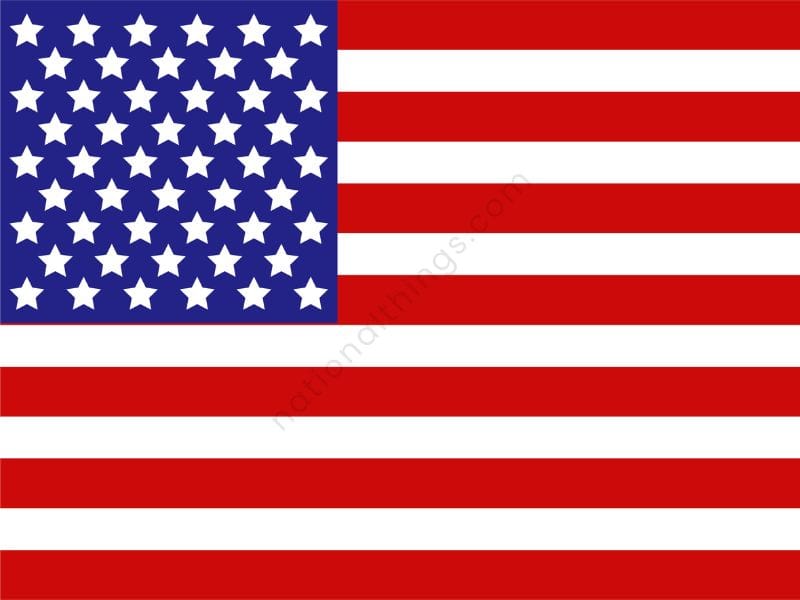
National Flag of USA is one of the most recognized national flags in the world. Its design has 50 white stars, 13 red and white stripes, and a dark blue rectangle in the upper corner. Each part records an important stage in the growth of the United States.
The present flag became official on July 4, 1960, after Hawaii joined the country as its 50th state. The stars represent the current states. The stripes preserve the memory of the 13 original colonies that declared independence from Great Britain.
This article explains the design, history, colors, dimensions, names, and rules connected with the American flag. It also clears up common confusion about Betsy Ross, the Star-Spangled Banner, military flag patches, and the meaning of the colors.
The flag does not have a separate ceremonial name under federal law. Official documents normally call it the flag of the United States or the flag of the United States of America. “National Flag of USA” is a common search term, but it is not the formal wording used in most federal documents.
The American flag is also one of the main national symbols of the USA. It represents the country as a whole. State flags, military flags, presidential flags, and agency banners have different purposes and do not replace it.
Americans often call the flag the Stars and Stripes because of its two main design elements. Another familiar nickname is Old Glory. Sea captain William Driver helped popularize that name during the 19th century.
The name Star-Spangled Banner can create confusion. It may refer to:
These names are widely used, but they do not describe separate versions of the current national flag.
The national flag of USA has 13 horizontal stripes. Seven are red and six are white. A blue rectangle occupies the upper corner nearest the flagpole. This rectangle contains 50 white five-pointed stars.
Several basic flag terms help readers understand its construction:
The flag begins with a red stripe at the top and ends with a red stripe at the bottom. Red and white alternate throughout the design. Each stripe has the same height.
The stripes cross the full width of the flag. However, the upper seven stripes appear partly behind the blue union. The remaining six stripes run fully from the hoist to the fly.
The blue rectangle appears in the upper hoist corner. Americans commonly call it the union because its stars represent the states united under one federal government.
The union is not the same as the Great Seal of the United States. The Great Seal contains an eagle, a shield, an olive branch, arrows, and other symbols. None of those elements appear on the national flag.
The union contains 50 equal white stars. Each star has five points. The stars appear in nine staggered horizontal rows.
Their arrangement follows this pattern:
This staggered design creates a balanced field without placing the stars in a simple square block.
The stars and stripes represent two different periods of American history. The 50 stars show the United States today, while the 13 stripes recall its beginning as a group of former British colonies.
The number of stars can change when the country admits a new state. The number of stripes remains fixed at 13.
Each star represents one U.S. state. Together, the stars show the political union of all 50 states.
They do not represent:
Washington, D.C., Puerto Rico, Guam, the U.S. Virgin Islands, American Samoa, and the Northern Mariana Islands do not have individual stars because they are not states.
The stripes represent the 13 British colonies that declared independence in 1776. These colonies became the first states of the United States:
The order above follows the dates on which the states ratified the U.S. Constitution. It is not the order in which the colonies were founded.
Federal law provides a clear rule for adding a state. A new star enters the flag on the first July 4 after admission. The change does not always happen on the exact date when the state joins the Union.
For example, Hawaii entered the United States on August 21, 1959. The 50th star appeared officially on July 4, 1960. If a 51st state entered the Union, the flag would receive another star on the following July 4. It would still have 13 stripes.
The USA flag’s colors are red, white, and blue. People often repeat simple meanings for each color. However, readers should understand the difference between historical government explanations and later popular interpretations.
The original Flag Resolution of 1777 did not provide a detailed meaning for each color. The best-known official-style explanation comes from Charles Thomson’s 1782 description of the colors used in the Great Seal of the United States.
Red is commonly linked with valor and bravery. Charles Thomson also connected it with hardiness.
Some modern explanations say that red represents the blood of soldiers or people who died for independence. That idea may appear in patriotic writing, but the 1777 Flag Resolution did not state it. Writers should not present it as the original legal meaning.
White traditionally represents purity and innocence. This meaning comes from the 1782 explanation associated with the Great Seal.
The color does not represent a particular state, religion, ethnic group, or region. It forms six stripes and all 50 stars.
Blue represents vigilance, perseverance, and justice in the traditional government explanation. It also forms the background of the union.
People sometimes call the shade “Old Glory Blue.” The exact color used in official production follows government specifications. Printed flags, fabric flags, and digital images may look slightly different because materials and screens reproduce color differently.
No. The resolution adopted on June 14, 1777, described 13 alternating stripes and 13 white stars in a blue field. It called the stars a “new constellation,” but it did not define the meaning of red, white, and blue.
The familiar meanings appeared in 1782, when Charles Thomson explained the colors used in the Great Seal. Because the seal used the same three colors, later government publications connected his explanation with the flag.
The federal design does not require one physical size. A desk flag and a large building flag can both follow the official design because the measurements use relative proportions.
The official construction system controls the flag’s width, height, canton, stripes, stars, and spacing. It prevents manufacturers from stretching the design or arranging the stars incorrectly.
The official hoist-to-fly proportion is 1 to 1.9. People often express this as a ratio of 10 to 19.
A flag measuring 10 feet in height would therefore measure 19 feet in length. Many commercial flags use ratios such as 2 to 3 because those dimensions are easier to manufacture. Such flags remain recognizable, but they do not match the precise federal construction sheet.
A specific government data point appears in Executive Order 10834 from the National Archives. It sets the flag’s hoist at 1.0 unit and its fly at 1.9 units.
Federal specifications use the flag’s height as the main unit. Important measurements include:
The star diameter describes the circle that would surround the five points of each star. The specifications also control the horizontal and vertical distance between star centers.
A commercially produced flag may use a different ratio and still function as an American flag. However, schools, publishers, designers, and government bodies should use the official star arrangement and stripe order.
Common design mistakes include:
These errors matter most in educational graphics and official displays.
The history of the USA flag follows the growth of the country. Each major change came from a new law, the admission of states, or a decision to standardize the design.
The United States has used 27 official star totals since 1777. The number did not increase for every state separately because several new states sometimes entered before the next flag update.
The Grand Union Flag appeared during the early American Revolution. It had 13 red and white stripes with the British Union flag in the canton.
This design showed that the colonies were acting together while they still had historical ties to Britain. It should not be confused with the flag adopted after independence because it had no field of American stars.
The Continental Congress adopted the first national flag resolution on June 14, 1777. It called for 13 alternating red and white stripes and 13 white stars in a blue field.
The resolution did not explain:
This lack of technical detail allowed several early designs to exist at the same time. The United States now observes Flag Day on June 14 because of this resolution.
Early flagmakers arranged the 13 stars in circles, rows, arches, and other patterns. Some used five-pointed stars. Others used stars with six or eight points.
The circular arrangement commonly connected with Betsy Ross became famous later. Congress did not select that pattern as the only legal layout. Early American flags could look different and still follow the short wording of the 1777 resolution.
Vermont and Kentucky joined the Union after the first 13 states. Congress added two stars and two stripes, creating a 15-star and 15-stripe flag in 1795.
This was the flag that flew over Fort McHenry during a British attack in September 1814. Francis Scott Key saw it after the bombardment and wrote the poem that became “The Star-Spangled Banner.”
Adding a new stripe for every state soon became impractical. A flag with dozens of narrow stripes would have been difficult to recognize and produce.
The Flag Act of 1818 restored the number of stripes to 13 permanently. Congress kept one star for each state and created the July 4 update rule.
The act produced a stable system:
This system still controls future changes.
By the early 20th century, flagmakers used several star layouts because no single detailed arrangement controlled production. President William Howard Taft issued an executive order in 1912 to standardize the 48-star flag.
The official design placed the stars in six horizontal rows of eight. It also established clearer proportions. The 48-star flag represented the country after the admission of Arizona and New Mexico.
Alaska became the 49th state on January 3, 1959. The 49-star flag became official on July 4 of that year.
Its stars appeared in seven rows of seven. This version lasted only one year because Hawaii entered the Union seven months after Alaska.
Hawaii became the 50th state on August 21, 1959. President Dwight D. Eisenhower prescribed the 50-star arrangement through Executive Order 10834 on the same date.
The design did not take effect immediately. It became official on July 4, 1960, under the existing rule for new states. This distinction explains why some sources mention 1959 while others give 1960.
The 50-star version is now the longest-serving American flag design. It has remained unchanged for more than six decades.
No single answer covers the full design history. The first flag emerged from a congressional resolution, early flagmakers produced different versions, and the federal government selected the modern arrangement.
Claims about individual designers need careful wording because historical records remain incomplete.
Betsy Ross was a real Philadelphia upholsterer and flagmaker. Her family later said that George Washington and other officials visited her in 1776 and asked her to produce a flag.
However, historians have not found contemporary documents proving that she created the first official national design. The story became widely known after her grandson presented it to the Historical Society of Pennsylvania in 1870.
Ross may have made early American flags. The evidence does not prove that she alone designed the first one.
Francis Hopkinson signed the Declaration of Independence and worked on several American symbols. In 1780, he requested payment from Congress for designing the United States flag and other public devices.
His request provides a documented link to early flag design. Congress did not pay him because officials said that several people contributed to the work. This makes it difficult to identify him as the sole confirmed designer.
The Eisenhower administration received many proposed arrangements for 49-star and 50-star flags. Government officials reviewed the submissions and selected a balanced staggered pattern.
Robert G. Heft is often credited in popular accounts. As a student, he created a 50-star design before Hawaii became a state and sent it to the federal government. His arrangement closely matched the final flag.
Federal records show that other people also submitted similar patterns. Executive Order 10834 gave the final design its legal status. It is therefore more accurate to describe the modern flag as an officially selected federal design rather than the undisputed work of one person.
The historic Star-Spangled Banner and the present flag are not the same design. The Fort McHenry flag had 15 stars and 15 stripes. The modern flag has 50 stars and 13 stripes.
The historic banner was also extremely large. Mary Pickersgill and her assistants made it for Fort McHenry in Baltimore. Its size allowed ships to see it from a distance.
Francis Scott Key saw the flag after the British attack in 1814. His poem later became the lyrics of the national anthem. Congress officially made “The Star-Spangled Banner” the U.S. national anthem in 1931.
The United States normally uses the same basic Stars and Stripes design for national civilian, government, and military identification. It does not maintain separate national civil and war flags in the same way as some countries.
However, the government and armed forces use many specialized flags. Their purpose depends on the office, service, vessel, or agency displaying them.
When a U.S. Navy ship flies the Stars and Stripes, the flag functions as the national ensign. The word “ensign” describes its maritime role.
It does not mean that the Navy uses a completely different national flag. The stars, stripes, colors, and proportions remain those of the United States flag.
The Navy union jack consists of the blue union and white stars taken from the national ensign. A Navy vessel may display it from a staff at the bow under specific conditions.
The union jack is a separate naval flag. It is not an alternative design for general national use.
The president, vice president, military services, and federal departments use their own official flags. These designs may contain:
Such flags identify an office or organization. They never replace the national flag as the symbol of the United States.
The U.S. Flag Code explains traditional standards for displaying and handling the flag. The rules help schools, homes, government buildings, businesses, and public events show it consistently.
The code gives detailed guidance, but several practical rules cover most everyday situations.
When the flag hangs flat against a wall, the union should appear uppermost and to the flag’s own right. To a person facing it, this normally means the upper left corner.
When displayed with another national flag, international practice usually gives both flags equal height and similar sizes. No national flag should appear below another during a peaceful international display.
A flag displayed vertically should not simply be rotated without checking the union. The blue field must remain in the correct upper position.
Half-staff means lowering the flag below the top of the pole as a sign of mourning or respect. The president can order federal flags to half-staff. State governors may issue orders within their states under defined circumstances.
The usual method is to raise the flag briefly to the top before lowering it. Before removal, it returns briefly to the top again.
The correct term on land is half-staff. On a ship, speakers often use half-mast.
The Flag Code says the flag should not appear with the union down except as a signal of dire distress involving extreme danger to life or property.
An upside-down flag is not an ordinary decorative variation. People may also use it as political expression, but that use differs from the traditional distress meaning stated in the code.
Customary practice displays the flag outdoors from sunrise to sunset. It may remain outside 24 hours a day when suitable lighting keeps it visible during darkness.
A small porch light may provide enough illumination for a home flag if it clearly lights the fabric. Large public flags usually need dedicated lighting.
Bad weather is another factor. The code advises against outdoor display during severe weather unless the flag uses an all-weather material.
The flag should not touch the ground, floor, water, or objects below it. If accidental contact occurs, the code does not require automatic destruction. A washable flag can be cleaned and used again if it remains in good condition.
A flag that becomes torn, faded, or unfit for display should receive a dignified retirement. Veterans’ groups, scouting organizations, fire departments, and community groups often conduct retirement ceremonies.
The familiar triangular fold is a respected custom. Popular explanations assigning a separate meaning to every fold are not part of federal law.
The Flag Code mainly provides standards of respect and proper practice. It does not create an automatic criminal punishment for every incorrect display by a private citizen.
The U.S. Supreme Court has also protected some uses of the flag as political expression under the First Amendment. This means that recommended etiquette and enforceable criminal law are not always the same thing.
Government employees, military personnel, and official institutions may still have binding workplace or service regulations.
A flag patch on the right shoulder of a military uniform may appear reversed because the union faces forward. This placement creates the visual effect of a flag moving forward in the wind as the service member advances.
A normal flag carried on a pole has the union nearest the pole. If the pole moved forward, the stripes would stream behind it. The right-shoulder patch copies that position.
The patch does not change the national design. It applies the flag to a moving uniform in a way that represents forward movement rather than retreat.
Several national flags use red and white stripes with a colored canton. Quick comparison prevents confusion.
The most useful details are the number of stripes, the canton symbol, the star count, and the flag ratio.
The Liberian flag has 11 red and white stripes and one white star in a blue canton. The United States flag has 13 stripes and 50 stars.
Liberia’s design has a historical connection with the United States. The country was established through the settlement of formerly enslaved and free Black people from the United States. Its flag still has its own national meaning and identity.
Key differences include the following:
Malaysia’s flag has 14 red and white stripes. Its blue canton contains a yellow crescent and a 14-point star.
The 14 stripes and star points represent the country’s federal members. The crescent connects with Islam. The yellow color represents royal authority.
The American flag has no crescent. Its 50 individual stars represent states rather than federal territories and states together.
Many familiar flag stories mix documented facts with legends. Clear distinctions make the history more accurate.
There is no surviving contemporary record proving that Betsy Ross designed the first national flag. She worked as a flagmaker, but the famous design story came from family testimony given many decades later.
President Eisenhower prescribed the design in 1959. It officially took effect on July 4, 1960. Both dates matter, but they describe different legal stages.
The flag had 15 stripes from 1795 until the Flag Act of 1818 restored the permanent total of 13. The Fort McHenry flag belonged to this 15-stripe period.
The 1777 resolution did not explain the colors. The common meanings come from Charles Thomson’s 1782 explanation of the Great Seal.
The original Star-Spangled Banner had 15 stars. It flew in 1814 when the United States had 18 states, but the flag had not yet received stars for every recent admission under the later 1818 system.
The national flag serves as the U.S. naval ensign. The Navy union jack and military service flags have separate functions, but they are not replacement national flags.
The traditional code meaning is dire distress involving extreme danger. It is not the standard orientation for ordinary display.
The current flag has 50 white stars. Each star represents one U.S. state.
The stripes represent the 13 original colonies that declared independence from Great Britain and became the first states.
President Eisenhower prescribed the design on August 21, 1959. It became official on July 4, 1960.
No single designer has been proved beyond doubt. Betsy Ross and Francis Hopkinson have strong links to early flag history, but the surviving evidence does not establish one undisputed creator.
Red traditionally represents valor and hardiness. White represents purity and innocence. Blue represents vigilance, perseverance, and justice. These meanings connect with the 1782 explanation of the Great Seal rather than the 1777 Flag Resolution.
The federal construction ratio is 10 to 19. This equals a hoist-to-fly relationship of 1 to 1.9.
A right-shoulder military patch places the union toward the front. This makes the flag look as though it is moving forward as the wearer advances.
It can mean both. The historic Star-Spangled Banner is the 15-star Fort McHenry flag. “The Star-Spangled Banner” is also the United States national anthem.
The national flag of the USA combines the country’s founding history with its present political structure. Its 13 stripes remember the original states. Its 50 stars show the states that form the modern union.
The design also records important changes in American history. It grew from loosely defined 13-star flags to a carefully measured federal pattern. The 15-stripe Fort McHenry banner inspired the national anthem. The current 50-star version followed Hawaii’s admission and became official in 1960.
Accurate study requires separating law from custom, history from legend, and official symbolism from popular interpretation. Those distinctions explain why the flag remains simple in appearance but detailed in meaning.
Explore More USA National Things