The National Animal of Canada is the North American beaver (Castor canadensis), an official symbol of Canadian sovereignty and a well-known part of the country’s national identity. The beaver became an official national symbol on March 24, 1975, under the National Symbol of Canada Act. However, its connection with Canada began centuries earlier through Indigenous traditions, the fur trade, and the development of early Canadian communities.
The beaver represents resourcefulness, hard work, and Canadian heritage. Its image appears on Canadian coins and historic emblems, making it one of the country’s most recognizable animals. This article explores the beaver’s official status, history, meaning, physical characteristics, ecological role, and conservation. It also explains Canada’s other national animal symbol and answers common questions about Canadian wildlife and national identity.
What Is the National Animal of Canada?

The North American beaver is Canada’s national animal and one of its most important national symbols. Its scientific name is Castor canadensis, and it represents the country’s wildlife, history, and cultural heritage.
The beaver has a special connection with Canada because it played a major role in the fur trade and the development of early trading communities. Today, Canadians recognize it as a symbol of resourcefulness and perseverance.
Canada also recognizes the Canadian horse as a national animal symbol. The beaver, however, remains the animal most widely associated with Canada’s national identity.
Is the Beaver Canada’s Official National Animal?

Yes. Canada officially recognized the beaver as a symbol of its sovereignty through the National Symbol of Canada Act. The legislation received royal assent on March 24, 1975.
The act identifies the beaver as a symbol of Canadian sovereignty, giving legal recognition to an animal that had represented the country for centuries.
Before 1975, the beaver already appeared on Canadian stamps, coins, and historical emblems. Its official recognition did not create its connection with Canada; it confirmed a long-established national association.
The official legislation is available through the National Symbol of Canada Act.
Why Is the Beaver the National Animal of Canada?

The beaver became Canada’s national animal because of its historical importance, economic influence, and cultural significance. For centuries, beaver pelts played a major role in Canada’s fur trade and helped shape the country’s early commercial networks.
The animal also became associated with qualities that Canadians often connect with their national identity, including:
- Hard work: Beavers build dams and lodges through persistent activity.
- Resourcefulness: They use natural materials to modify their environment.
- Perseverance: They maintain and repair their structures.
- Canadian heritage: Their history is closely connected with the fur trade and early settlement.
The beaver was not simply selected because it is a hardworking animal. Its national importance developed through a long history of Indigenous relationships, trade, exploration, and cultural symbolism.
History of the Beaver as a Canadian Symbol

The beaver’s connection with Canada began long before the country became a confederation in 1867. Indigenous peoples used beaver resources for practical purposes, while the fur trade later made the animal a major part of Canada’s economic history.
The Beaver Before Confederation
Indigenous peoples across parts of what is now Canada had long used beaver resources for food, clothing, tools, and other purposes. Their relationships with beavers varied among communities and reflected local environments and traditions.
From the 17th century onward, European demand for beaver fur expanded trading networks across North America. Beaver pelts became valuable commodities, and traders established routes and posts that influenced the development of many regions.
The fur trade also brought profound changes to Indigenous communities. It reshaped economies and relationships, contributed to colonial expansion, and increased pressure on wildlife populations.
The Beaver on Canada’s First Postage Stamp
In 1851, the beaver appeared on Canada’s Three-Penny Beaver stamp, one of the earliest postage stamps issued in what was then the Province of Canada.
The stamp featured a beaver in a natural setting and helped establish the animal as a recognizable national image. Its appearance on postage connected the beaver with public communication and official Canadian imagery.
The beaver’s use on stamps also showed that it had become an important symbol before Canada adopted its present national flag or formally recognized it under the 1975 legislation.
Official Recognition in 1975
On March 24, 1975, the National Symbol of Canada Act received royal assent and officially recognized the beaver as a symbol of Canadian sovereignty.
The law reflected the animal’s longstanding role in Canadian history. By this time, the beaver had already appeared in national imagery for more than a century.
Its official recognition strengthened its position among Canada’s national symbols, alongside the maple leaf, national flag, and coat of arms.
What Does the Beaver Symbolize in Canada?

The beaver symbolizes industry, perseverance, resourcefulness, and Canadian heritage. Its ability to build and maintain dams has made it a familiar representation of steady work and practical skill.
These meanings are cultural associations rather than a complete list of qualities formally defined by the law. The National Symbol of Canada Act establishes the beaver’s status as a symbol of sovereignty, while its broader meanings developed through history and popular culture.
The beaver also represents Canada’s natural environment. Its connection with rivers, lakes, forests, and wetlands reflects the country’s extensive freshwater landscapes.
For many Canadians, the beaver recalls the fur trade, early commercial history, and the animal’s lasting place in national imagery.
Beaver Facts and Physical Characteristics

The North American beaver is a large, semi-aquatic rodent native to North America. It has several physical adaptations that help it swim, build structures, and live near freshwater.
Scientific Name and Classification
The scientific name of Canada’s beaver is Castor canadensis. It belongs to the rodent family and is one of two living beaver species.
The other species is the Eurasian beaver (Castor fiber), which lives across parts of Europe and Asia. The North American beaver is the species associated with Canada’s national symbol.
Appearance and Adaptations
Beavers have thick brown fur, strong front teeth, short legs, and a broad, flat tail. Their bodies suit life in and around water.
Important physical features include:
- Large incisors: Their strong front teeth help them cut trees and branches.
- Webbed hind feet: These help them swim efficiently.
- Flat tail: The tail supports balance and movement in water and can help signal danger.
- Water-resistant fur: Dense fur helps keep the animal warm in cold water.
Beavers can remain underwater for several minutes, allowing them to escape danger and move through aquatic environments.
Habitat and Distribution
North American beavers live in freshwater environments across much of Canada. They commonly inhabit rivers, streams, lakes, ponds, and wetlands where they can find food and suitable building materials.
They prefer areas with trees and shrubs, especially willow, aspen, and other plants they can use for food and construction.
Beavers occur in many Canadian provinces and territories, although local populations depend on habitat conditions, water availability, and wildlife management.
Beaver Dams, Lodges, and Their Role in Nature

Beavers build dams and lodges to create and maintain suitable living environments. Their construction activities can change water flow and create wetlands that support many other species.
A beaver dam uses branches, sticks, mud, and other natural materials to slow or hold back water. This can create a pond that gives beavers access to food and protection from predators.
Beaver lodges are different from dams. Lodges provide shelter and usually include underwater entrances, which help protect beavers from land-based predators.
Beaver activity can benefit ecosystems by:
- Creating wetlands and shallow-water habitats
- Supporting fish, amphibians, birds, and other wildlife
- Retaining water in some landscapes
- Increasing habitat diversity
However, beaver dams can also flood roads, farmland, or other infrastructure. Wildlife managers may need to balance ecological benefits with human safety and land-use concerns.
The Beaver and Canada’s Fur Trade

The beaver played a central role in Canada’s fur trade from the 17th to the mid-19th century. European markets placed high demand on beaver pelts, especially for making felt hats.
Traders established networks across large parts of Canada to obtain and transport fur. These networks influenced exploration, settlement, and the development of trading posts.
The fur trade also depended heavily on Indigenous knowledge, labor, and trade relationships. Indigenous communities contributed to the exchange of goods and helped traders navigate unfamiliar regions.
The demand for beaver fur had serious consequences. Intensive trapping reduced beaver populations in many areas and contributed to major ecological changes. The fur trade also transformed Indigenous economies and communities through colonial pressures, disease, competition, and changing access to land and resources.
The beaver’s place in Canadian history therefore includes both economic development and the costs of commercial exploitation.
Beaver Conservation and Population Recovery in Canada
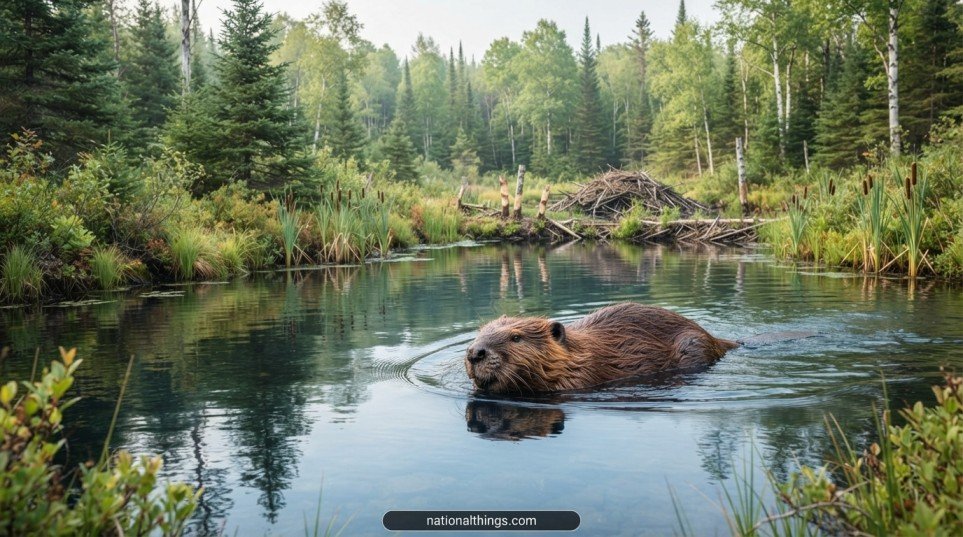
Heavy trapping caused major declines in beaver populations during the fur trade era. Protection measures and changes in trapping practices later helped many populations recover across Canada.
Beavers now occupy a wide range of freshwater habitats, although their local abundance varies. Their recovery demonstrates the importance of wildlife protection and habitat management.
Beaver conservation remains relevant because the animals help create wetlands and support biodiversity. Their dams can also affect human activities, so responsible management may involve protecting suitable habitat while addressing flooding or infrastructure problems.
People should avoid damaging beaver lodges or dams and follow local wildlife regulations when observing or photographing these animals.
The Beaver in Canadian Coins, Heraldry, and Culture
The beaver appears in Canadian public imagery, including coins and heraldic designs. These uses reinforce its connection with the country’s history and national identity.

The beaver is featured on the Canadian five-cent coin, commonly called the nickel. Its image has appeared on the coin for generations and remains one of the most familiar depictions of Canadian wildlife.
Beavers also appear in heraldic emblems and historical designs associated with Canadian institutions and communities. Their use reflects the animal’s longstanding role in the country’s symbolism.
In 2025, Canada marked the 50th anniversary of the beaver’s official recognition as a national symbol. Commemorative coin issues celebrated the animal’s legacy and its place in Canadian history.
Beaver vs. Canadian Horse: Canada’s National Animal Symbols
Canada recognizes both the North American beaver and the Canadian horse as national animal symbols. They represent different aspects of the country’s history and identity.

| Feature | North American Beaver | Canadian Horse |
|---|---|---|
| Scientific name | Castor canadensis | Equus caballus |
| Official recognition | 1975 | 2002 |
| Main association | Fur trade and national sovereignty | Canadian agricultural and equestrian heritage |
| Cultural meaning | Resourcefulness and perseverance | Strength, endurance, and heritage |
| Common appearance | Coins and national imagery | Historical and cultural references |
The beaver received official recognition under the National Symbol of Canada Act in 1975. The Canadian horse received recognition as a national animal in 2002.
The two animals have different histories, but both contribute to Canada’s national identity. The beaver is especially associated with the fur trade and sovereignty, while the Canadian horse represents the country’s agricultural and equestrian traditions.
Where Can You See Beavers in Canada?

Beavers live in freshwater habitats throughout much of Canada. Visitors may see them near lakes, rivers, ponds, and wetlands, especially in areas with trees and shrubs.
Beavers often become more active around dawn and dusk. Visitors exploring natural areas may notice signs of their activity even when the animals remain hidden.
Look for:
- Trees with gnawed trunks
- Cut branches near the water
- Beaver dams across streams
- Lodges built from sticks and mud
- Small channels through wetland vegetation
Beavers are wild animals and can react defensively if people approach too closely. Observe them from a safe distance, avoid disturbing their lodges or dams, and follow the rules of national parks and local wildlife areas.
References
FAQs About Canada’s National Animal
What is the national animal of Canada?
The North American beaver (Castor canadensis) is an official national symbol of Canada. It represents Canadian sovereignty and has a long connection with the country’s fur trade and cultural history.
When did the beaver become Canada’s national animal?
The beaver received official recognition on March 24, 1975, when the National Symbol of Canada Act received royal assent.
Why is the beaver important to Canada?
The beaver played a major role in Canada’s fur trade and early economic history. It also represents resourcefulness, perseverance, and Canadian heritage through its longstanding presence in national symbols.
Is the beaver the only national animal of Canada?
No. Canada recognizes both the North American beaver and the Canadian horse as national animal symbols. The beaver received recognition in 1975, while the Canadian horse received recognition in 2002.
What is the scientific name of Canada’s beaver?
The scientific name of the North American beaver is Castor canadensis. It is a large semi-aquatic rodent native to North America and the species associated with Canada’s national symbol.
What are the two national animals of Canada?
The two recognized national animal symbols are the North American beaver and the Canadian horse. The beaver represents Canada’s sovereignty and fur trade history, while the horse reflects its agricultural and cultural heritage.
Does Canada have a national bird?
Canada does not have an officially designated national bird. The common loon is widely associated with the country and appears on the Canadian one-dollar coin, but it is not officially designated as Canada’s national bird.
Does Canada have a state animal?
Canada does not have a state animal because it is a country with provinces and territories, not states. Individual provinces and territories may designate their own official animal symbols.
What is Canada’s iconic animal?
The beaver is widely considered Canada’s most iconic animal because of its official national-symbol status, historical importance in the fur trade, and appearance on Canadian coins and emblems.
Conclusion
The North American beaver holds a special place in Canada’s national identity. Its official recognition in 1975 reflects a much older connection with Indigenous history, the fur trade, and the development of Canadian national symbols.
Beyond its historical importance, the beaver plays a valuable role in Canada’s natural environment by creating wetlands and supporting wildlife. Its image continues to represent resourcefulness, perseverance, and Canadian heritage.
Together with the Canadian horse, the beaver remains an important national animal symbol and a lasting reminder of Canada’s history and natural landscape.