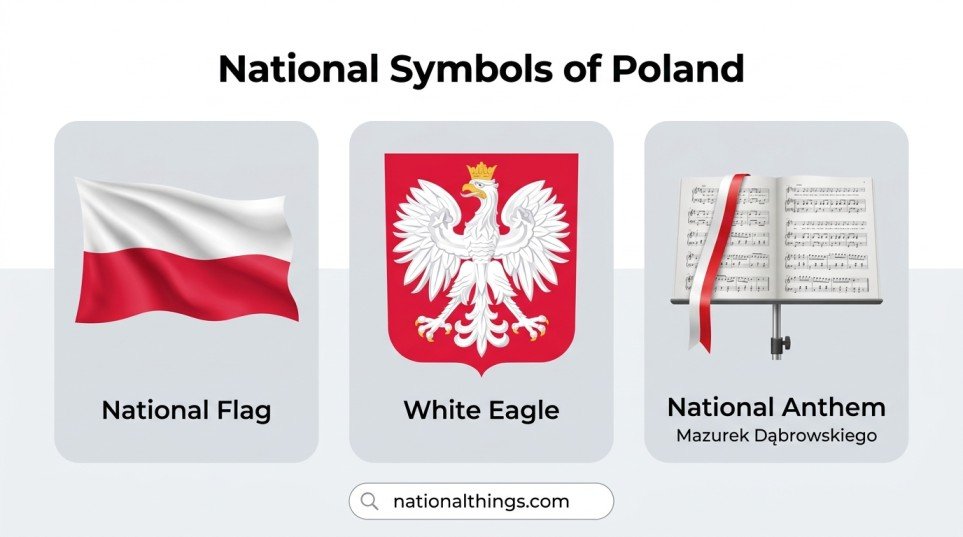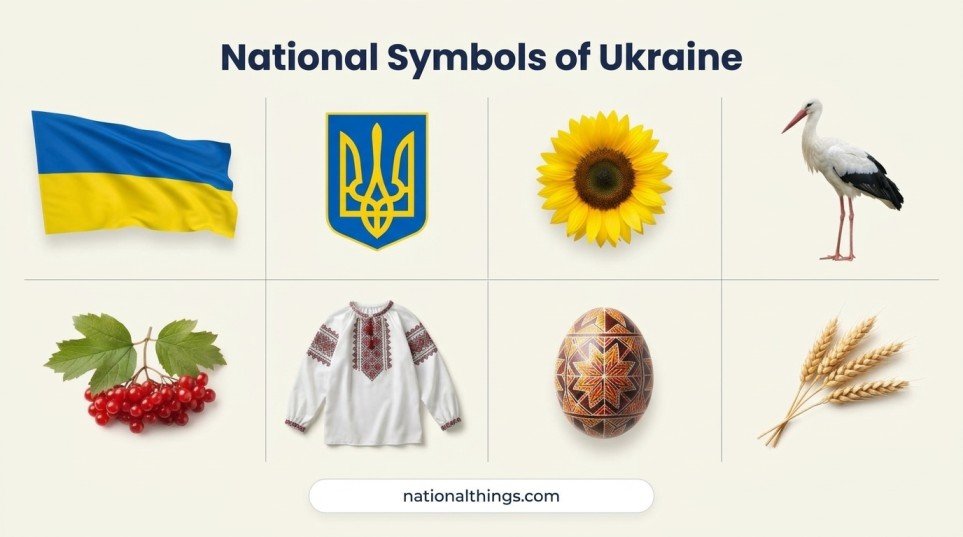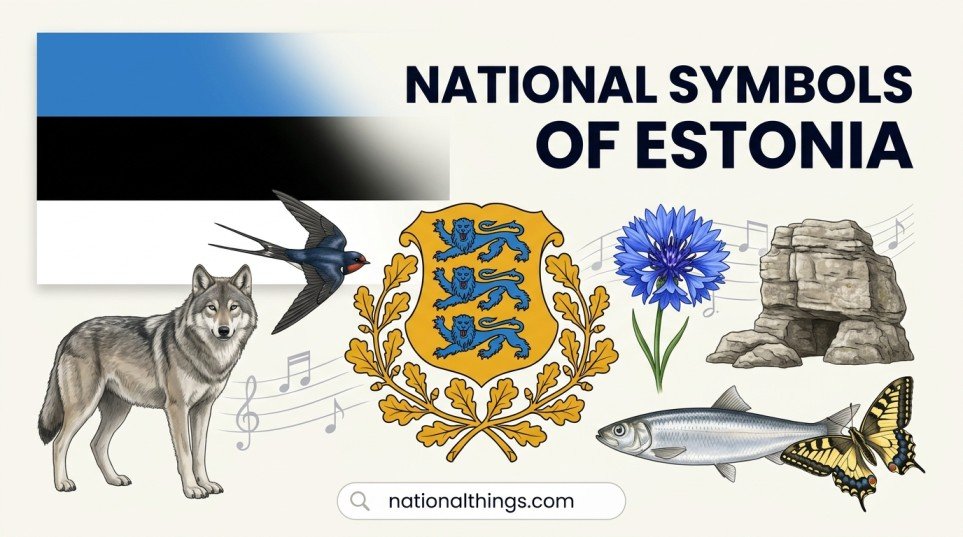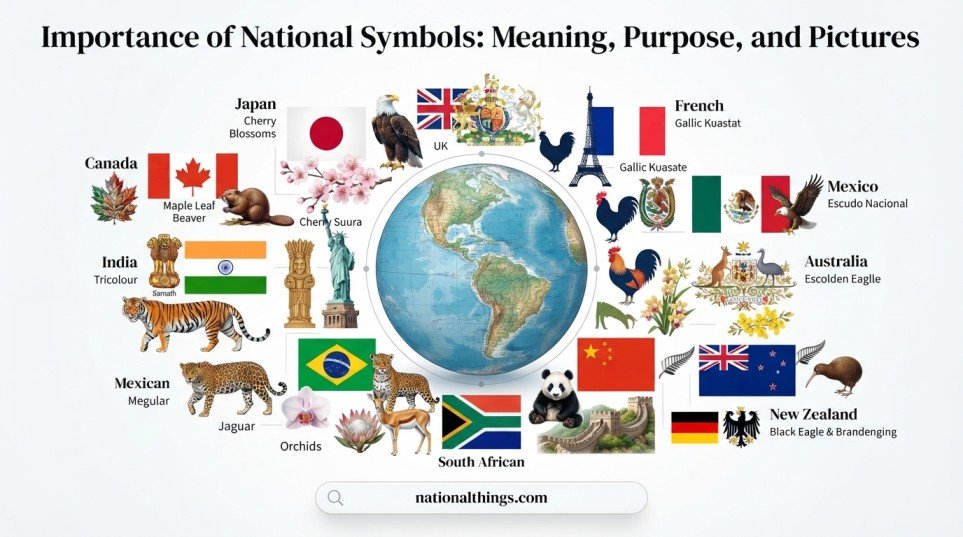
National symbols are important because they represent a country’s identity, history, culture, values, and national unity. They give people a shared sense of belonging and help distinguish one nation from another. Symbols such as the national flag, national anthem, national emblem, national animal, national bird, and national flower reflect a country’s natural heritage, historical events, traditions, and achievements. They also represent the pride, independence, and sovereignty of a nation.
This article explains the importance of national symbols, their meaning, purpose, and role in society. It explores how these symbols preserve cultural heritage, strengthen patriotism, educate future generations, and promote national unity. You will also find pictures and examples of different national symbols to understand how countries use meaningful representations to express their identity and values.
What Are National Symbols?
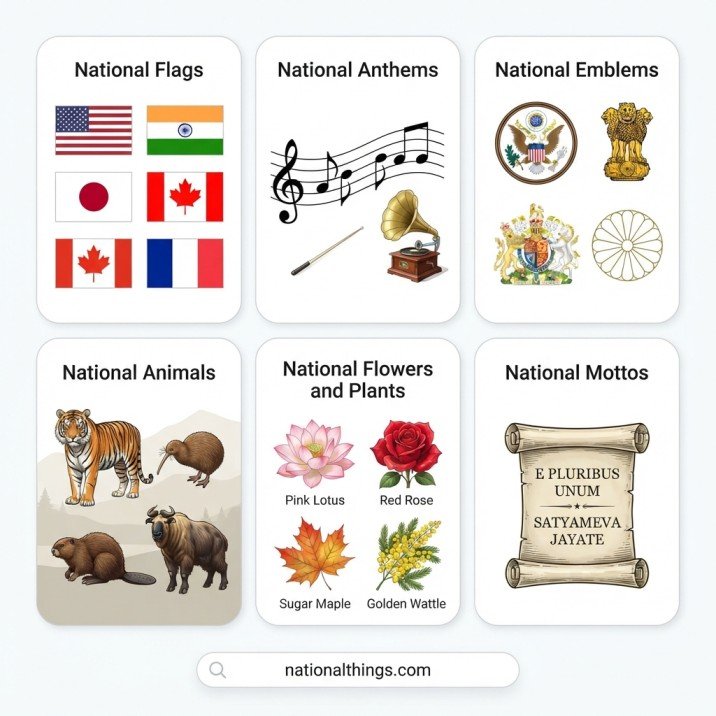
National symbols are objects, images, sounds, words, or cultural representations that identify a country and communicate something important about its people, history, traditions, or values. They provide recognizable expressions of national identity and sovereignty and help people understand what makes one country distinct from another.
Common examples include national flags, anthems, coats of arms, national animals, birds, flowers, and trees. Some countries also recognize national mottos, seals, and other emblems. These symbols may represent historical events, independence movements, natural environments, traditional beliefs, or important cultural practices.
National symbols generally fall into two groups:
- Official national symbols: Formally recognized through constitutions, laws, government decisions, or other official processes.
- Unofficial or culturally associated symbols: Widely connected with a country through traditions, history, popular recognition, or cultural significance without necessarily having formal legal status.
For example, Japan’s national flag is officially recognized, while Canada’s maple leaf is a widely recognized national symbol with a long-established place in the country’s identity. The status of each symbol depends on the country’s own laws and traditions.
Why Are National Symbols Important?

National symbols are important because they give countries recognizable identities and connect people with their shared history, culture, and heritage. They help communicate national values, encourage a sense of belonging, and represent nations during important domestic and international events.
Their significance extends beyond their appearance. A flag may recall a country’s independence, an anthem may express its historical aspirations, and a national animal may represent its natural environment or cultural traditions.
They Represent National Identity
National symbols help distinguish one country from another by providing recognizable representations of its identity. A country’s flag, emblem, anthem, and other national symbols communicate its distinct history, traditions, and national character.
For example, the maple leaf is strongly associated with Canada, while Japan’s flag features a red disc representing the sun. These recognizable symbols help people identify the countries they represent.
National identity can include several elements:
- Shared historical experiences.
- Cultural and linguistic traditions.
- Geographical and natural heritage.
- National values and aspirations.
- Common historical and political institutions.
Although citizens may have different backgrounds and beliefs, national symbols can provide a shared reference point for their country’s identity.
They Promote National Unity and Belonging
National symbols can bring people together by representing a shared country rather than a particular region, language, or community. They create opportunities for people with different backgrounds to participate in common national celebrations and traditions.
During independence anniversaries, national festivals, sporting competitions, and public ceremonies, citizens may gather around the same flag or sing the same anthem. These activities can strengthen social connections and national belonging.
However, national unity does not mean that everyone must share identical opinions or cultural practices. A country’s symbols can represent a common national identity while its population maintains considerable diversity.
They Preserve History and Collective Memory
National symbols often preserve memories of important historical events, including independence movements, struggles for sovereignty, political changes, and national achievements. Their meanings can remind present generations of experiences that shaped their countries.
Flags and coats of arms sometimes contain colors, animals, plants, or other elements connected with historical events and traditions. National anthems may commemorate independence, express hopes for peace, or reflect the aspirations of earlier generations.
Through historical remembrance, these symbols help connect the past with the present. They also provide educational opportunities for schools, museums, and cultural institutions to explain important periods in national history.
They Express Cultural Values and Traditions
National symbols can communicate a country’s cultural heritage through recognizable images, objects, music, and traditional representations. They may reflect Indigenous knowledge, local customs, religious influences, traditional craftsmanship, and connections with the natural environment.
For example, national plants and animals can represent the relationship between communities and their surroundings. Traditional patterns or historical figures appearing in national emblems may also communicate important cultural influences.
These representations help preserve cultural identity and traditional knowledge. However, a national symbol should not be assumed to represent every community equally, especially in countries with diverse Indigenous populations and regional traditions.
They Inspire National Pride and Patriotism
National symbols can encourage people to feel connected to their country and appreciate its history, achievements, and cultural heritage. Seeing a national flag displayed during a celebration or hearing an anthem at an international competition can create feelings of pride and belonging.
People often display national symbols during national holidays, independence celebrations, sporting events, and other important occasions. These activities express their connection with the country and its people.
Patriotism can involve appreciating a country’s achievements while also recognizing its challenges. Respect for national symbols does not require unquestioning agreement with every government decision or historical interpretation.
They Represent Countries Internationally
National symbols provide recognizable identities for countries during international relations, diplomacy, sports, and cultural exchanges. Flags, anthems, and official emblems help distinguish national delegations and institutions.
For example, national flags appear at international conferences, the Olympic Games, and diplomatic meetings. Anthems are played during certain official ceremonies and sporting events, while national emblems appear on diplomatic documents and government materials.
These symbols contribute to a country’s international recognition and representation. They also help introduce national identities to people who may have limited knowledge of a particular country’s history or culture.
Different Types of National Symbols and What They Represent
Countries use different types of national symbols to express their identity, history, culture, and natural heritage. Some are formally designated by governments, while others become important through traditional use and public recognition.
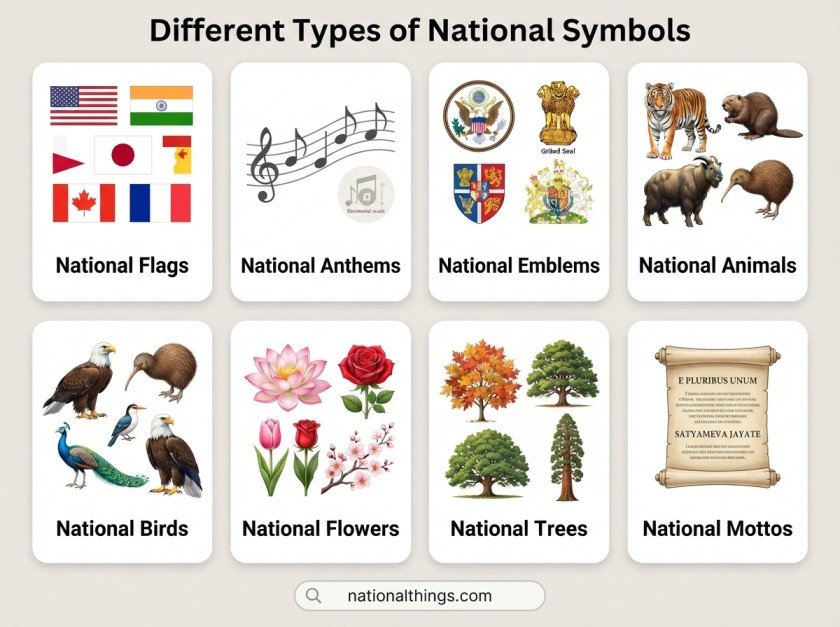
The main categories include flags, anthems, emblems, animals, birds, flowers, trees, and national mottos. Their meanings differ according to each country’s history and cultural background.
National Flags

National flags are among the most recognizable national symbols. They identify countries through distinctive colors, shapes, patterns, and designs and often carry historical, cultural, or political meanings.
Different elements of a flag may represent:
- Colors: Historical struggles, natural features, cultural traditions, or national ideals.
- Stars and other shapes: Unity, geographical divisions, historical events, or national aspirations.
- Animals and plants: Wildlife, natural heritage, or cultural traditions.
- Stripes and patterns: Historical influences, political developments, or regional identities.
For example, Japan’s national flag features a red disc on a white background, commonly associated with the sun. Canada’s flag features a red maple leaf, a widely recognized representation of the country.
Not every flag element has one universally accepted interpretation. Some meanings are established through official explanations, while others develop through historical and popular understanding.
National Anthems

A national anthem is an officially recognized musical composition associated with a country. It may contain lyrics, music, or both, and is commonly performed during national ceremonies, public celebrations, and international sporting events.
National anthems can communicate:
- Historical struggles and independence.
- National unity and sovereignty.
- Peace, freedom, and national aspirations.
- Cultural traditions and shared values.
- Respect for the country and its people.
For example, South Africa’s national anthem combines sections in multiple languages, reflecting the country’s linguistic diversity and its commitment to unity.
The words and music of an anthem can preserve important historical experiences and communicate national ideals across generations.
National Emblems and Coats of Arms

National emblems and coats of arms are official or historically established designs used to represent countries, governments, and national institutions. They may include shields, animals, plants, crowns, stars, historical objects, and other symbolic elements.
Their meanings often relate to:
- National sovereignty and state authority.
- Historical events and political traditions.
- Cultural and regional heritage.
- National values and institutional identity.
- Important geographical or natural features.
India’s State Emblem, adapted from the Lion Capital of Ashoka at Sarnath, is an important example of an official national emblem. Mexico’s coat of arms features an eagle holding a serpent while perched on a prickly pear cactus, an image associated with the historical foundation tradition of Tenochtitlan.
A coat of arms and a national flag are different forms of representation, although both may contain important national symbols.
National Animals and Birds
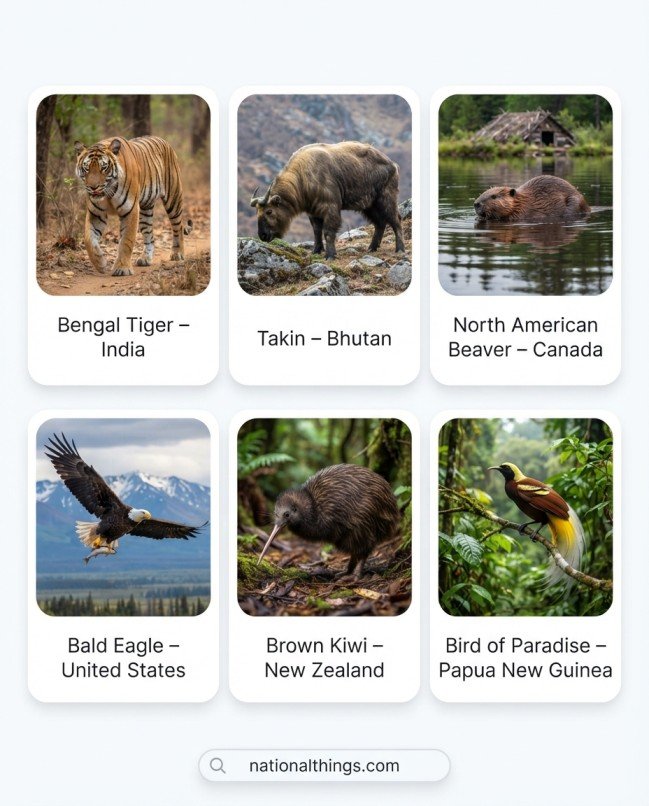
National animals and birds represent a country’s wildlife, natural environment, cultural traditions, or historical associations. Some are formally designated, while others become widely recognized through folklore, national identity, and public use.
Examples include:
- Tiger: India’s national animal, representing its rich wildlife heritage.
- Takin: Bhutan’s widely recognized national animal, associated with local traditions and Himalayan biodiversity.
- Beaver: Canada’s widely recognized national animal, historically connected with the country’s fur trade and development.
- Bald eagle: A prominent national symbol of the United States, associated with strength and freedom.
- Kiwi: A widely recognized national bird and cultural symbol of New Zealand.
These examples show how wildlife can become closely connected with a country’s identity. They can also encourage interest in biodiversity, environmental protection, and conservation.
National Flowers, Plants, and Trees
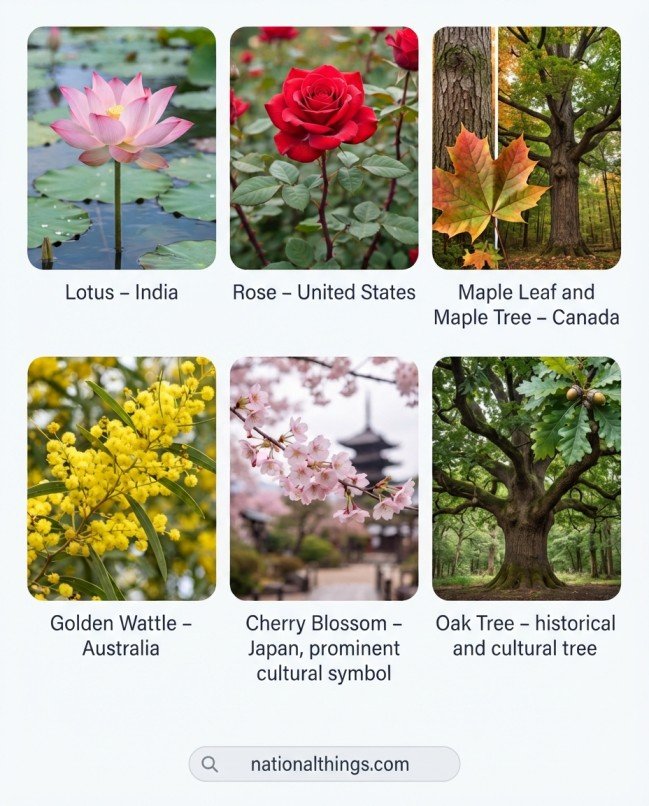
National flowers, plants, and trees represent a country’s natural heritage, biodiversity, traditional practices, and cultural associations. They may be selected because of their historical importance, distinctive appearance, geographical distribution, or connection with local communities.
Examples include:
- Lotus: India’s national flower, associated with cultural and religious traditions.
- Rose: The national flower of the United States, formally designated through legislation.
- Maple tree: Strongly associated with Canada’s natural heritage and national identity.
- Cherry blossom: A prominent cultural symbol of Japan, although its cultural importance should not automatically be confused with formal national-flower designation.
Plants and trees also help communicate environmental values. Their inclusion in national identity can encourage appreciation of native species, forests, and natural landscapes.
National Mottos and Other Symbols

National mottos are short statements that express a country’s ideals, guiding principles, or aspirations. They may appear on national emblems, official documents, government buildings, or other institutional materials.
Other national symbols can include:
- Official government seals.
- National monuments.
- Historic objects and memorials.
- Traditional instruments.
- Recognized national costumes.
- National insignia and ceremonial objects.
For example, Canada’s national motto is A Mari Usque ad Mare, meaning “From Sea to Sea.” It reflects the country’s geographical extent.
The recognition and use of these additional symbols vary considerably between countries. Some are official state representations, while others have primarily historical or cultural significance.
How National Symbols Reflect a Country’s History and Culture
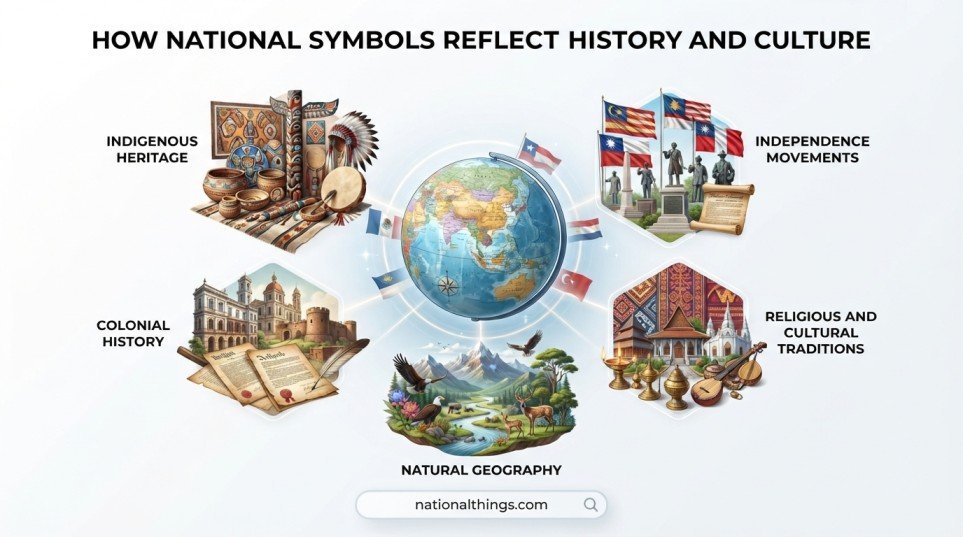
National symbols reflect the historical experiences, cultural traditions, and political developments that shape a country. Their designs and meanings often come from significant events, traditional beliefs, independence movements, and relationships with the natural environment.
Some symbols originate from periods before a country became an independent state. Others are introduced following political changes, constitutional developments, or national independence.
Several influences contribute to their development:
- Indigenous heritage: Traditional animals, plants, designs, and cultural knowledge may influence national representations.
- Independence movements: Flags, colors, and emblems can commemorate struggles for freedom and sovereignty.
- Colonial history: Some national symbols retain historical influences from colonial periods, while others represent efforts to establish a distinct identity.
- Religious traditions: Religious beliefs and cultural practices may influence the meanings of certain national symbols.
- Natural geography: Mountains, rivers, forests, wildlife, and native plants may become important national representations.
For example, Mexico’s national coat of arms connects a modern national emblem with an important tradition associated with the founding of Tenochtitlan. Canada’s maple leaf reflects a long-standing relationship between the country’s natural environment and its national identity.
The meanings of national symbols can also change. A symbol that once represented a particular historical movement may later become associated with a broader national identity. Different communities may also interpret the same symbol in different ways.
Official and Unofficial National Symbols: What Is the Difference?
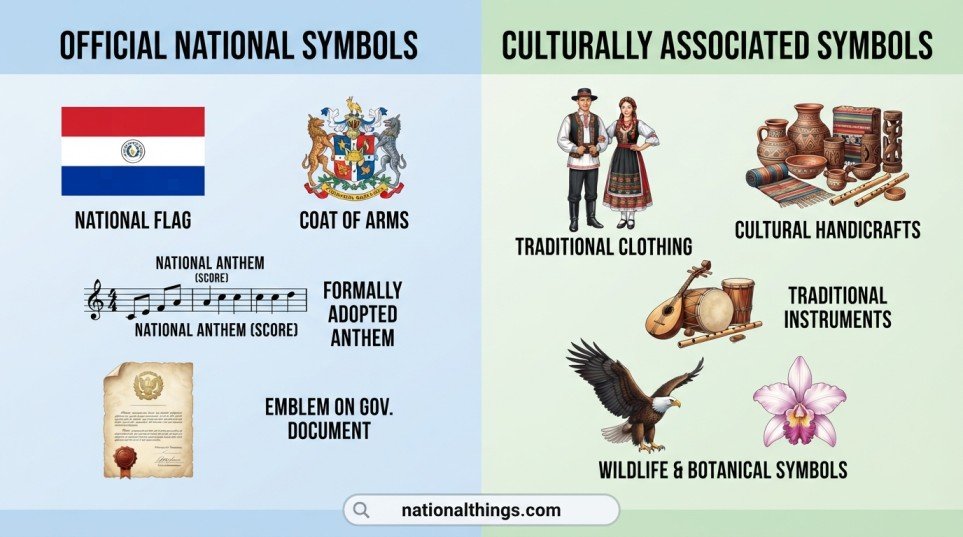
Not every symbol associated with a country has the same legal or cultural status. Some national symbols are formally recognized by governments, while others become important through tradition, historical connections, and public acceptance.
Understanding this distinction is essential when researching national animals, flowers, birds, trees, and other national representations. A symbol’s popularity does not automatically make it an official national designation.
Officially Recognized National Symbols
Official national symbols are formally established or recognized through legal, constitutional, legislative, or governmental processes. Their recognition may be supported by official documents that explain their designation, appearance, and use.
Common examples include:
- National flags established through law or constitutional provisions.
- National anthems formally adopted by governments.
- State emblems and coats of arms recognized through official legislation.
- National animals, birds, or flowers formally designated by recognized authorities.
- Official national mottos and government seals.
Japan’s national flag and anthem, for example, received formal legal recognition through the Act on National Flag and Anthem of 1999.
Official designations differ between countries. Some governments formally recognize several categories of national symbols, while others establish only a smaller number of official designations.
Unofficial but Culturally Important Symbols
Unofficial national symbols are widely associated with a country even when they have not received formal government designation. Their importance usually develops through cultural traditions, historical associations, public recognition, and repeated use.
Examples include:
- Cultural icons associated with national identity.
- Traditional clothing and handicrafts.
- Popular national animals or plants without verified formal designation.
- Historic buildings and monuments.
- Traditional foods and musical instruments.
For example, the kiwi is widely recognized as a symbol of New Zealand and is closely connected with the country’s people and wildlife. Its cultural significance should be distinguished from the legal status of any particular national designation.
Both official and unofficial symbols can contribute to national identity. However, accurate classification matters because cultural recognition and legal recognition are not the same thing.
Examples of Important National Symbols Around the World
Countries across the world use different symbols to represent their national identity, history, natural heritage, and cultural traditions. Although flags and anthems are common national representations, animals, flowers, plants, and emblems also play important roles.
The following examples from six geographical regions illustrate how national symbols differ in design, meaning, and official recognition.
Asia
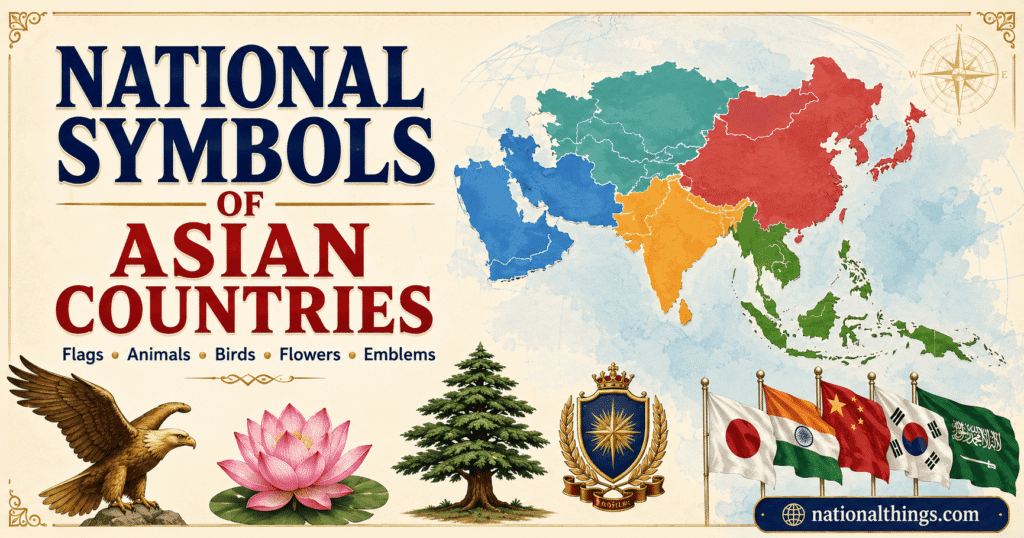
Asian countries have diverse national symbols influenced by ancient civilizations, Indigenous traditions, religious beliefs, independence movements, and natural environments.
Some notable examples include:
| Country | National symbol | Significance |
|---|---|---|
| Japan | National flag (Hinomaru) | Represents the sun and national identity |
| India | State Emblem (Lion Capital of Ashoka) | Represents authority, heritage, and national values |
| India | Bengal tiger | Official national animal and wildlife heritage |
| Bhutan | National flag | Features a white dragon representing the country’s identity and traditions |
| Bhutan | Takin | Widely recognized national animal associated with Bhutanese tradition |
| Bangladesh | National flag | Represents national identity and the country’s independence history |
| Nepal | National flag | Its distinctive double-pennant design reflects national identity and historical traditions |
These examples demonstrate that national symbols can reflect both historical achievements and cultural traditions. India’s emblem draws from ancient Indian history, while Bhutan’s dragon reflects an important connection with the country’s name and cultural identity.
Europe
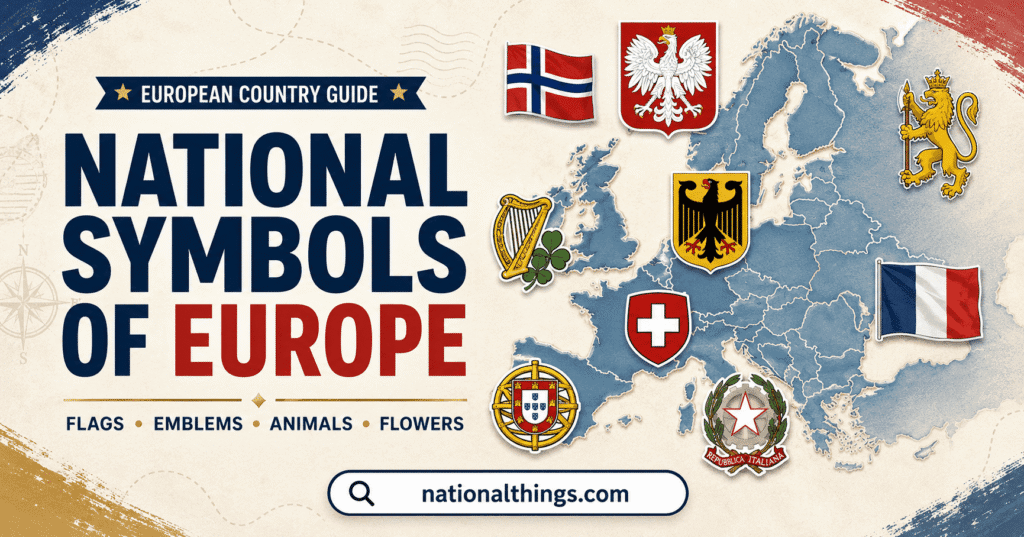
European national symbols reflect a wide range of historical developments, including monarchies, republics, independence movements, religious traditions, and political transformations.
Examples include:
| Country | National symbol | Significance |
|---|---|---|
| United Kingdom | Union Flag | Represents the union of Great Britain and Northern Ireland |
| Germany | Black, red, and gold flag | Represents national identity and democratic traditions |
| France | Tricolour flag | Associated with the French Revolution and republican identity |
| Portugal | National flag and coat of arms | Reflect historical and national traditions |
| Albania | Double-headed eagle | Represents an important element of Albanian national identity |
| Greece | National flag | Reflects national identity and historical independence traditions |
European symbols often have long historical backgrounds. For example, the French Tricolour became closely associated with the French Revolution, while the Union Flag combines elements of the flags historically associated with England, Scotland, and Ireland.
These examples also demonstrate that national symbols can reflect political unions, constitutional changes, and the development of modern states.
Africa
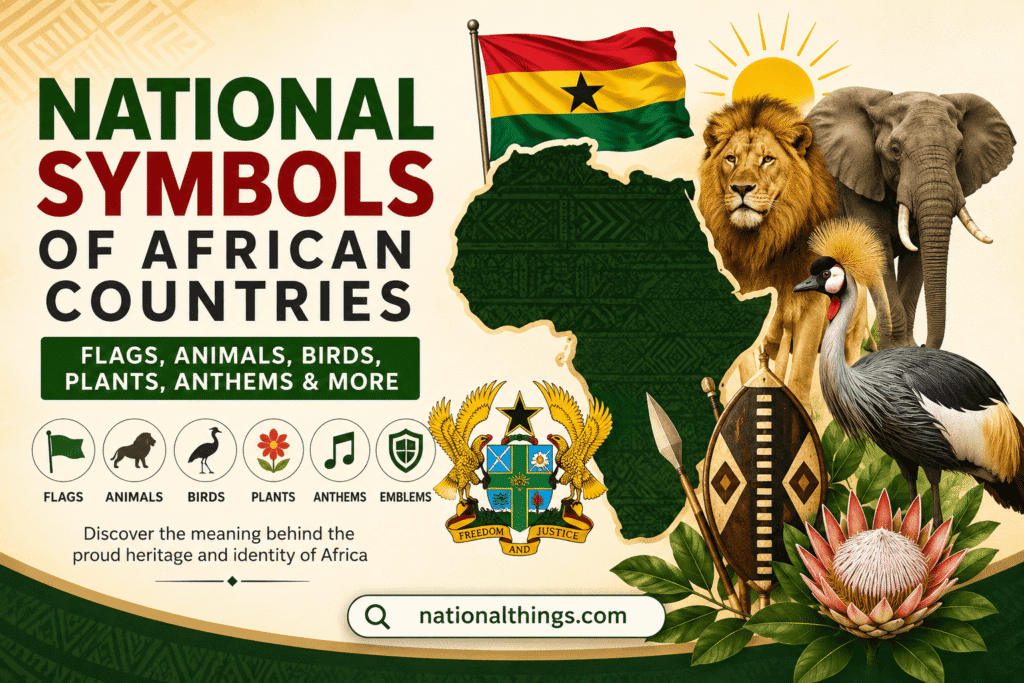
African national symbols often reflect independence movements, traditional cultures, regional identities, and the continent’s natural diversity. Many national flags and emblems were adopted or developed during periods of independence and political transformation.
Examples include:
| Country | National symbol | Significance |
|---|---|---|
| South Africa | National flag | Represents unity and the country’s democratic transition |
| South Africa | National anthem | Reflects linguistic and cultural diversity |
| Ghana | National flag | Its colors and black star are associated with African freedom and identity |
| Kenya | National flag | Includes a traditional shield and crossed spears |
| Ethiopia | Green, yellow, and red flag tradition | Influenced several African independence movements |
| Nigeria | Green and white flag | Green represents agriculture and natural wealth, while white represents peace |
The national flag of South Africa is particularly significant because its design brings together different colors and visual traditions associated with the country’s diverse history.
Ghana’s black star is another important example. It is associated with African freedom and the country’s historical role in the independence movement.
African national symbols should be understood within their individual historical and cultural contexts rather than treated as representations of one uniform African identity.
North America, Central America, and the Caribbean
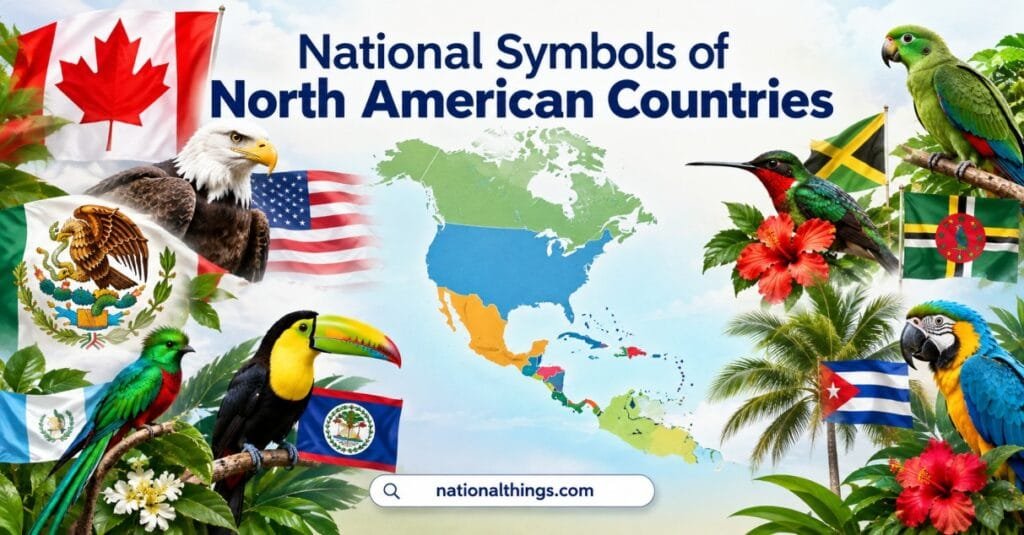
National symbols throughout North America, Central America, and the Caribbean reflect Indigenous heritage, colonial history, independence, regional traditions, and natural environments.
Examples include:
| Country | National symbol | Significance |
|---|---|---|
| Canada | Maple leaf | Widely recognized symbol of national identity and natural heritage |
| Mexico | National coat of arms | Represents the historical foundation tradition of Tenochtitlan |
| United States | Bald eagle | National symbol associated with strength and freedom |
| United States | National flag | Represents the country’s identity and historical development |
| Jamaica | National flag | Its colors are associated with the country’s people, natural resources, and creativity |
| Costa Rica | National flag | Represents national identity and historical traditions |
Canada’s maple leaf is one of the region’s most recognizable national symbols. It has appeared in Canadian national imagery for generations and features prominently on the country’s flag.
Mexico’s coat of arms has a different historical foundation. Its eagle, serpent, and cactus imagery connects the modern Mexican state with the traditional story associated with the founding of Tenochtitlan.
The region also includes many countries in Central America and the Caribbean, each with distinct national symbols and cultural histories. Their symbols should be understood individually rather than grouped under a single cultural identity.
South America
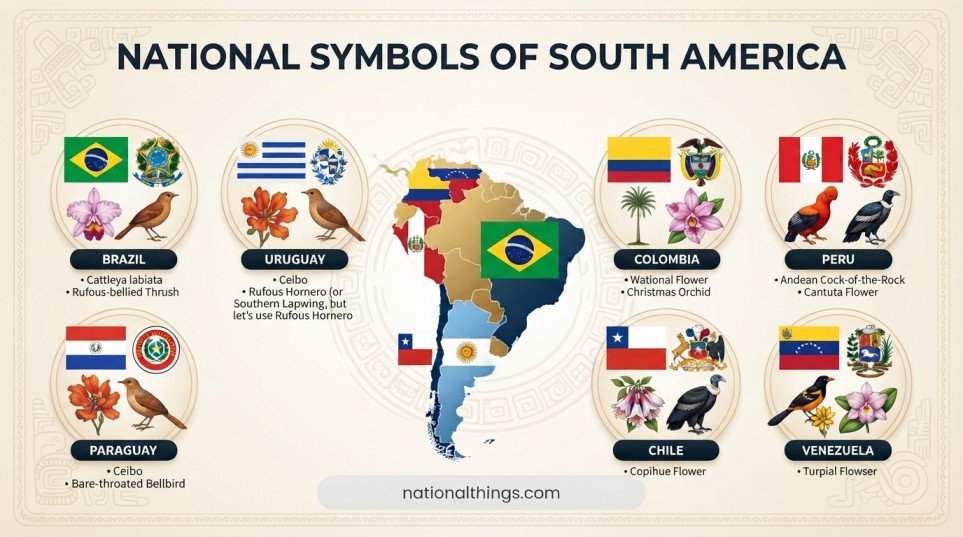
South American national symbols reflect Indigenous civilizations, colonial history, independence movements, geographical features, and cultural traditions. Many national flags contain elements connected with the political and historical development of their countries.
Examples include:
| Country | National symbol | Significance |
|---|---|---|
| Brazil | National flag | Represents the country’s national identity and historical development |
| Argentina | Sun of May on its flag | Associated with the May Revolution and independence history |
| Colombia | Yellow, blue, and red flag | Represents national identity and historical traditions |
| Chile | National flag | Features a white star associated with national unity and progress |
| Peru | National coat of arms | Represents the country’s natural wealth and national heritage |
Brazil’s flag is particularly recognizable because of its green field, yellow diamond, and blue globe containing stars and the national motto, Ordem e Progresso (Order and Progress).
Argentina’s Sun of May is another historically significant feature. It is associated with the May Revolution of 1810, an important event in the country’s independence history.
These symbols demonstrate how national identity in South America is connected with political independence, historical memory, and cultural heritage.
Oceania
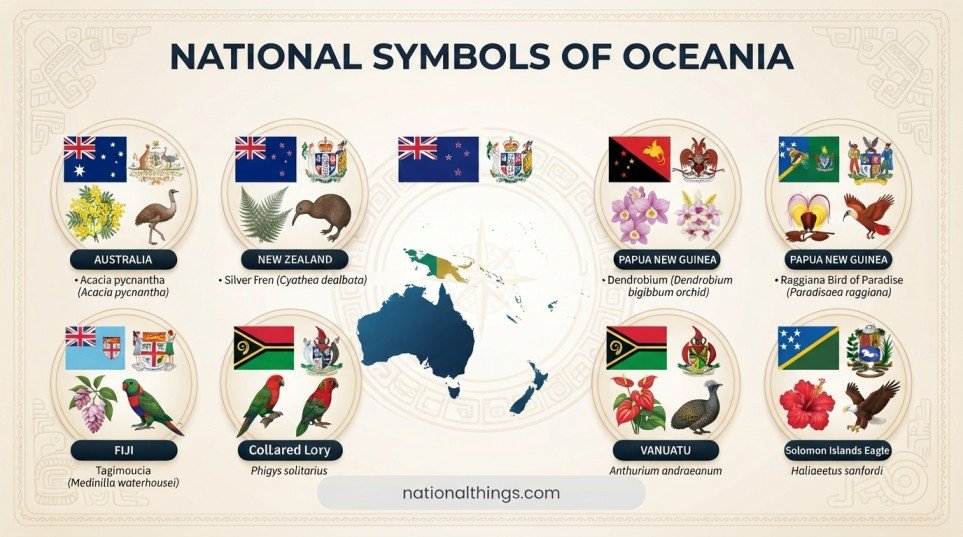
Oceania’s national symbols reflect Indigenous heritage, island cultures, marine environments, wildlife, and historical connections with colonial powers. The region includes Australia, New Zealand, Papua New Guinea, and the Pacific island countries.
Examples include:
| Country | National symbol | Significance |
|---|---|---|
| Australia | National flag | Includes the Commonwealth Star and the Southern Cross |
| Australia | Golden wattle | Official national floral emblem |
| New Zealand | Kiwi | Widely recognized national bird and cultural symbol |
| New Zealand | Silver fern | Prominent national sporting and cultural symbol |
| Papua New Guinea | Bird of paradise | Featured on the national flag and associated with national identity |
| Fiji | National flag | Includes symbols reflecting national history and identity |
Oceania’s symbols often have strong connections with native wildlife and traditional cultures. Australia’s golden wattle is its official floral emblem, while New Zealand’s kiwi has become a familiar representation of the country and its people.
Papua New Guinea’s national flag features a bird of paradise, reflecting the importance of the country’s natural heritage.
Indigenous traditions are also essential to understanding the region’s identity. Māori cultural heritage, Aboriginal Australian traditions, and the distinct histories of Pacific island communities contribute to the region’s diverse national representations.
How National Symbols Are Used in Everyday Life and Society
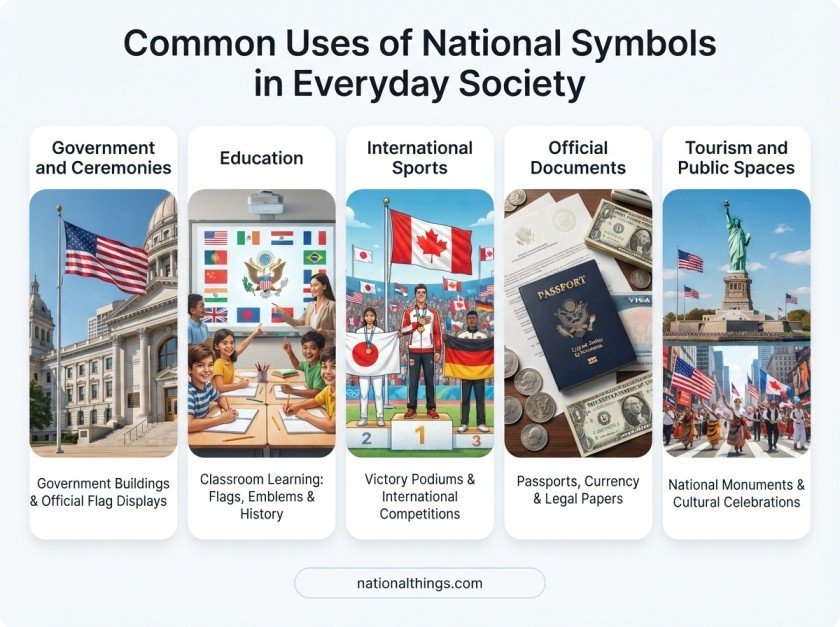
National symbols appear in many parts of public and private life. They are used to identify countries, represent governments, support national celebrations, and communicate national identity in educational, cultural, and international settings.
Their use depends on national laws, customs, and the particular symbol involved.
Government Buildings and Official Ceremonies
National flags and emblems are commonly displayed on government buildings, courts, parliaments, embassies, and other public institutions. They identify official institutions and represent the authority and sovereignty of the state.
National symbols also appear during:
- Presidential and royal ceremonies.
- Independence Day celebrations.
- National memorial services.
- Diplomatic meetings.
- State visits and official receptions.
- Military and national commemorations.
During these occasions, flags may be raised, anthems performed, and official emblems displayed according to established national protocols.
Schools and Educational Institutions
National symbols play an important role in education because they help students understand their country’s history, geography, culture, and political development.
Schools may use national flags, maps, historical emblems, and anthems during lessons and national celebrations. Teachers can explain the meaning of flag colors, the historical background of national monuments, and the significance of recognized national animals and plants.
Educational activities involving national symbols can help students:
- Identify their country’s official representations.
- Understand important historical events.
- Recognize cultural and regional diversity.
- Appreciate national heritage.
- Develop knowledge of geography and civic identity.
However, education about national symbols should also explain historical context and different cultural perspectives.
Sports and International Events
National symbols are especially visible during international sporting competitions. Athletes often compete under their national flags, and national anthems may be played during medal ceremonies and other official occasions.
Events such as the Olympic Games and international football competitions provide opportunities for countries to display their national identities before global audiences.
Flags, team uniforms, and national emblems help spectators identify participating countries. They can also create a sense of connection between athletes and supporters.
Currency, Passports, and Official Documents
National symbols are frequently used on official documents and government-issued materials. Their presence helps identify the issuing country and distinguish its institutions from those of other states.
Common examples include:
- Passports: May feature a national emblem or coat of arms on the cover.
- Coins and banknotes: May display historical figures, national monuments, wildlife, or official symbols.
- Government documents: May contain official seals, emblems, or other institutional identifiers.
- Identity documents: May use national or governmental insignia as part of their design.
These applications demonstrate how national symbols function as practical forms of identification in addition to their cultural and historical significance.
Tourism, Cultural Events, and Public Spaces
National symbols are frequently displayed in museums, monuments, cultural centers, tourist attractions, and public spaces. They help visitors recognize important aspects of a country’s history and cultural heritage.
Tourism authorities may also use recognizable national imagery in promotional materials, souvenirs, and cultural exhibitions.
Examples include:
- Historical monuments and national memorials.
- Traditional costumes and handicrafts.
- Museums displaying national flags and emblems.
- Public celebrations and cultural festivals.
- Souvenirs featuring popular national symbols.
However, tourism branding and commercial imagery should not automatically be classified as official national symbols. Their cultural significance and formal recognition are separate matters.
How National Symbols Help Preserve Cultural Heritage for Future Generations
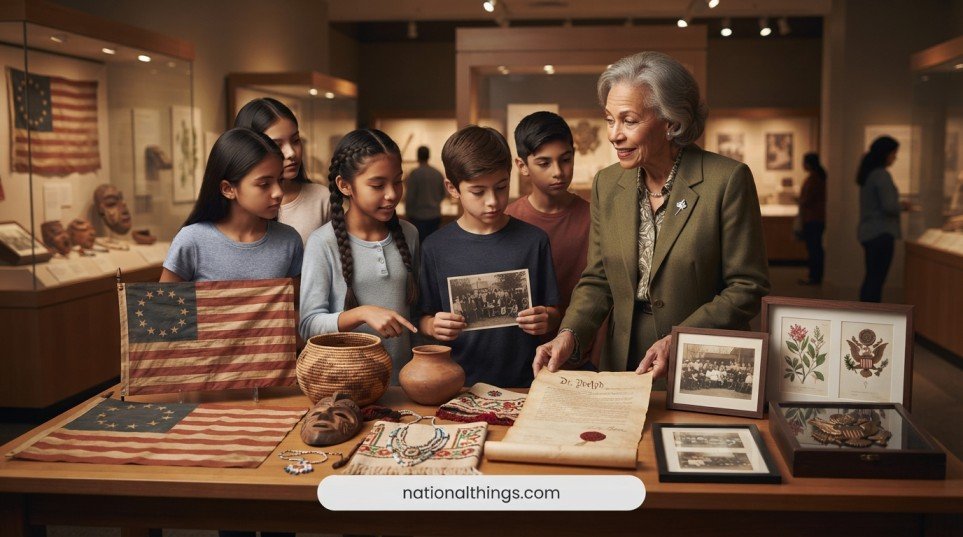
National symbols help preserve cultural heritage by keeping important historical events, traditions, and national identities visible across generations. They provide recognizable connections between a country’s past and its present.
Their educational and commemorative roles are particularly important in societies with diverse cultural backgrounds and long historical traditions.
National symbols contribute to heritage preservation in several ways:
- Historical remembrance: Flags, monuments, and emblems can commemorate important events and historical movements.
- Cultural continuity: Traditional designs, plants, animals, and objects can preserve connections with earlier generations.
- Indigenous heritage: Recognized cultural representations can help maintain awareness of Indigenous knowledge and traditions.
- Education: Schools and cultural institutions use national symbols to explain history and national development.
- Conservation awareness: National animals, birds, flowers, and trees can encourage interest in protecting native species and habitats.
Museums, archives, heritage organizations, and educational institutions play important roles in documenting the origins and meanings of these symbols.
Preservation also requires accurate historical interpretation. A symbol may have different meanings for different communities, and its history should not be simplified to represent only one group or perspective.
Similarities and Differences Between National Symbols of Countries
National symbols sometimes share similar colors, designs, animals, plants, and historical influences. These similarities may result from geographical connections, shared traditions, political relationships, independence movements, or common historical experiences.
However, similar-looking symbols do not necessarily have identical meanings or official status.
For example, several countries use stars on their national flags, but the number, arrangement, and meaning of those stars can differ. Similarly, plants and animals may appear in the national identities of several countries without representing the same cultural traditions.
Comparison of Selected National Symbols
| Country | Representative symbol | What it represents |
|---|---|---|
| Canada | Maple leaf | National identity and natural heritage |
| Japan | National flag | National identity and the sun |
| Mexico | National coat of arms | Historical and cultural heritage |
| Bhutan | Takin | Wildlife and cultural traditions |
These examples illustrate different ways countries express national identity. Canada’s maple leaf is a widely recognized national symbol, Japan’s flag is an officially recognized national representation, Mexico’s coat of arms connects national identity with historical traditions, and Bhutan’s takin is widely associated with the country’s cultural and natural heritage.
Why Do Different Countries Have Similar Symbols?
Several factors explain why national symbols sometimes resemble one another.
Shared historical experiences: Countries with historical connections may adopt similar colors, patterns, or visual elements.
Geographical similarities: Nations with comparable natural environments may use similar animals, plants, rivers, or mountains in their national representations.
Cultural influences: Neighboring countries may share religious traditions, artistic styles, or historical symbols.
Political movements: Independence movements and regional political developments have influenced the designs of several national flags.
Common natural heritage: The same animal or plant may be important to multiple countries because it exists across their geographical regions.
Despite these similarities, every national symbol should be interpreted within its own historical and cultural context. A shared color or animal does not mean that two countries have identical national identities.
Common Misconceptions About National Symbols
National symbols are sometimes misunderstood because official designations, cultural traditions, and popular associations can overlap. Understanding their differences helps prevent inaccurate descriptions and incorrect classifications.
Some common misconceptions include:
- Every popular national symbol is officially recognized: This is incorrect. Some animals, plants, and cultural objects are widely associated with countries without formal government designation.
- Every country has the same categories of national symbols: Countries differ in their official designations and cultural traditions. A country may have an official flag and anthem but no formally designated national bird or tree.
- National flags and coats of arms are interchangeable: A flag is a distinct national representation, while a coat of arms is a heraldic design. Some countries display a coat of arms on their flags, but the two terms do not mean the same thing.
- A national symbol represents every citizen equally: Symbols can have different meanings for different communities, particularly in culturally and historically diverse countries.
- The meaning of a symbol never changes: Historical events, political developments, and social changes can influence how people understand national symbols over time.
- Every national animal or flower is unique to one country: The same species can be associated with several countries, and its national status may differ in each.
Accurate information requires checking official government records, relevant legislation, national heritage institutions, and reliable historical references rather than relying only on popular websites or repeated claims.
FAQs About the Importance of National Symbols
Why are national symbols important to a country?
National symbols represent a country’s identity, history, culture, and values. They encourage national unity, preserve collective memories, express cultural heritage, and help countries gain international recognition.
What are the five main national symbols?
Five widely recognized categories are national flags, anthems, emblems, animals, and flowers. However, countries have different official designations and may recognize additional symbols.
How do national symbols promote unity?
National symbols provide shared representations that connect people from different regions, languages, and cultural backgrounds. They encourage a sense of belonging during national celebrations and important public events.
What is the difference between national symbols and cultural symbols?
National symbols represent a country or its national identity, while cultural symbols may represent particular communities, traditions, religions, or regional practices without having national recognition.
Are all national symbols officially recognized by governments?
No. Some national symbols receive formal recognition through laws or government decisions, while others become associated with countries through historical traditions, cultural practices, and public recognition.
How do national symbols preserve history?
National symbols preserve historical memories by representing important events, independence movements, cultural traditions, and national achievements. They help communicate these experiences to younger generations.
Can a country have more than one national animal, bird, or flower?
Yes. A country may recognize several national animals, birds, or flowers. Their official status depends on government decisions, legislation, and established national traditions.
Why should people respect national symbols?
National symbols carry historical, cultural, and national significance. Respecting them helps preserve heritage, recognize shared identity, and appreciate the traditions and experiences associated with a country.
Conclusion
National symbols are important representations of a country’s identity, history, culture, and heritage. Flags, anthems, emblems, animals, birds, flowers, and other national representations communicate different aspects of what makes each country distinct. They preserve historical memories, encourage a sense of belonging, and help nations represent themselves internationally.
Their meanings and official recognition vary across countries, reflecting different historical experiences, cultural traditions, and natural environments. Understanding these differences helps us appreciate the diversity of national identities and the importance of preserving cultural heritage for future generations.