
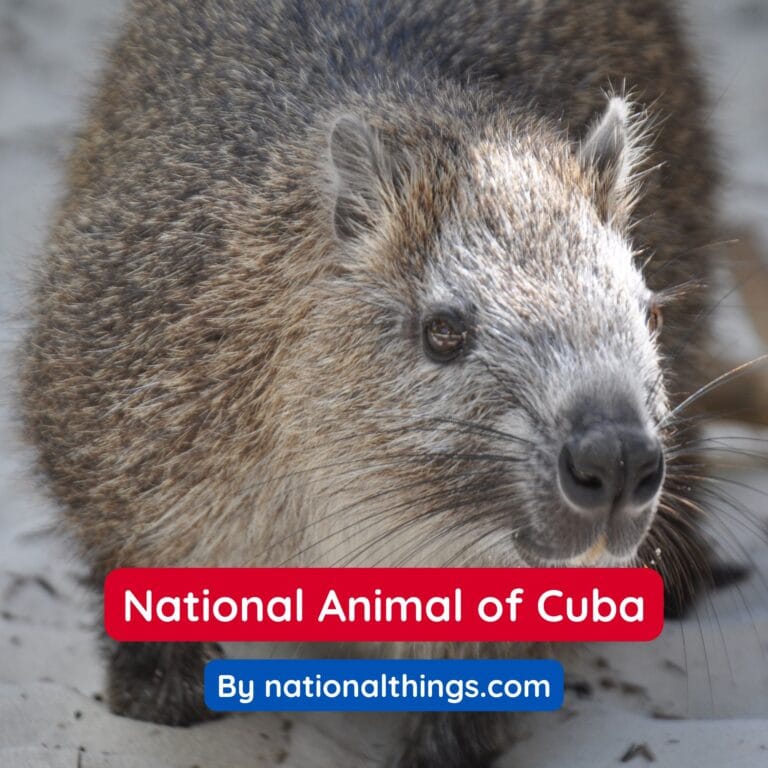
National Animal of Cuba: The Cuban Hutia
The national animal of Cuba is the Cuban Hutia (Capromys pilorides). This unique mammal is a large rodent that lives…
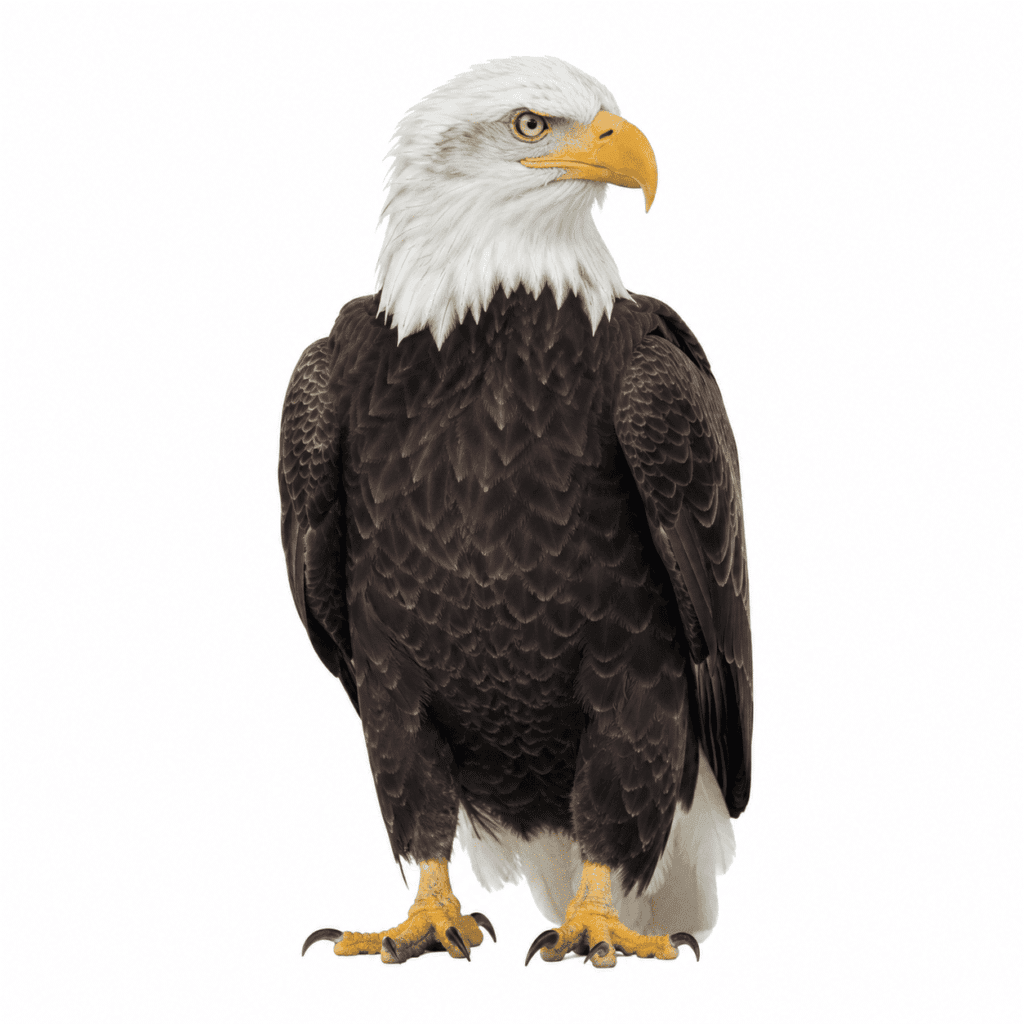
The National Bird of the USA is the bald eagle, a powerful North American bird recognized by its white head, dark brown body, yellow bill, and broad wings. Many people believed it had always held an official legal title. In fact, the United States used the bald eagle as a national symbol for more than two centuries before federal law formally named it the country’s national bird in December 2024.
The bald eagle appears on the Great Seal of the United States, government documents, passports, military insignia, coins, and the one-dollar bill. Its image represents freedom, strength, independence, and national unity. The bird also has deep cultural and spiritual importance for many Indigenous peoples and Tribal communities.
The bald eagle is the official national bird of the USA. Its scientific name is Haliaeetus leucocephalus. Congress added this title to Section 306 of Title 36 of the United States Code. The law states clearly that the bald eagle is the national bird.
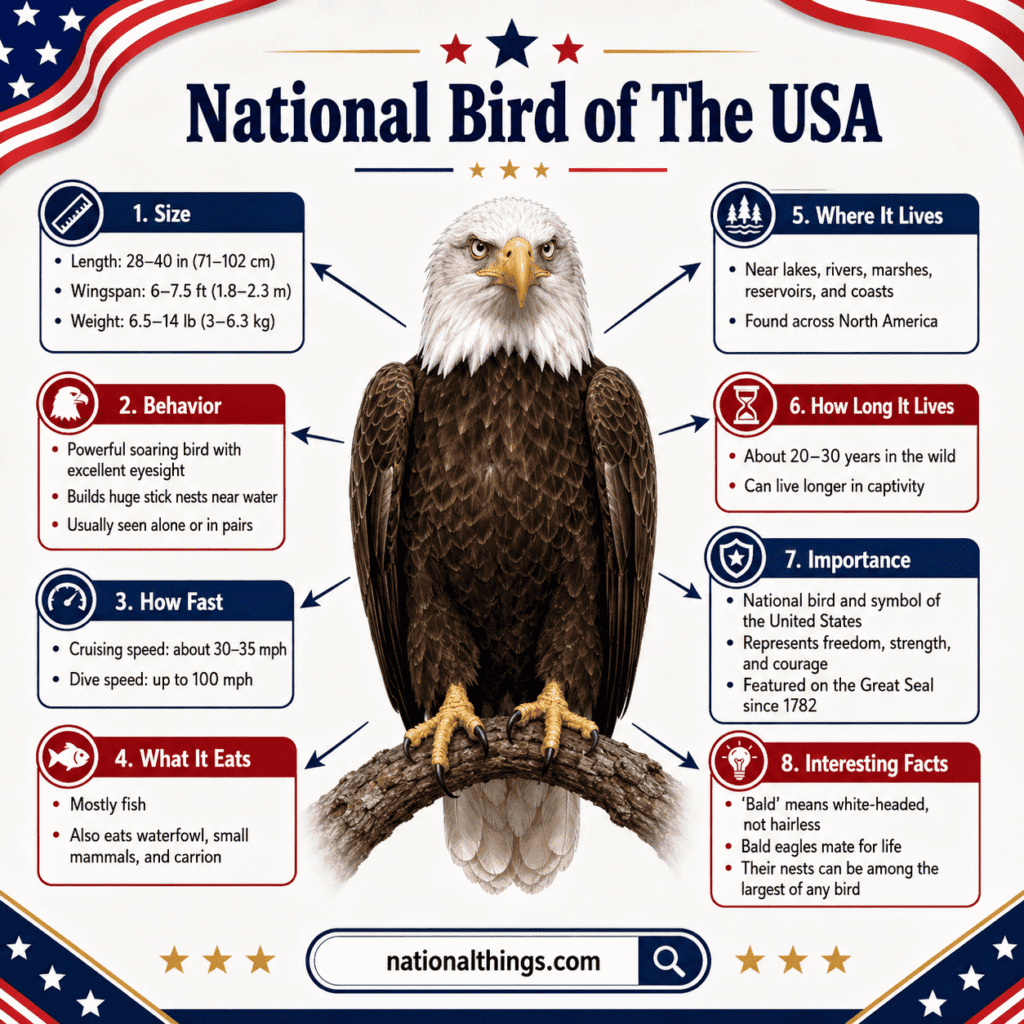
Here is a quick overview:
The bald eagle is officially a national bird, not a separately designated national animal. Birds are animals in science. However, lists of national symbols normally keep birds and mammals in separate categories.
President Joe Biden signed Public Law 118-206 on December 23, 2024. The law formally added the bald eagle to the United States Code as the national bird. The Senate had passed the bill by unanimous consent on July 29, 2024. The House passed it by voice vote on December 16, 2024.
This legal action corrected an unusual gap in American law. The bald eagle had served as the country’s most famous bird symbol since 1782. Government agencies and the public often called it the national bird. Yet no federal law had formally given it that title until 2024.
The final wording is simple:
“The bald eagle (Haliaeetus leucocephalus) is the national bird.”
The designation appears under 36 U.S.C. Section 306. The law also explains that giving the bird an official title does not change existing government wildlife policies, regulations, or management decisions.
The bald eagle was chosen because it is a large, independent, and distinctly North American bird. Its strong appearance suited the image that the newly formed United States wanted to present. The bird can fly high, defend its territory, build enormous nests, and survive across many different environments.
Congress gave several reasons for confirming the designation:
The choice therefore rests on more than appearance. The bird connects American history, government, wildlife, culture, and conservation.
The bald eagle became part of the Great Seal of the United States on June 20, 1782. The Continental Congress approved the final design after six years of proposals and work by three different committees. Charles Thomson, Secretary of the Continental Congress, prepared the final design.
On the front of the Great Seal, the eagle appears with its wings open. It carries:
The number 13 represents the original 13 states. The olive branch represents the power and desire for peace. The arrows represent the country’s ability to defend itself. The eagle faces toward the olive branch, which places the visual focus on peace rather than conflict.
The Great Seal functions as an official mark of the United States Government. It appears on treaties, presidential documents, commissions, passports, diplomatic materials, and the reverse side of the one-dollar bill. The Secretary of State serves as the official custodian of the seal.
The National Bird of the USA carries several connected meanings.
The bald eagle can travel across wide areas and fly high above the land. This image has made it a natural symbol of freedom and independence.
Its large body, strong talons, hooked bill, and broad wings give it a powerful appearance. These physical features support its use as a symbol of national strength.
The Great Seal places an olive branch in one talon and arrows in the other. Together they show that the United States seeks peace but remains ready to defend itself.
The shield, stars, stripes, arrows, and motto on the Great Seal repeatedly use the number 13. They represent the original states joining together as one country.
The bald eagle nearly disappeared from much of the United States during the twentieth century. Its return now represents the value of wildlife protection, scientific action, and public responsibility.
An adult bald eagle has a dark brown body, dark wings, a white head, a white tail, a bright yellow bill, and yellow feet. The contrast between its white head and dark body makes an adult easy to recognize.
Young bald eagles look very different. Juveniles are mainly brown with uneven white patches on their bodies, wings, and tails. Their eyes and bills also look darker. They gradually develop the famous white head, white tail, pale eyes, and yellow bill as they mature. Full adult coloring normally appears when the bird is around four or five years old.
Adult bald eagles generally have these measurements:
The word “bald” does not mean that the eagle has no feathers. The name refers to its white-feathered head.
Bald eagles are native to North America. Their historic range extends from Alaska and Canada through the continental United States and into northern Mexico. The U.S. Fish and Wildlife Service describes the bald eagle as the only eagle species native only to North America.
Large populations live in:
Bald eagles usually choose places with open water, reliable food, and large trees. Common habitats include:
Some bald eagles now live near farms, towns, suburbs, and other developed areas. They may nest close to people when suitable trees and food remain available. During winter, groups often gather near open water where fish and other food are easier to reach.
Fish make up a major part of the bald eagle’s diet. The bird watches from a high tree, flies over the water, or moves close to the surface before catching prey with its talons.
Bald eagles may also eat:
The bald eagle is an opportunistic feeder. This means it uses the food that is easiest and safest to obtain. It may hunt live prey, eat carrion, or take fish captured by another bird. This flexible diet helps the species survive in many habitats.
Bald eagles build some of the largest bird nests in North America. A pair normally chooses a tall tree near a river, lake, marsh, or coast. Both the male and female help bring branches and other material to the nest.
A pair may return to the same nesting area for many years. Each season, the birds add new sticks and material. This repeated building can make the nest extremely large. Some nests reach about 10 feet across and may weigh close to 2,000 pounds. One recorded eagle nest reached about 20 feet deep and had an estimated weight of two tons.
The female usually lays one to three eggs, with two being common. Both parents protect the territory and care for the young. Bald eagle pairs often remain together for life. If one bird dies, the surviving bird may later accept another mate.
Bald eagles can live for 30 years or longer in the wild. Their survival depends on food supply, habitat quality, disease, weather, human disturbance, and exposure to dangerous materials.
Young eagles face the greatest risk during their early years. Those that reach adulthood gain the benefit of their large size, flying ability, and broad diet. Adults may continue using the same general nesting territory over many breeding seasons.
The bald eagle is not currently listed as threatened or endangered under the federal Endangered Species Act. The U.S. Fish and Wildlife Service removed it from that list on August 9, 2007 after a major population recovery.
Its removal from the endangered species list did not remove all protection. Bald eagles remain protected under:
These laws generally prohibit killing, capturing, selling, possessing, transporting, or disturbing bald eagles without legal authorization. Their eggs, nests, feathers, and body parts also receive protection. People planning construction or other work near an eagle nest may need guidance or a permit from the U.S. Fish and Wildlife Service.
Bald eagle numbers fell sharply because of several connected threats:
DDT created one of the most serious problems. Its breakdown product DDE collected in the food chain and caused thin eggshells in bald eagles and other birds of prey. Many eggs broke or failed to produce healthy young.
By 1963, federal surveys found only about 417 nesting pairs in the lower 48 states. The figure showed how close the bird had come to disappearing from many parts of the country.
The United States banned most uses of DDT in 1972. Government agencies also protected nesting habitat, enforced wildlife laws, restored eagle populations, reduced illegal shooting, and supported breeding and release programs. State agencies, conservation groups, landowners, researchers, and members of the public all contributed.
The results were substantial. The U.S. Fish and Wildlife Service’s 2020 update estimated about 316,700 bald eagles in the lower 48 states. This total included approximately 71,400 nesting pairs and represented a fourfold increase from the agency’s 2009 estimate. The estimate used aerial surveys conducted during 2018 and 2019 as well as additional data for areas that were difficult to survey from the air.
The bald eagle’s return is now one of the best-known examples of successful wildlife recovery in the United States. It also shows why removing a species from the endangered list does not mean that monitoring and protection should stop.
The bald eagle and golden eagle are separate species. Both are large birds of prey and both receive protection under federal law.
An adult bald eagle has:
A golden eagle has:
Young bald eagles can be harder to identify because they have not developed their white head and tail. Their mixed brown and white feathers may lead people to confuse them with golden eagles.
Only the bald eagle is the official National Bird of the USA.
The bald eagle appears across the federal government because of its place on the Great Seal. Its image appears in presidential, congressional, military, diplomatic, and departmental designs.
Common examples include:
The image used in each place may not look exactly the same. Some designs show a full eagle. Others use only the head, wings, or shape. The Great Seal remains the main official design connected with the national government.
Bald eagles have deep spiritual and cultural meaning for many Indigenous peoples and Tribal communities. Traditions differ among nations and communities, so the bird does not carry one single meaning for all Native peoples.
Eagle feathers and images may appear in ceremonies, songs, regalia, stories, dances, flags, art, and sacred practices. Federal law recognizes specific lawful access to eagle feathers and parts for enrolled members of federally recognized tribes through the National Eagle Repository and related permit systems.
This cultural importance existed long before the United States adopted the eagle as a federal symbol. A complete account of the national bird should therefore recognize both its government symbolism and its much older place in Indigenous cultures.
The bald eagle is the official national bird of the United States of America. Federal law formally confirmed the title on December 23, 2024.
Its scientific name is Haliaeetus leucocephalus. This name also appears in the federal law that designates the species as the national bird.
No. It had served as a national emblem since its adoption for the Great Seal in 1782. Congress did not add the formal national-bird title to federal law until 2024.
It is native to North America and has represented freedom, strength, independence, and national unity for more than two centuries.
The official federal title is national bird. The United States has not given the bald eagle a separate federal title of “national animal.”
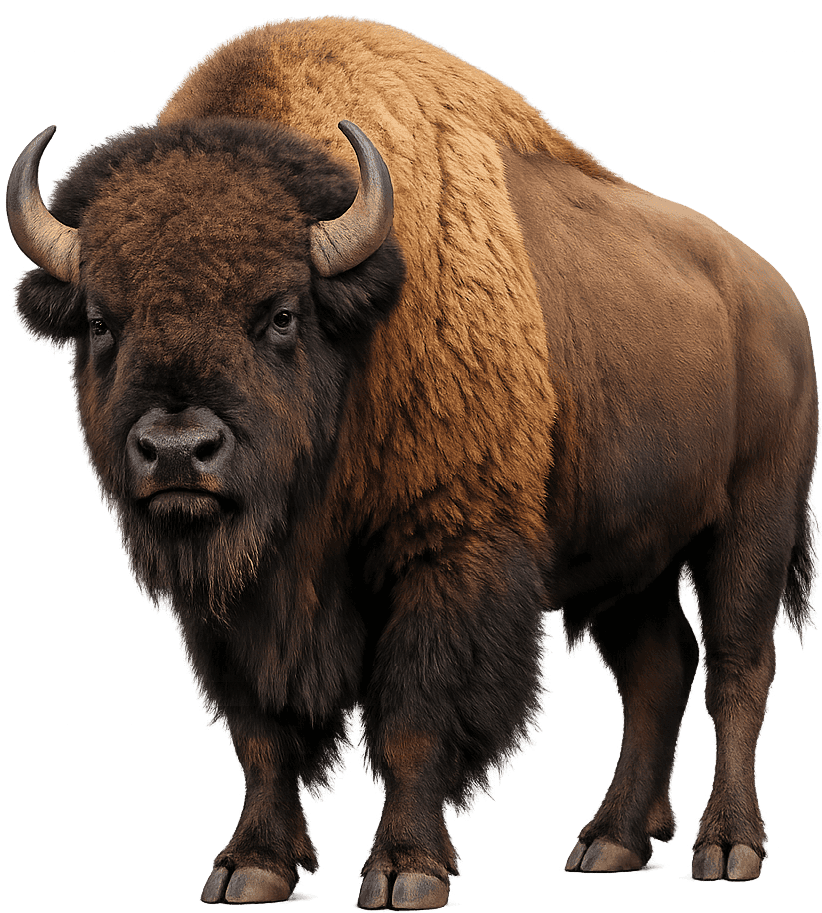
The American bison is the national mammal. This is a separate category from the national bird.
It is no longer listed as threatened or endangered under the federal Endangered Species Act. It remains protected by the Bald and Golden Eagle Protection Act and the Migratory Bird Treaty Act.
Federal law generally restricts the possession of bald eagle feathers and other parts. Limited lawful access exists through permits and special programs, including provisions connected with federally recognized Tribal religious practices.
They live across North America from Alaska and Canada through the United States and into northern Mexico. They commonly live near rivers, lakes, marshes, reservoirs, and coastal waters.
Use these authoritative sources to verify the legal status, history, biology, and protection of the bald eagle:
The National Bird of the USA is the bald eagle. The species became part of the Great Seal in 1782 and served as a national emblem for generations. Public Law 118-206 finally made the title official on December 23, 2024.
Its white head, broad wings, strong talons, and North American origin helped make it a symbol of freedom and strength. Its recovery from severe decline also gave the bird a modern meaning. It now represents the results that are possible when laws, scientific research, habitat protection, and public support work together.
You May Also Like