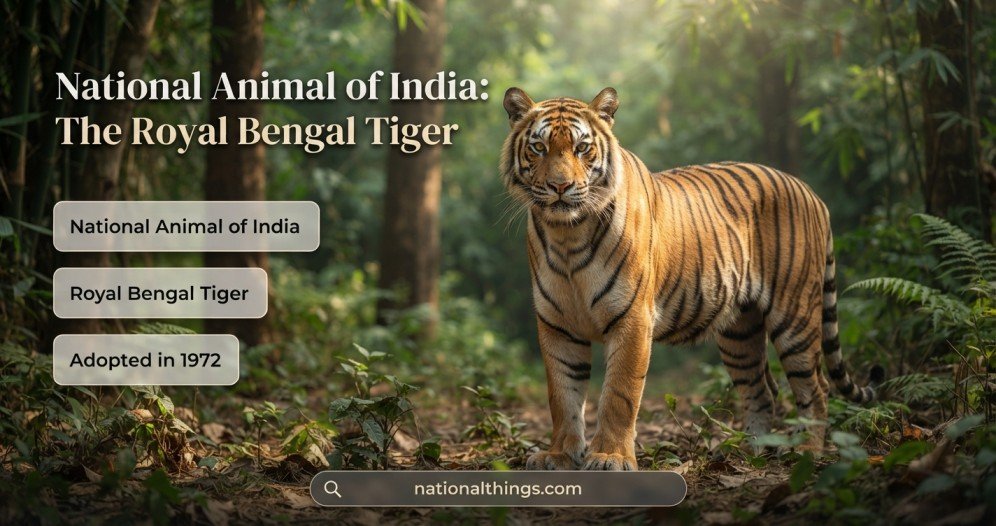
The national animal of India is the Royal Bengal Tiger, scientifically known as Panthera tigris tigris. Recognized for its powerful body, orange coat, black stripes, and strength, this magnificent big cat represents India’s wildlife heritage and natural diversity. India adopted the tiger as its national animal in 1973, replacing the Asiatic lion. The Royal Bengal Tiger symbolizes strength, courage, power, and grace, making it an important national symbol. It is also closely associated with India’s wildlife conservation efforts, particularly Project Tiger, which was launched in 1973 to protect the country’s declining tiger population.
The Royal Bengal Tiger is primarily found in India’s forests, grasslands, mangroves, and other suitable habitats, including the Sundarbans. As one of the world’s most recognizable wild cats, it plays an essential role in maintaining ecological balance as an apex predator. This article explores the tiger’s history, meaning, symbolism, physical characteristics, habitat, diet, conservation status, and interesting facts about its importance as India’s national animal.
What Is the National Animal of India?
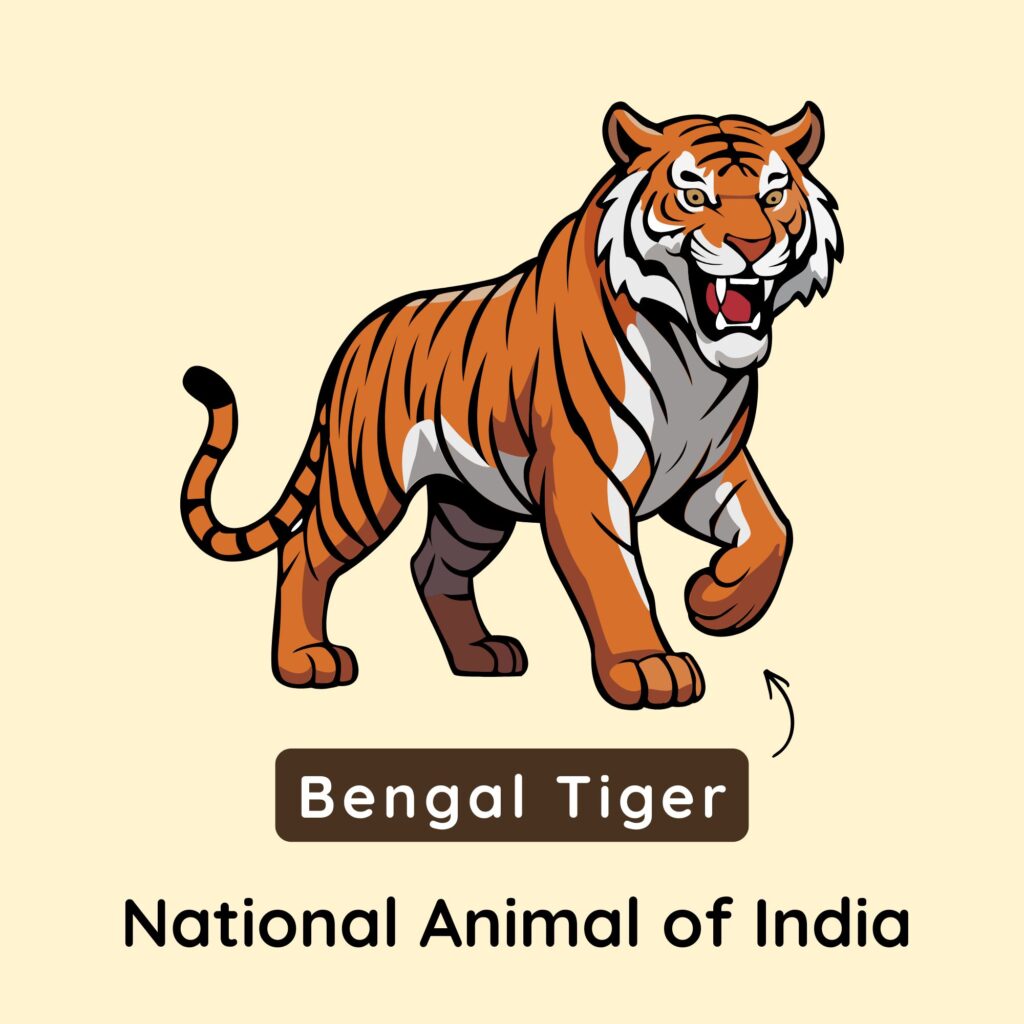
The Royal Bengal tiger is the national animal of India. It belongs to the cat family, Felidae, and is scientifically known as Panthera tigris tigris. This magnificent animal represents India’s rich wildlife heritage and is widely associated with strength, courage, and power.
The Bengal tiger is a subspecies of the tiger, not a separate animal species. It occurs naturally in India and neighboring parts of South Asia, including Bangladesh, Nepal, and Bhutan.
Quick Facts About India’s National Animal
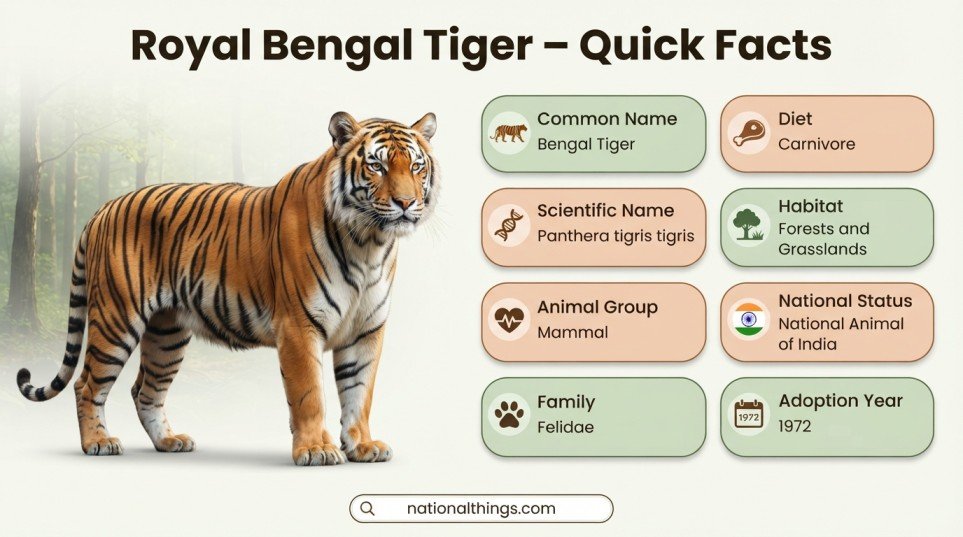
| Feature | Information |
|---|---|
| National Animal | Royal Bengal Tiger |
| Common Name | Bengal Tiger |
| Scientific Name | Panthera tigris tigris |
| Animal Group | Mammal |
| Family | Felidae |
| Order | Carnivora |
| Diet | Carnivorous |
| Natural Habitat | Forests, grasslands, and mangroves |
| National Status | National Animal of India |
| Adoption Year | Commonly reported as 1972; historical accounts also associate recognition with 1973 |
| Conservation Status | Endangered (tiger species) |
India is home to a major share of the world’s wild tiger population. The country protects this animal through national parks, tiger reserves, wildlife laws, and conservation programs.
Why Is the Bengal Tiger the National Animal of India?

India chose the tiger as its national animal because it represents strength, courage, agility, and majesty. Its impressive appearance and position as one of the strongest predators in the country’s forests make it an important symbol of India’s natural heritage.
Several qualities make the Bengal tiger a suitable national symbol:
- Strength: Its muscular body and powerful limbs represent physical strength and resilience.
- Courage: Its confident presence and hunting abilities are associated with bravery.
- Grace: Despite its large size, the tiger moves with remarkable control and agility.
- Wildlife heritage: It represents India’s diverse forests and rich natural environment.
- Ecological importance: As a top predator, it helps maintain balance in natural food chains.
The tiger also draws attention to the importance of protecting India’s wildlife. Its survival depends on healthy forests, sufficient prey, and connected natural habitats.
By recognizing the Bengal tiger as its national animal, India highlights the importance of conserving one of its most valuable wild species.
When Was the Tiger Declared the National Animal of India?
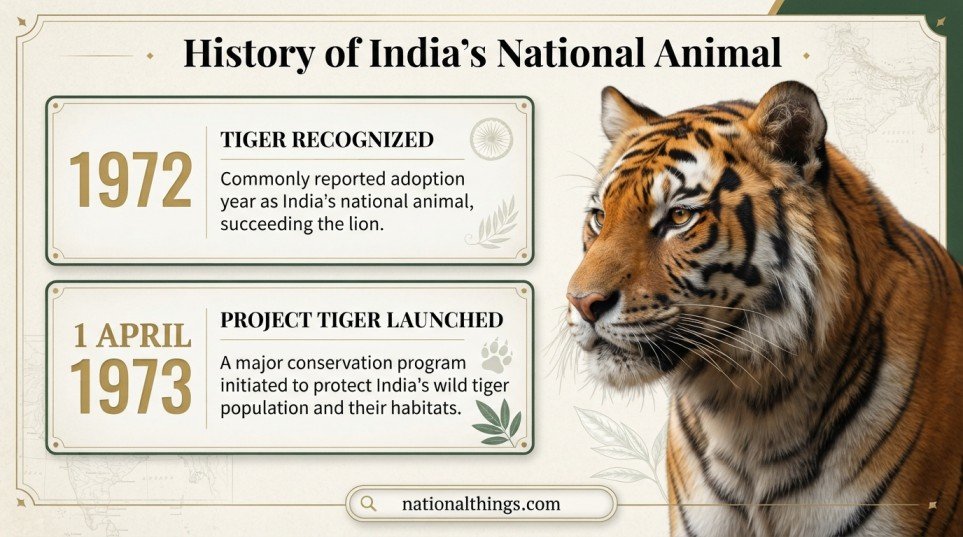
India’s recognition of the tiger as its national animal is commonly dated to 1972, although some historical accounts associate its formal recognition with 1973. The distinction matters because the country also launched Project Tiger in April 1973, a separate wildlife conservation initiative.
The tiger replaced the Asiatic lion as India’s national animal. The decision reflected the need to recognize and protect an important part of the country’s wildlife heritage.
The Indian Board for Wildlife is associated with the selection process. However, the exact date and administrative record of the designation should be checked against authoritative historical government documentation before presenting one date as definitively established.
National Animal Recognition and Project Tiger: Different Events
| Event | Year | Significance |
|---|---|---|
| Wildlife (Protection) Act | 1972 | Established an important legal framework for wildlife protection in India |
| Tiger national-animal recognition | Commonly reported as 1972; some accounts give 1973 | Recognized the tiger as India’s national animal |
| Project Tiger | 1973 | Introduced a dedicated national program for tiger conservation |
These events are closely connected to India’s wildlife protection history, but they do not represent the same decision or initiative.
What Does the Tiger Symbolize in Indian Culture?

The tiger symbolizes power, courage, strength, and royalty in Indian cultural traditions. Its presence in traditional artwork, stories, religious imagery, and regional heritage has helped establish it as one of the country’s most recognizable wild animals.
The animal has several cultural associations:
- Power and authority: Its strength and commanding appearance have made it a symbol of power in traditional representations.
- Courage: The tiger’s fearless image is often associated with bravery and determination.
- Royal heritage: Its historical presence in royal hunting traditions and artwork connects it with India’s royal past.
- Religious associations: Tigers appear in some regional depictions of Hindu deities and traditional religious art. For example, certain representations associate the tiger with Goddess Durga, although the lion is also a widely recognized traditional mount of the goddess.
- Traditional art: Tigers appear in paintings, sculptures, textiles, and decorative designs across different Indian regions.
These cultural connections demonstrate the tiger’s importance beyond its role as a wild animal.
However, its cultural significance should be distinguished from its official designation. The Royal Bengal tiger is India’s national animal, while other animals may have important religious, regional, or traditional associations without holding the same national status.
Physical Characteristics of the Royal Bengal Tiger
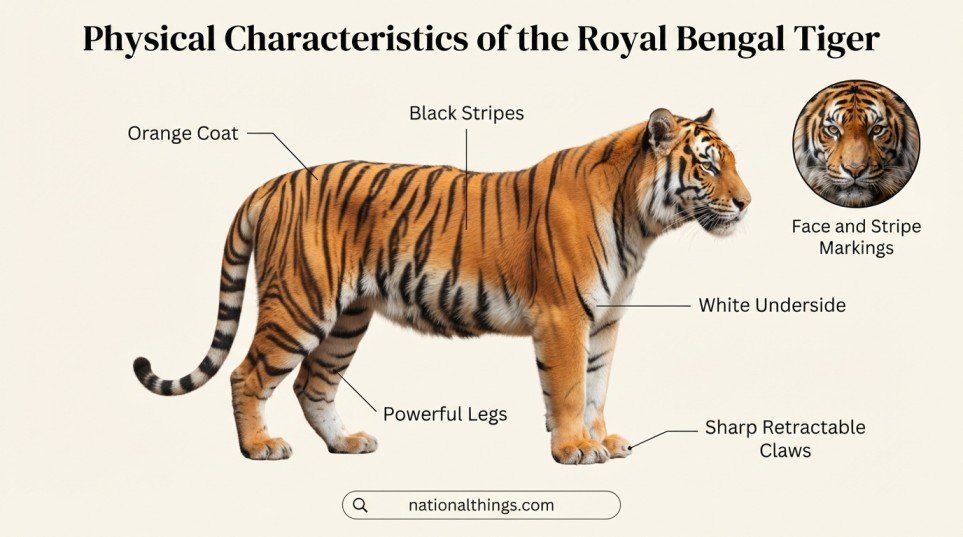
The Royal Bengal tiger is a large, muscular wild cat with an orange-yellow coat, black stripes, and a white underside. Its powerful body, strong jaws, sharp claws, and excellent senses make it an effective hunter.
Important Physical Features
1. Coat and stripes
The tiger has an orange or yellowish coat covered with dark vertical stripes. Its underside is generally white, while the face often has white markings around the cheeks and eyes.
Each tiger has a distinctive stripe pattern, much like a fingerprint. These markings help it blend into forest vegetation and grass.
2. Body size
Bengal tigers are among the largest wild cats in the world. Adult males are generally larger and heavier than females.
Typical adult measurements vary by habitat and individual:
- Male weight: Approximately 180–260 kg.
- Female weight: Approximately 100–160 kg.
- Body length: Generally around 2.5–3 metres, including the tail, although measurements vary.
3. Powerful legs and paws
The tiger has strong legs that help it run, jump, climb, and overpower prey. Its large paws contain sharp, retractable claws that assist in hunting and gripping.
4. Sharp teeth and jaws
Its long canine teeth and powerful jaw muscles help it capture and kill prey. These features make it an effective carnivorous predator.
5. Excellent senses
The Bengal tiger has strong eyesight, particularly in low light, along with sensitive hearing and a highly developed sense of smell. These abilities help it locate prey and detect other animals.
Where Does the Bengal Tiger Live in India?
The Bengal tiger lives in different parts of India, including tropical forests, grasslands, wetlands, and mangrove ecosystems. Its distribution extends across several major landscapes, although habitat availability and population density vary by region.

Himalayan Foothills and Terai Grasslands
The Himalayan foothills and Terai region contain important tiger habitats in northern India. These landscapes include tall grasslands, riverine forests, wetlands, and dense vegetation.
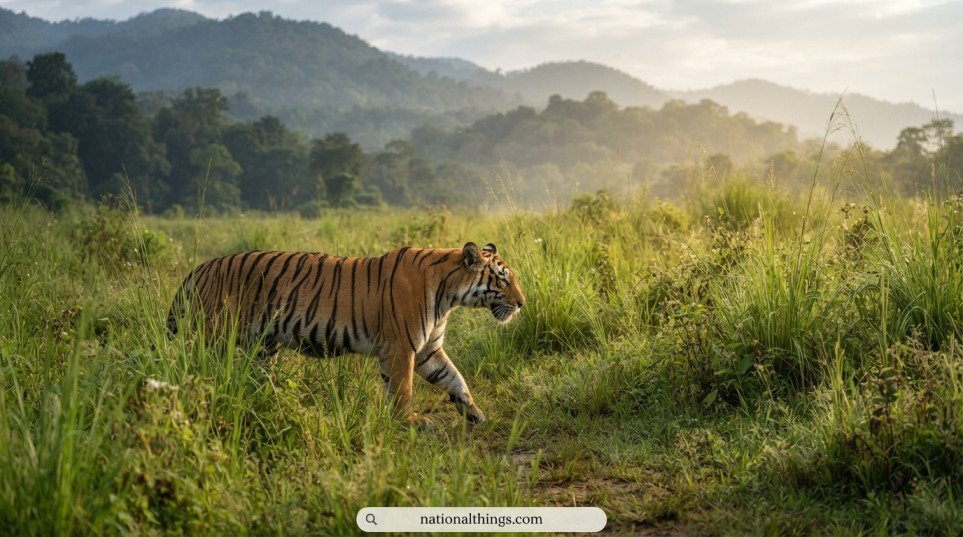
Important tiger landscapes include:
- Uttarakhand.
- Uttar Pradesh.
- Bihar.
- West Bengal.
- Parts of the Himalayan foothills.
Protected areas such as Jim Corbett National Park and Dudhwa National Park provide important habitats for Bengal tigers.
The combination of forests, water sources, and grasslands supports prey animals and provides suitable conditions for tiger survival.
Central Indian Forests
Central India contains some of the country’s most important tiger habitats. Its forests support deer, wild boar, and other prey animals that provide food for tigers.
Important tiger landscapes include:
- Madhya Pradesh.
- Maharashtra.
- Chhattisgarh.
- Parts of Rajasthan and adjoining regions.
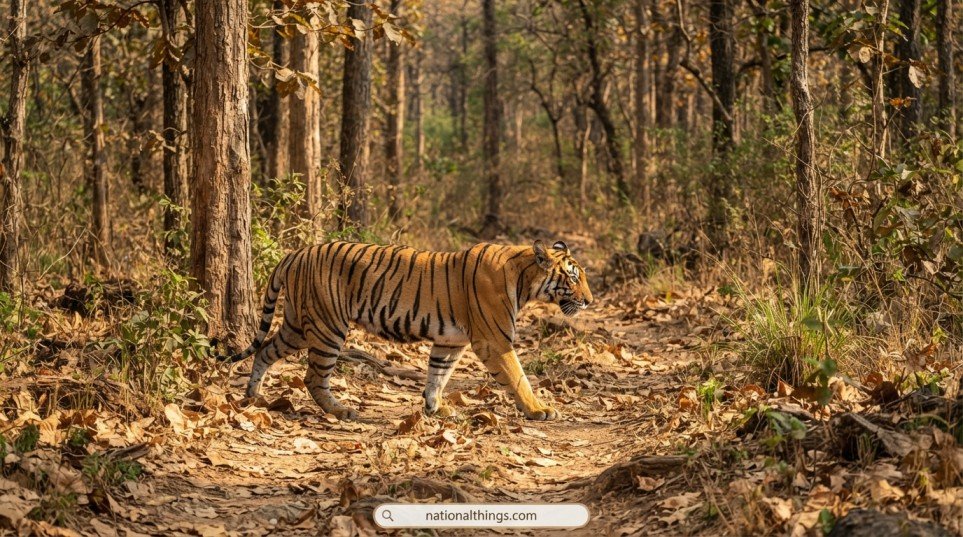
Famous protected areas include Kanha National Park, Bandhavgarh National Park, Pench Tiger Reserve, and Tadoba-Andhari Tiger Reserve.
These forests also form part of larger wildlife landscapes that connect different protected areas.
Western Ghats
The Western Ghats are an important mountain range along India’s western side. Their tropical forests, valleys, and protected landscapes support a wide range of wildlife, including Bengal tigers.

Important tiger habitats occur in:
- Karnataka.
- Kerala.
- Tamil Nadu.
Major protected areas include Nagarhole National Park, Bandipur National Park, Periyar Tiger Reserve, and Mudumalai Tiger Reserve.
The forests of the Western Ghats provide shelter, water, and prey for tigers. Maintaining connections between these habitats is important for wildlife movement and long-term conservation.
Sundarbans Mangrove Forests
The Sundarbans is one of the most distinctive tiger habitats in India. Located in the Ganges-Brahmaputra delta, this vast mangrove ecosystem extends across India and Bangladesh.

The Indian Sundarbans provides a natural home for Bengal tigers that live among mangrove trees, tidal waterways, and muddy islands.
These tigers have adapted to a challenging environment:
- They can swim across waterways.
- They move through tidal channels and mangrove vegetation.
- They hunt suitable prey available in the mangrove ecosystem.
- They live in a landscape influenced by tides and changing water levels.
The Sundarbans demonstrates the Bengal tiger’s ability to survive in different natural environments.
What Does the Royal Bengal Tiger Eat?
The Royal Bengal tiger is a carnivore that mainly hunts other animals for food. It generally targets medium-sized and large mammals, depending on the prey available in its habitat.
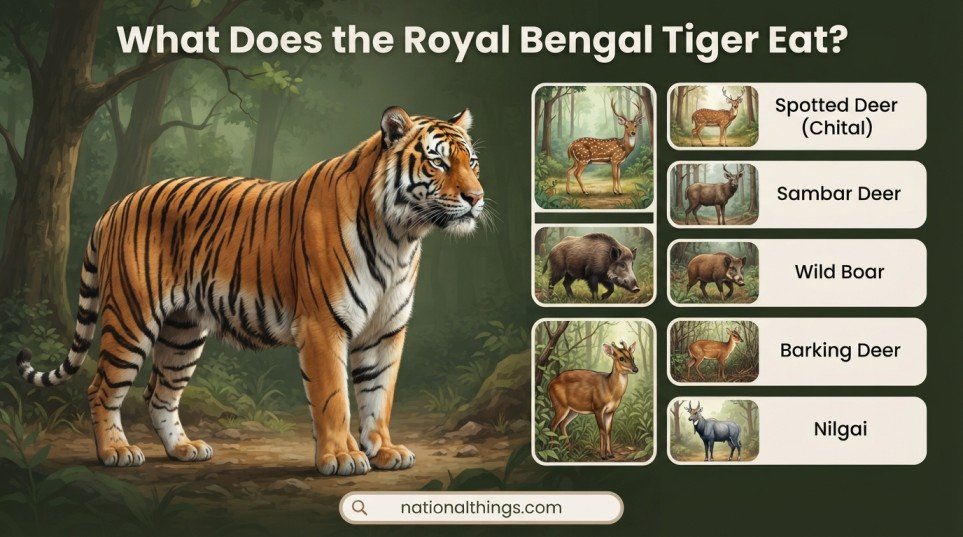
Common Prey Animals
Its diet may include:
- Spotted deer (chital).
- Sambar deer.
- Wild boar.
- Barking deer.
- Nilgai.
- Other suitable mammals.
In some regions, tigers may also hunt smaller animals when larger prey is unavailable.
How Does the Tiger Hunt?
Tigers usually hunt alone rather than in groups. They use their striped coats as camouflage and approach prey quietly before launching a short, powerful attack.
Their hunting process generally involves:
- Identifying suitable prey.
- Approaching quietly through vegetation.
- Getting close enough to attack.
- Using powerful forelimbs and jaws to capture the animal.
- Feeding after a successful hunt.
Tigers are ambush predators, so they rely more on stealth and strength than on long-distance pursuit.
As top predators, they help regulate prey populations and contribute to the balance of forest ecosystems.
Behavior and Interesting Facts About the Bengal Tiger
Bengal tigers are generally solitary animals that establish territories and spend much of their time hunting, resting, and moving through their habitats. They are powerful swimmers and usually avoid unnecessary contact with other adult tigers.

Interesting Facts About Bengal Tigers
1. Tigers usually live alone
Adult Bengal tigers generally live independently. They may come together temporarily during mating, while mothers stay with their cubs until the young animals become independent.
2. They are excellent swimmers
Unlike many domestic cats, tigers enjoy water and can swim across rivers and other waterways. Swimming helps them cool down and move through wet habitats.
3. Their stripes are unique
Every tiger has its own stripe pattern. These markings help researchers identify individual animals through camera-trap photographs.
4. Tigers are active hunters
They often hunt during the early morning, evening, or night. Their excellent low-light vision helps them move and locate prey when visibility is limited.
5. Female tigers raise their cubs
A female tiger usually gives birth to a small litter after a gestation period of approximately 100–110 days. The cubs depend on their mother for food, protection, and survival skills.
6. Tigers communicate in different ways
They use vocal sounds, scent markings, scratching, and body movements to communicate with other tigers and mark their territories.
7. They have strong territorial instincts
Adult tigers maintain territories that may vary considerably in size depending on prey availability, habitat quality, and the presence of other tigers.
These behaviors help the Bengal tiger survive as a solitary predator in diverse environments.
Project Tiger and India’s Tiger Conservation Efforts
Project Tiger is one of India’s most important wildlife conservation programs. The Government of India launched it on 1 April 1973 to protect declining tiger populations and conserve their natural habitats.

Before the program began, hunting, poaching, and habitat destruction had seriously threatened tiger populations. Project Tiger introduced a coordinated approach to protect the species and its ecosystems.
Main Objectives of Project Tiger
- Protect tiger populations: Reduce illegal hunting and poaching.
- Conserve natural habitats: Protect forests, grasslands, and other important ecosystems.
- Establish tiger reserves: Create protected areas where tigers can survive and reproduce.
- Protect prey species: Maintain healthy populations of animals that tigers depend on for food.
- Monitor tiger populations: Use scientific surveys, camera traps, and other monitoring methods.
- Reduce human-wildlife conflict: Improve management of interactions between communities and wildlife.
National Tiger Conservation Authority
The National Tiger Conservation Authority (NTCA) plays an important role in India’s tiger conservation system. It oversees key aspects of tiger reserve management, monitoring, and conservation policy.
The authority works with state governments and other wildlife organizations to improve protection measures.
Tiger Reserves in India
India has established a network of tiger reserves under its conservation framework. These protected areas provide important habitats for tigers and other wildlife.
Some well-known examples include:
| Tiger Reserve | State |
|---|---|
| Jim Corbett | Uttarakhand |
| Ranthambore | Rajasthan |
| Kanha | Madhya Pradesh |
| Bandhavgarh | Madhya Pradesh |
| Sundarbans | West Bengal |
| Bandipur | Karnataka |
| Nagarhole | Karnataka |
| Periyar | Kerala |
| Tadoba-Andhari | Maharashtra |
| Kaziranga | Assam |
Each reserve contributes to protecting tiger populations, conserving biodiversity, and maintaining natural habitats.
How Many Bengal Tigers Are Left in India?
India had an estimated 3,682 wild tigers in 2022, according to the country’s fifth All India Tiger Estimation. This assessment, released in 2023, reported a national estimate rather than an exact count of every tiger living in the country.
The survey estimated a range of approximately 3,167–3,925 tigers, reflecting the uncertainty involved in estimating wildlife populations.
India’s Tiger Population Over Time
The following figures show the estimated tiger population reported in successive national assessments.
| Assessment Year | Estimated Tiger Population |
|---|---|
| 2006 | 1,411 |
| 2010 | 1,706 |
| 2014 | 2,226 |
| 2018 | 2,967 |
| 2022 | 3,682 |
Estimated wild tiger population in India across national assessment years.
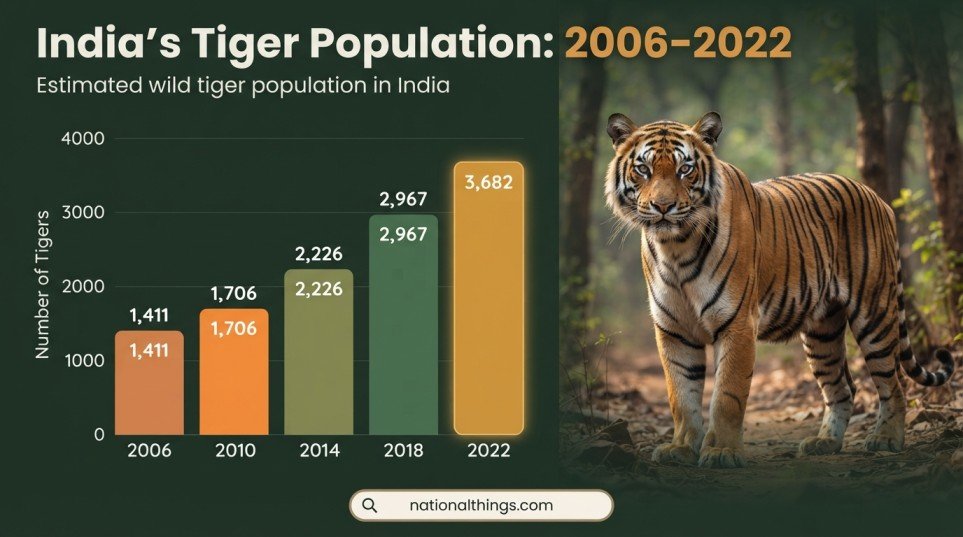
The figures indicate a substantial increase in India’s estimated tiger population over these assessment periods.
Why Is India’s Tiger Population Increasing?
Several conservation measures have contributed to the improvement:
- Stronger wildlife protection laws.
- Expansion and improved management of tiger reserves.
- Anti-poaching operations.
- Better wildlife monitoring.
- Protection of forests and prey populations.
- Increased public awareness about tiger conservation.
However, population growth does not mean that every tiger habitat is safe. Some regions still face serious conservation challenges.
Note: The 2022 assessment is the latest national population estimate identified in the research material available for this article. The figures should not be presented as a 2026 population count.
Is the Royal Bengal Tiger Endangered?
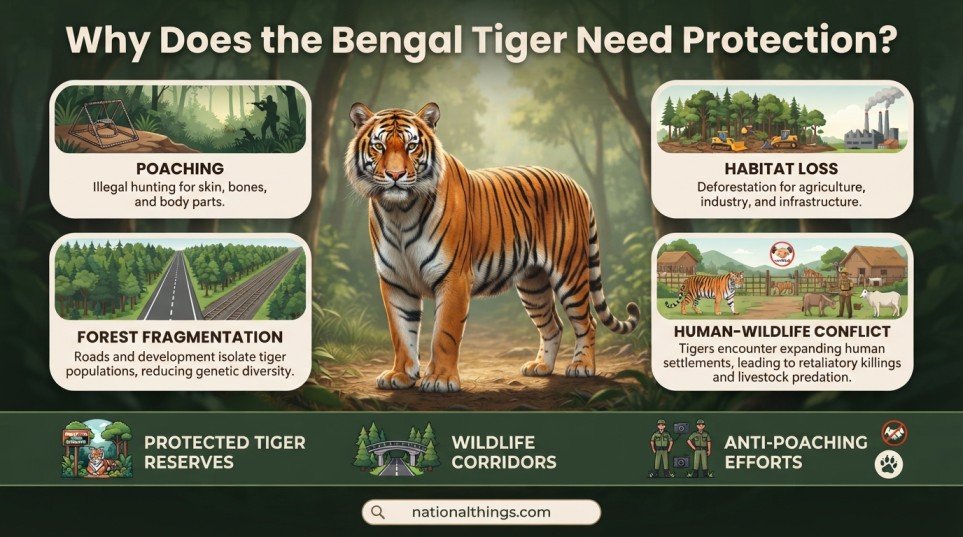
Yes. The tiger (Panthera tigris) is classified as Endangered on the International Union for Conservation of Nature (IUCN) Red List. Although India’s conservation efforts have helped increase its tiger population, the species continues to face threats across its natural range.
Major Threats to Bengal Tigers
1. Poaching
Illegal hunting remains a serious threat. Tigers are sometimes killed for their skins, bones, and other body parts used in illegal wildlife trade.
2. Habitat loss
Deforestation, agricultural expansion, roads, mining, and construction can destroy natural tiger habitats.
3. Habitat fragmentation
When large forests become divided into smaller areas, tigers may struggle to move between habitats. This can reduce breeding opportunities and genetic exchange.
4. Human-wildlife conflict
As human settlements and activities expand near tiger habitats, encounters between people and tigers may increase. Such conflicts can result in injuries, livestock losses, and retaliatory killings.
5. Declining prey populations
Tigers depend on healthy populations of deer, wild boar, and other prey animals. Hunting and habitat degradation can reduce the availability of food.
Why Are Tiger Conservation Efforts Important?
Protecting tigers also helps protect the wider ecosystems in which they live.
Conservation measures support:
- Forest biodiversity.
- Healthy prey populations.
- Natural food chains.
- Wildlife corridors.
- Water and forest ecosystems.
Protecting the Bengal tiger therefore contributes to the preservation of many other plant and animal species.
Royal Bengal Tiger vs. White Tiger: What Is the Difference?
The Royal Bengal tiger and the white tiger are not separate tiger species. A white tiger is a Bengal tiger with a rare inherited genetic condition that produces a pale coat and dark stripes.

Comparison Between Bengal Tigers and White Tigers
| Feature | Royal Bengal Tiger | White Tiger |
|---|---|---|
| Coat Color | Orange or yellowish | White or creamy |
| Stripes | Black | Dark brown or black |
| Eye Color | Usually golden or amber | Often blue |
| Genetic Background | Typical pigmentation | Rare recessive color variant |
| Species | Panthera tigris | Panthera tigris |
| National Status | India’s national animal | Not a separate national animal |
Why Are Some Tigers White?
White coloration results from a rare recessive genetic variant that affects pigmentation. A white tiger is not an albino because it retains dark stripes and other pigmentation.
Both parents must carry the relevant genetic variant for a cub to inherit the white coat.
Are White Tigers Found in the Wild?
White tigers have historically been recorded in the wild in the Indian subcontinent, but they are extremely rare. Most white tigers seen today live in captivity.
Their unusual appearance does not make them a separate species or a different national symbol.
The Royal Bengal tiger with its typical orange coat and black stripes remains India’s national animal.
References and Sources
- National Tiger Conservation Authority (NTCA) – India’s tiger conservation programmes and official information.
- Ministry of Environment, Forest and Climate Change, Government of India – Government policies and wildlife conservation information.
- IUCN Red List – Tiger (*Panthera tigris*) – Species conservation status and assessment information.
- World Wildlife Fund (WWF) – Tiger – Tiger characteristics, habitat, threats, and conservation.
FAQs About India’s National Animal
The scientific name of India’s national animal, the Royal Bengal tiger, is Panthera tigris tigris. It is a subspecies of the tiger and belongs to the cat family, Felidae.
Yes. Royal Bengal tiger and Bengal tiger are commonly used names for the same tiger subspecies, Panthera tigris tigris. The word Royal is an honorific commonly used for this animal.
India chose the tiger because it represents strength, courage, grace, and power. Its importance as a top predator also highlights the country’s rich wildlife heritage and conservation responsibilities.
The adoption is commonly dated to 1972, although some accounts associate its formal recognition with 1973. This date should be distinguished from Project Tiger, which began in April 1973.
The national-animal designation recognizes the tiger as India’s national symbol. Project Tiger is a wildlife conservation program launched in April 1973 to protect tiger populations and their habitats.
No. Bengal tigers also occur in Bangladesh, Nepal, and Bhutan. India contains a major share of the world’s remaining wild Bengal tiger population.
No. India’s national animal is the Royal Bengal tiger. A white tiger is a rare color variant of the Bengal tiger, not a separate species or national symbol.
India has established more than 50 tiger reserves under its national conservation program. The exact number changes as new reserves receive official recognition, so the latest NTCA list should be consulted for the current total.