Types and List of National Symbols: Explained with Meanings
Types of National Symbols help people recognize a country through its flag, anthem, emblem, plants, animals, and traditions. But a…
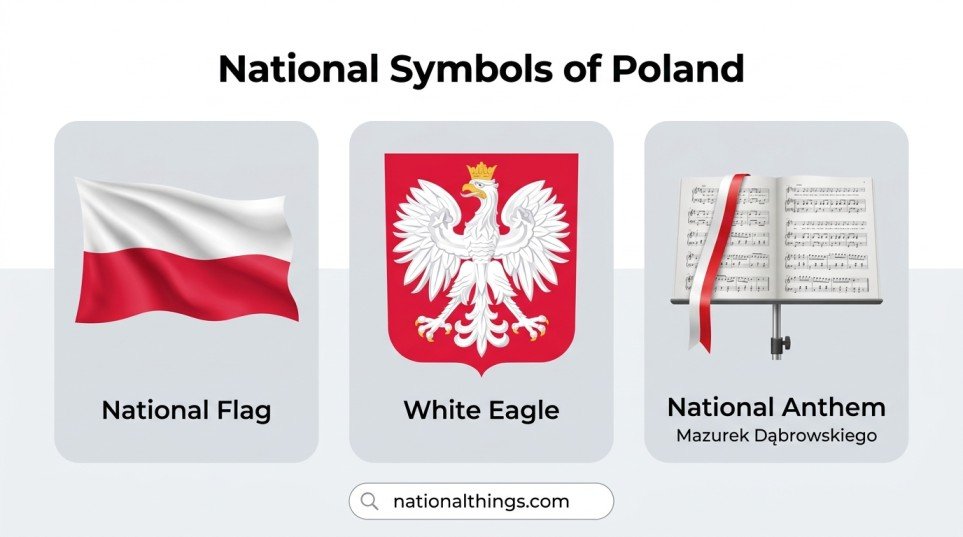
Poland’s national symbols include its white-and-red flag, the White Eagle coat of arms, and the national anthem, Mazurek Dąbrowskiego. These symbols represent the country’s sovereignty, historical identity, and determination to preserve its national heritage. Located in Central Europe, Poland has a long history in which national emblems, patriotic songs, and traditional colours have played important roles, particularly during periods when the country lost its independence. Other familiar associations, including the European bison and the artistic figure of Polonia, also contribute to Poland’s cultural identity. However, not every popular national symbol has official legal status. Understanding this distinction helps explain what Poland’s symbols represent and how they developed over time.
Poland’s main national symbols are the national flag, the White Eagle coat of arms, and the national anthem. Each has a distinct role in representing the country’s identity, sovereignty, and history.
Poland’s official state symbols are established under Article 28 of the country’s Constitution. The provision identifies the white eagle on a red field as the coat of arms, white and red as the national colours, and Mazurek Dąbrowskiego as the national anthem.
Other symbols also help express Polish identity, but their status differs. Some are historical or artistic representations, while others are associated with Polish wildlife, food, and cultural traditions. These associations should not automatically be treated as legally recognized national symbols.
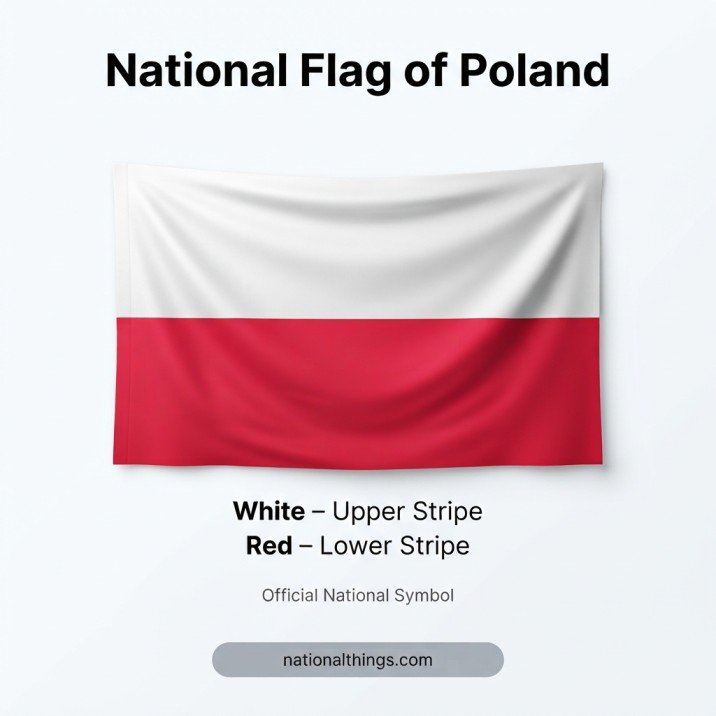
The flag of Poland consists of two horizontal stripes of equal width: white on top and red underneath. Its straightforward design reflects the country’s national colours, which are also represented in the Polish coat of arms.
White and red became important symbols of Polish identity during the nineteenth century, when Poland was divided among neighbouring powers. The colours helped people express their national allegiance even when Poland did not exist as an independent state.
Poland formally established its national colours in 1831. The national flag was officially adopted on 1 August 1919, following the restoration of Polish independence in 1918. Its design and use are now governed by Polish law.
The white and red colours of the Polish flag come from the country’s heraldic traditions. White corresponds to the white eagle, while red comes from the shield on which the eagle appears in the coat of arms.
These colours have become closely connected with Polish sovereignty, patriotism, and national unity. Their importance grew during periods of foreign rule, when displaying them could express support for Polish independence.
The colours are sometimes explained through broader symbolic interpretations, such as associating white with purity and red with courage or sacrifice. However, these interpretations should be distinguished from the documented heraldic relationship between the flag and the coat of arms.
Polish Flag Day takes place on 2 May each year. It honours the national flag and encourages people to display it as a sign of respect for the country’s heritage.
The Polish flag is also commonly displayed during important national observances, including:
These occasions connect the flag with the country’s history, civic traditions, and national identity. The legal rules governing flag display can differ according to the occasion, location, and type of institution.
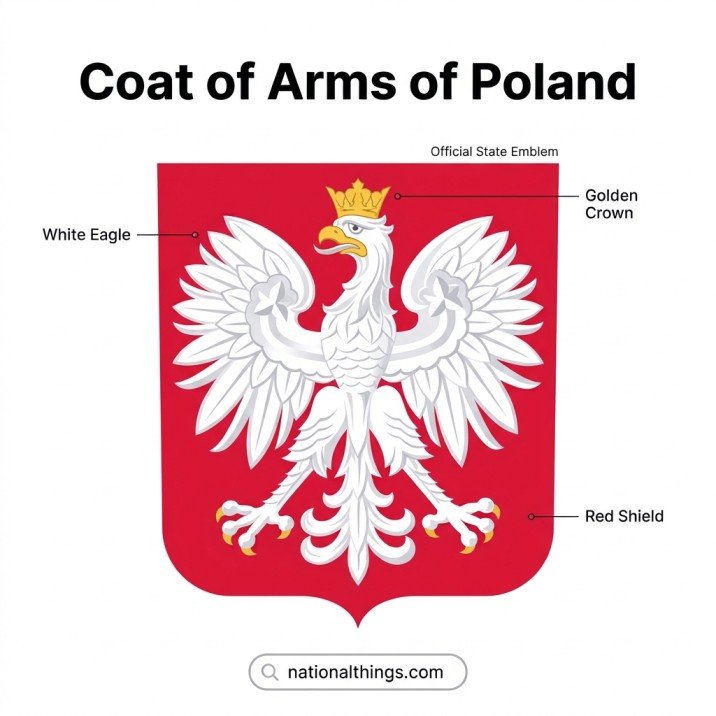
The White Eagle is the central figure in Poland’s national coat of arms. It appears as a white eagle with a golden beak and talons and a golden crown, placed against a red shield.
The emblem represents Polish statehood and has been associated with the country’s rulers and political institutions for centuries. Its design is formally established in Polish law, making it an official state symbol rather than merely a popular cultural image.
The eagle’s appearance has changed over time, reflecting developments in Polish political history. Despite these changes, it has remained one of the most recognizable representations of Poland.
A traditional Polish legend connects the White Eagle with Lech, a legendary founder associated with the origins of the Polish nation. According to the story, Lech saw a white eagle against a red sunset and chose the place as the site for a settlement.
The eagle’s nest is traditionally connected with the name Gniezno, one of the earliest important centres of Polish statehood. The legend explains the symbolic relationship between the eagle, the settlement, and the country’s national identity.
This story is part of Polish cultural tradition, not a fully documented historical account of the founding of the state. The eagle’s historical use as an emblem developed over time, and the legend should be understood separately from the evidence provided by historical records.
The White Eagle has appeared in different forms throughout Poland’s history. Polish rulers used eagle imagery as a mark of authority, and the emblem gradually became associated with the Polish state.
Several important developments shaped its modern appearance:
The restored crown is an important part of the emblem’s modern design. The White Eagle therefore represents both the continuity of Polish national identity and changes in the country’s political history.
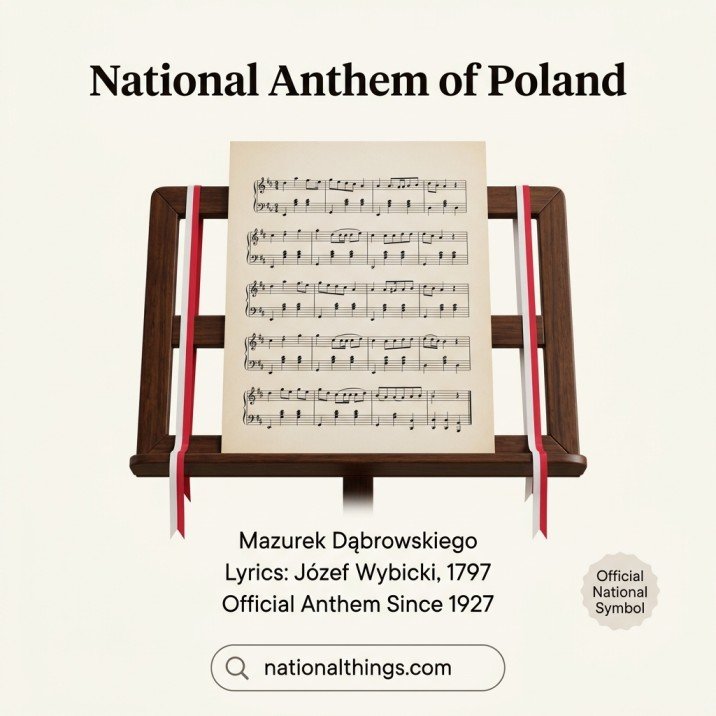
Poland’s national anthem is Mazurek Dąbrowskiego, commonly translated as Dąbrowski’s Mazurka. Its lyrics were written by Józef Wybicki in 1797, when Poland had been partitioned by neighbouring powers and no longer existed as an independent state.
The song was originally known as Pieśń Legionów Polskich we Włoszech, meaning Song of the Polish Legions in Italy. It was connected with Polish soldiers serving under General Jan Henryk Dąbrowski and became a patriotic expression of the continuing struggle for independence.
The anthem was officially adopted in 1927. Its origins in the late eighteenth century explain why it became such a powerful symbol of Polish national survival.
The national anthem expresses the belief that Poland would survive as long as the Polish people remained alive and determined to preserve their nation. Its opening words, commonly rendered in English as “Poland is not yet lost,” communicate hope in the face of political defeat.
The song’s historical meaning is closely connected with the partitions of Poland, which erased the independent Polish state from the map in the late eighteenth century. Rather than accepting the disappearance of their country as permanent, Polish patriots continued to pursue independence.
The anthem also refers to historical leaders and military struggles associated with that goal. Today, it represents national resilience, remembrance, and the continuing identity of the Polish people.
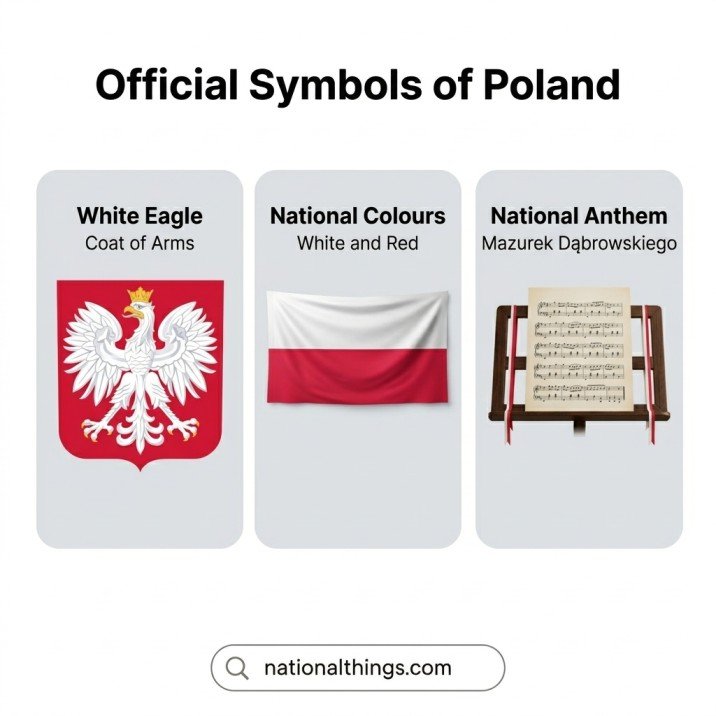
Poland’s Constitution identifies the White Eagle, the national colours, and the national anthem as the country’s central state symbols. Other items may have official significance under separate laws, but they should not be described as national symbols without evidence of the relevant designation.
A useful distinction is the difference between national symbols and other official state insignia. Government seals, military emblems, institutional badges, and ceremonial insignia can represent particular public bodies without being national symbols in the same constitutional sense.
For this reason, lists that present a national animal, flower, tree, or motto alongside the flag and anthem require careful checking. Cultural importance and widespread recognition do not automatically establish legal status.
Poland does not have a universally established official national motto equivalent to the three symbols identified in Article 28 of its Constitution. Historical patriotic expressions and political slogans may be important, but they should not be presented as an officially adopted national motto without supporting legal evidence.
The phrase Za wolność naszą i waszą, translated as “For our freedom and yours,” is associated with Polish struggles for freedom and international solidarity. It is a historically significant patriotic expression, not automatically an official national motto.
Other state insignia can have their own legal definitions and uses. When discussing them, writers should explain the relevant institution and purpose rather than treating every government emblem as a national symbol.
Poland has a rich natural heritage, and several animals are associated with its forests, landscapes, and conservation efforts. However, a widely recognized animal is not necessarily an officially designated national animal.
The European bison is one of the most prominent animals associated with Poland. It is particularly connected with the country’s protected forest landscapes and efforts to conserve this large European mammal.
Poland is also home to wolves, lynxes, storks, and other wildlife. These species are relevant to its biodiversity, but their presence in the country does not establish an official national-symbol designation.
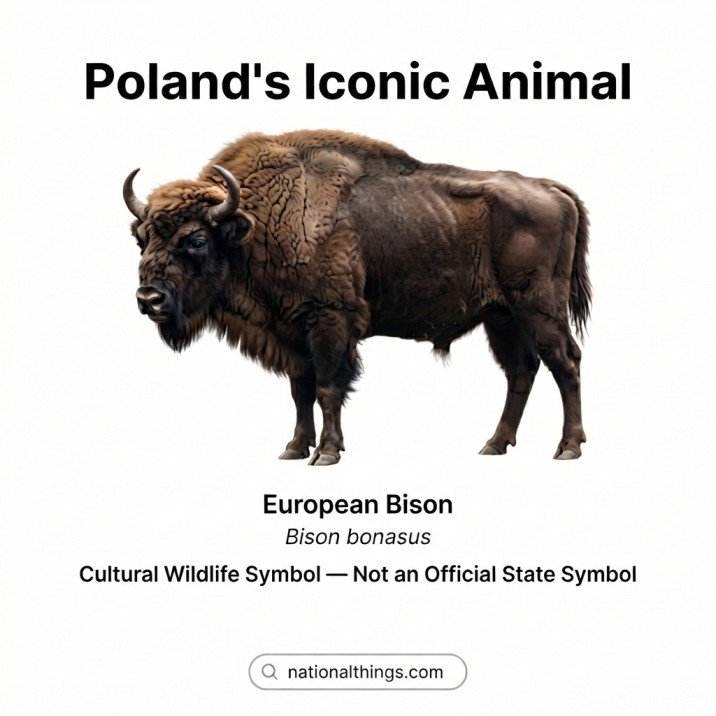
The European bison (Bison bonasus) is a large wild mammal associated with Poland’s forests and conservation history. It is particularly well known in connection with Białowieża Forest, a transboundary woodland shared by Poland and Belarus.
The species became an important focus of conservation after its numbers fell dramatically across Europe. Protection and reintroduction programmes helped restore wild populations, making the bison a significant example of wildlife conservation.
Its association with Poland makes it a suitable subject when discussing the country’s natural heritage. However, it should be described as a culturally and ecologically important animal rather than an officially designated national animal unless an authoritative source establishes that status.
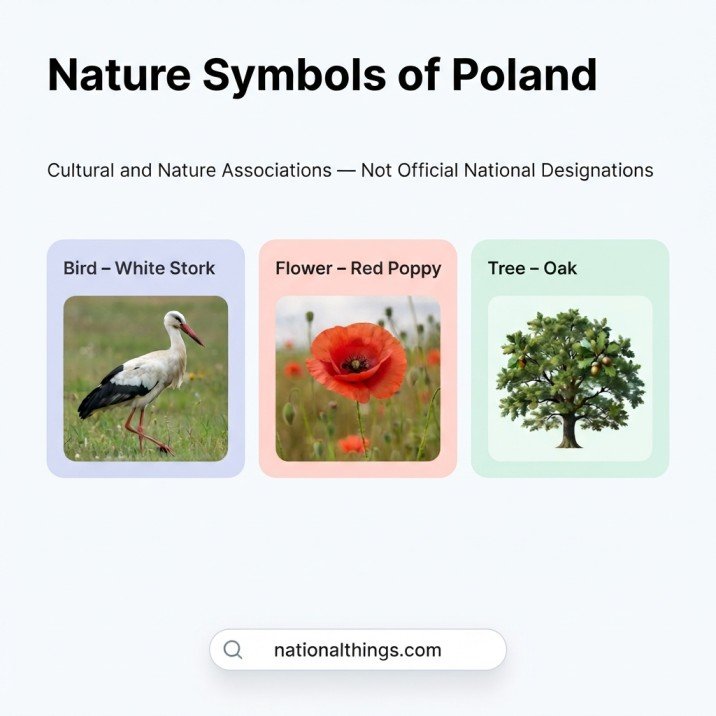
Poland has many notable bird and plant species, but claims about an official national bird, flower, or tree require separate verification. The country’s principal constitutional symbols do not establish a formal designation for each of these categories.
The following distinctions are important:
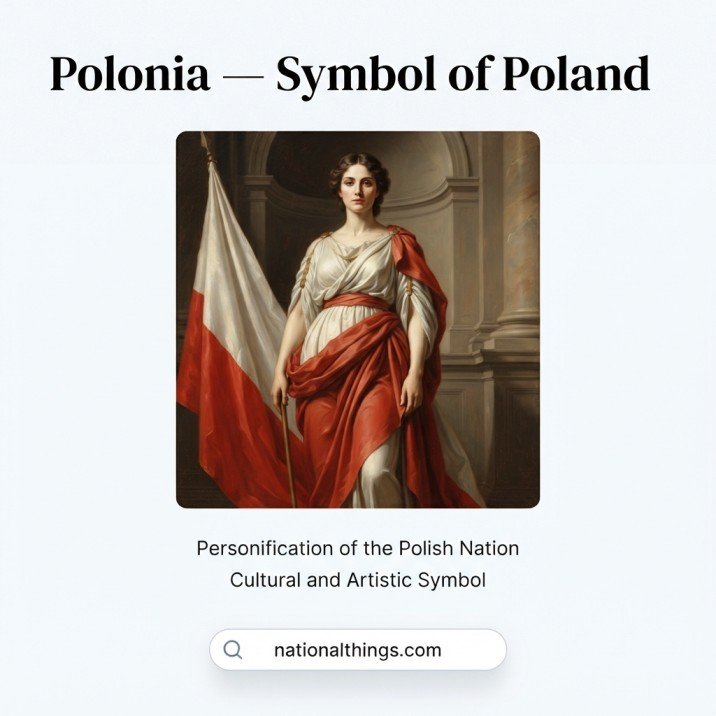
Polonia is a female allegorical figure representing Poland. Artists and writers have used this personification to express the country’s identity, historical suffering, patriotic hopes, and desire for independence.
The figure became particularly meaningful during periods when Poland was partitioned or ruled by foreign powers. In paintings and other artistic works, Polonia could represent a nation that continued to exist in the minds and loyalties of its people despite the absence of an independent state.
Artists have portrayed Polonia in different ways, including as a dignified national figure, a victim of oppression, or a symbol of resistance. These images reflect the political and cultural circumstances in which they were created.
Unlike the White Eagle or the national flag, Polonia is an artistic and cultural personification, not one of the three principal national symbols established by the Constitution. Nevertheless, she offers valuable insight into how Polish identity has been represented beyond official emblems.
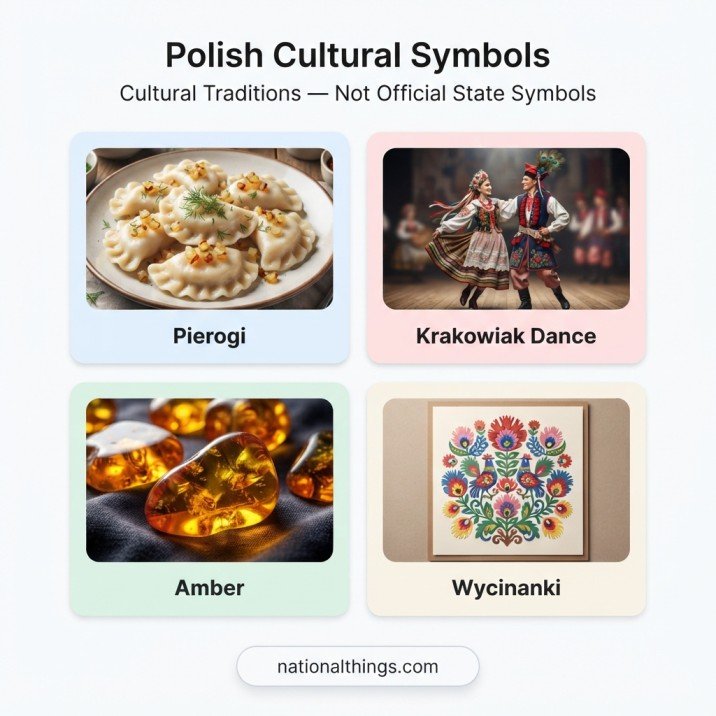
Polish identity is also expressed through traditional food, folk customs, music, crafts, and historical traditions. These associations provide cultural context, but they do not necessarily have official national-symbol status.
Examples include:
The European bison also belongs in discussions of Poland’s natural and cultural heritage, while Polonia represents its artistic and historical identity.
These examples show that national identity extends beyond official state symbols. However, a traditional dish, popular animal, or cultural practice should be described as a cultural association unless its formal national status can be demonstrated.
Poland’s national symbols reflect a history shaped by state formation, territorial change, foreign rule, and the restoration of independence. The flag, White Eagle, and anthem became powerful expressions of national continuity, particularly during periods when Poland’s sovereignty was threatened or absent.
The partitions of Poland in the late eighteenth century divided Polish territory among neighbouring powers. The Polish state disappeared from the political map in 1795, but national identity continued through language, traditions, patriotic movements, and cultural expression.
The anthem was written in 1797, only two years after the final partition. Its message expressed the determination of Polish patriots to restore their country. The national colours also became an important means of expressing solidarity during the nineteenth-century struggle for independence.
The Constitution of 3 May 1791 is another major milestone in Polish history. It sought to reform the Polish-Lithuanian Commonwealth and is remembered as an important constitutional achievement. It is a historical document, however, rather than a national symbol in the same formal category as the flag, coat of arms, or anthem.
Poland regained independence in 1918. The subsequent formal recognition of its national flag and the adoption of its anthem helped establish the symbols of the restored state. Later changes to the White Eagle, including the restoration of its crown in 1990, reflected further political developments.
Together, these symbols demonstrate how national identity can persist through political change. Their meanings come not only from their appearance but also from the historical events and public traditions associated with them.
The distinction between official and unofficial symbols helps prevent common misunderstandings about Poland’s national identity. The flag, coat of arms, and anthem have a defined constitutional status, while many other familiar associations are cultural, historical, or ecological.
| Symbol or association | Category | Official status | Meaning or significance |
|---|---|---|---|
| White-and-red flag | National flag | Official constitutional symbol | Represents Poland and its national identity |
| White Eagle on a red shield | Coat of arms | Official constitutional symbol | Represents Polish statehood |
| Mazurek Dąbrowskiego | National anthem | Official constitutional symbol | Expresses national survival and independence |
| European bison | Wildlife | No national-animal designation established here | Represents important wildlife and conservation heritage |
| White stork | Bird | No official national-bird designation established here | A familiar bird in Polish landscapes and rural life |
| Oak, pine, and other native trees | Plants | No official national-tree designation established here | Reflect Poland’s forest ecosystems |
| Polonia | Artistic personification | Cultural and historical representation | Represents Poland through allegory and art |
| Bigos and pierogi | Traditional foods | Cultural associations | Represent aspects of Polish culinary heritage |
| “For our freedom and yours” | Patriotic expression | Historical slogan, not established here as an official motto | Expresses freedom and solidarity |
Poland’s three main constitutional national symbols are its white-and-red flag, the White Eagle coat of arms, and the national anthem, Mazurek Dąbrowskiego. They represent the country’s identity, statehood, and historical resilience.
The White Eagle has a long history as an emblem of Polish rulers and statehood. A traditional legend links it with Lech and Gniezno, while its crowned form appears in Poland’s official coat of arms.
The white and red colours derive from Poland’s heraldic traditions. White corresponds to the White Eagle, and red comes from the shield in the coat of arms. Together, they represent Polish national identity.
The European bison is strongly associated with Poland’s wildlife and conservation heritage. However, an official national-animal designation is not established here, so it should not automatically be described as Poland’s legally designated national animal.
Poland has many notable flowers and birds, including native forest plants and the white stork. However, an official national flower or bird designation is not established here; such claims require confirmation from authoritative sources.
Poland’s national anthem is Mazurek Dąbrowskiego, meaning Dąbrowski’s Mazurka. Józef Wybicki wrote its lyrics in 1797, and it was officially adopted as the national anthem in 1927.