National Symbols of European Countries: Explained with History
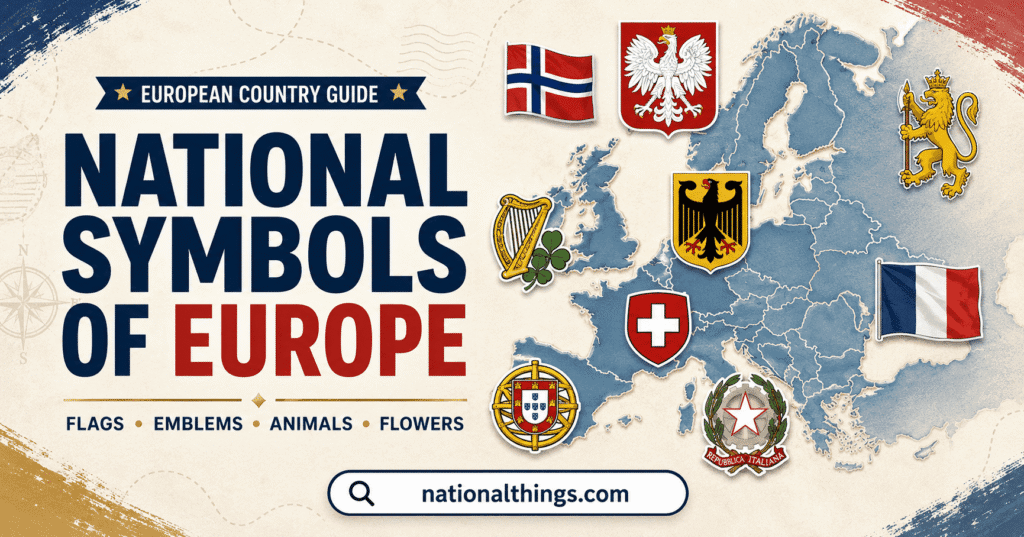
National Symbols of European Countries show how nations express their history, political identity, land, beliefs, and shared memory. A flag may recall a revolution. A coat of arms may preserve a royal or medieval design. An animal may appear in state heraldry without being an official national animal. These differences make European country symbols interesting, but they also create many errors in online lists.
This guide covers flags, emblems, anthems, animals, birds, plants, mottos, and cultural icons. It also explains which symbols have legal status and which ones are only traditional or popular.
Contents
39mn read
Introduction to the National Symbols of European Countries
Europe contains republics, monarchies, federal states, microstates, island countries, and transcontinental powers. Their symbols reflect this variety. Nordic countries often use cross flags. Several Slavic countries use red, white, and blue. Eagles appear in the arms of Poland, Germany, Albania, Serbia, Romania, Russia, and other states, but each eagle has a different history.
A reliable guide to the National Symbols of European Countries must not give every country the same fixed set of symbols. Every sovereign state has a flag and some form of state emblem, but many do not have a legally declared national animal, bird, flower, or tree.
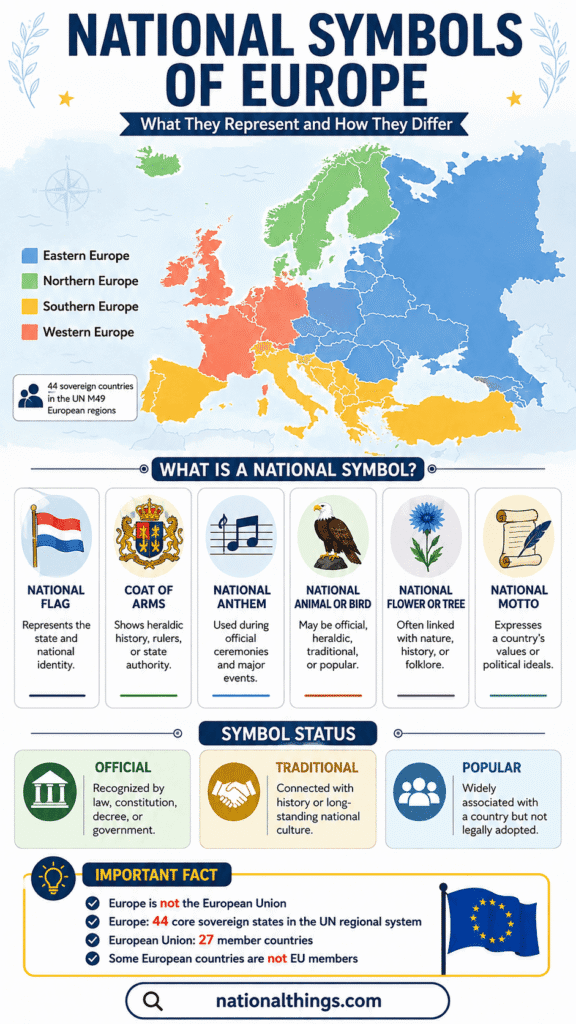
This article therefore uses clear status labels:
Official: Established by a constitution, law, decree, or state institution.
Heraldic: Shown on an official coat of arms or emblem.
Traditional: Connected with long national practice or history.
Popular: Widely associated with the country but not legally adopted.
Regional: Represents part of a country rather than the whole state.
What Does “National Symbol” Mean?
A national symbol is an image, object, song, phrase, plant, animal, or personification that represents a country. It may express state authority, national history, shared values, or cultural identity.
The strongest official symbols usually include:
The national flag
The coat of arms or state emblem
The national anthem
A constitutional or heraldic motto
A state seal
Official national colors
Other symbols may include a national animal, bird, flower, tree, monument, patron saint, traditional costume, or cultural figure. Their legal status differs from one country to another.
Official State Symbols
Official state symbols come from a recognized public authority. A constitution may define a flag. Parliament may approve an anthem. A heraldic law may regulate a coat of arms.
These symbols normally appear on:
Government buildings
Passports and identity documents
Embassies
Military uniforms
Official seals
State ceremonies
Coins and banknotes
A state symbol can have strict rules. Governments may define its exact colors, dimensions, placement, and permitted use.
Official Symbols Beyond the Flag and Emblem
Some European countries also recognize natural symbols. Estonia, for example, has clearly identified national birds, flowers, animals, and stones through public or institutional processes. Finland has a well-known group of nature symbols that includes the brown bear and whooper swan.
However, the word “national” does not always mean “created by law.” A bird may have been chosen through a public vote or promoted by a conservation organization. The body responsible for the designation should always be named.
Unofficial and Popular National Symbols
Popular symbols can be important without having legal status. The Russian bear, Spanish bull, Dutch tulip, French Gallic rooster, Irish shamrock, and Portuguese Barcelos rooster are strong examples.
These icons appear in:
Sports branding
Tourism campaigns
Political cartoons
Folklore
Souvenirs
Festivals
Popular art
They should be described as popular, traditional, or culturally associated, not automatically as official state symbols.
State Emblems, Coats of Arms, Seals, and Heraldic Badges
A coat of arms follows heraldic rules and normally contains a shield. It may also include crowns, supporters, helmets, mottos, orders, or plants.
A state emblem may use a more modern design. Italy’s emblem, for example, contains a white star, a cogwheel, an olive branch, and an oak branch. It is an official emblem, but it is not a traditional shield-based coat of arms.
A royal coat of arms may represent a monarch acting as head of state. It should not be confused with the monarch’s private badge, personal monogram, or household emblem.
Source and Verification Standards
A trustworthy symbols guide should give priority to:
National constitutions
Government websites
Parliamentary records
Royal or presidential offices
Heraldic authorities
Ministries of foreign affairs
National archives
Official cultural institutions
A symbol should not be called official only because many websites repeat the claim. The supplied outline also requires every entry to distinguish among official, institutional, traditional, historical, regional, and popular status.
National Symbols of European Countries
Which Countries Are Included in Europe?
The answer depends on the classification system. Geographic, political, historical, and cultural lists do not always include the same states.
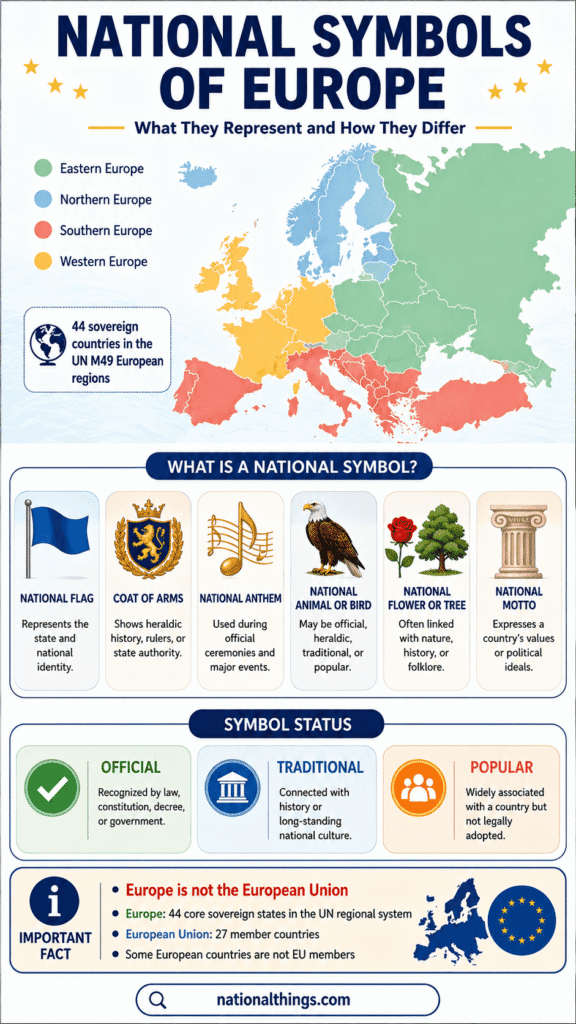
For consistency, this article uses the United Nations M49 geographic classification as its core. Its four European subregions contain 44 sovereign states: 10 in Eastern Europe, 10 in Northern Europe, 15 in Southern Europe, and 9 in Western Europe. The UN explains that these regional assignments exist for statistical use and do not express a political judgment.
Core European Country List
The 44-country core includes:
Eastern Europe: Belarus, Bulgaria, Czechia, Hungary, Poland, Moldova, Romania, Russia, Slovakia, and Ukraine.
Northern Europe: Denmark, Estonia, Finland, Iceland, Ireland, Latvia, Lithuania, Norway, Sweden, and the United Kingdom.
Southern Europe: Albania, Andorra, Bosnia and Herzegovina, Croatia, Greece, Vatican City, Italy, Malta, Montenegro, North Macedonia, Portugal, San Marino, Serbia, Slovenia, and Spain.
Western Europe: Austria, Belgium, France, Germany, Liechtenstein, Luxembourg, Monaco, the Netherlands, and Switzerland.
Russia is geographically transcontinental, but UN M49 places it in Eastern Europe.
Europe Is Not the Same as the European Union
Europe is a continent. The European Union is a political and economic organization.
The EU has 27 member countries, while the core UN European list has 44 sovereign states. Norway, Switzerland, Iceland, the United Kingdom, and several Balkan countries belong to Europe but not to the EU.
European Union, Council of Europe, Schengen Area, and Eurozone
These groups have different purposes and memberships:
European Union: A political and economic union of 27 countries.
Council of Europe: A human-rights organization with 46 member states.
Schengen Area: A travel zone with limited routine checks at internal borders.
Eurozone: The group of EU states using the euro. As of 2026, the euro is the official currency of 21 EU countries.
None of these membership lists provides a complete geographic definition of Europe.
Transcontinental and Politically European Countries
Broader European lists often include Armenia, Azerbaijan, Cyprus, Georgia, Kazakhstan, and Türkiye.
The UN M49 system places:
Armenia, Azerbaijan, Cyprus, Georgia, and Türkiye in Western Asia
Kazakhstan in Central Asia
Russia in Eastern Europe
Some of these countries still join European political, sporting, economic, or cultural institutions. They appear later in a separate section.
Kosovo and Disputed Recognition
Kosovo declared independence in 2008. Many countries recognize it as a sovereign state, while others do not. It is not a United Nations member.
Its flag, emblem, and anthem can still be described, but its political status needs a neutral note. The article should not imply either universal recognition or universal rejection.
Territories and Dependencies
Europe also contains territories that are not sovereign states. Examples include:
Åland Islands
Faroe Islands
Gibraltar
Guernsey
Isle of Man
Jersey
Svalbard and Jan Mayen
These places may have their own flags and arms, but they should not be counted as independent European countries.
European National Symbols
How Each Country Profile Should Be Organized
Each profile below covers the symbols with the clearest state or cultural importance:
Flag: Main colors and design
Emblem: Coat of arms or state emblem
Anthem: Current national anthem
Other symbol: A verified heraldic, traditional, or popular association
Status note: A warning where a cultural icon lacks official recognition
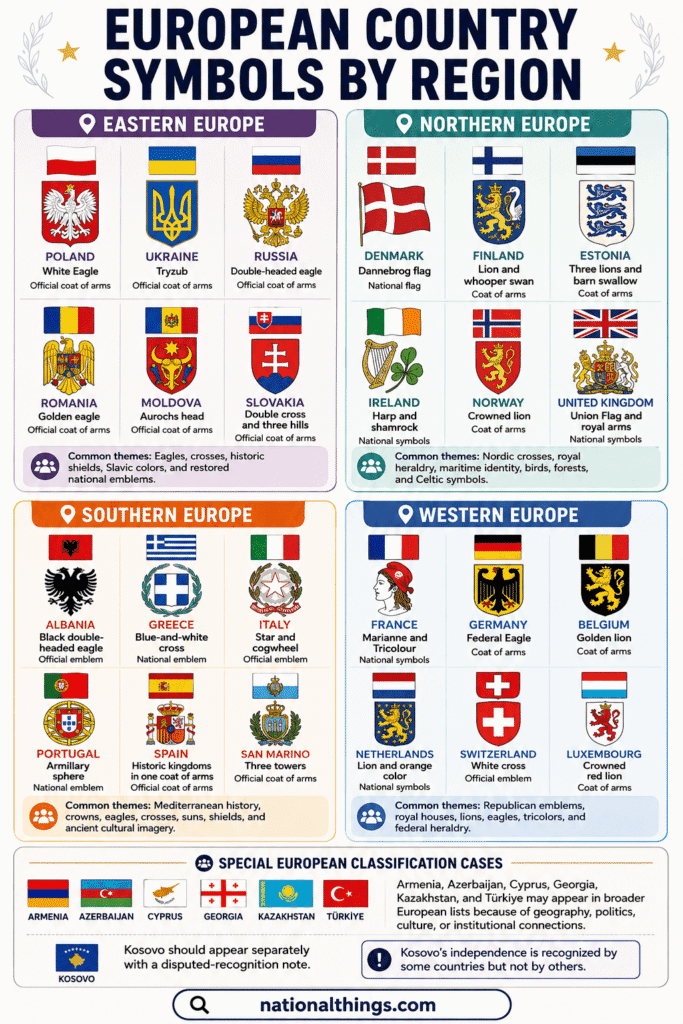
National Symbols of Eastern European Countries
The UN M49 system places ten sovereign states in Eastern Europe. Their symbols reflect Slavic traditions, Christianity, monarchy, imperial rule, independence movements, communist governments, and later political restoration.
Belarus
Flag: Red and green horizontal fields with a red-and-white decorative pattern near the hoist.
State emblem: A map of Belarus above sun rays, surrounded by grain, flowers, ribbons, and a red star.
Anthem: “My Belarusy,” meaning “We Belarusians.”
Popular natural symbols: The European bison and white stork have strong cultural links, but they should not replace the legally defined state symbols.
Historical white-red-white imagery should be clearly separated from the symbols used by the present Belarusian state.
Bulgaria
Flag: Three horizontal bands of white, green, and red.
Coat of arms: A crowned golden lion on a red shield, supported by two lions.
Anthem: “Mila Rodino,” meaning “Dear Motherland.”
Popular plant symbol: The rose has a major place in Bulgarian agriculture, perfume production, and tourism.
The lion is a heraldic state symbol. The rose is culturally important but should not automatically receive the same legal status.
Czechia
Flag: White and red horizontal fields with a blue triangle at the hoist.
Coat of arms: A quartered shield featuring the Bohemian lion and the eagles of Moravia and Silesia.
Anthem: “Kde domov můj,” meaning “Where Is My Home?”
Traditional tree: The linden has a long connection with Czech and wider Slavic identity.
“Czechia” is the official short English name. “Czech Republic” remains the formal political name and a common search term.
Hungary
Flag: Horizontal bands of red, white, and green.
Coat of arms: A divided shield with red and silver stripes, a double cross, three hills, and the Holy Crown.
Anthem: “Himnusz.”
Traditional figure: The Turul, a mythic bird of prey, appears in Hungarian origin stories and public monuments.
The Turul carries historical and cultural meaning, but it is different from the modern republic’s legally regulated arms.
Poland
Flag: Two horizontal fields, white above red.
Coat of arms: A crowned white eagle with a golden beak and claws on a red shield.
Anthem: “Mazurek Dąbrowskiego,” or “Dąbrowski’s Mazurka.”
Heraldic animal: The White Eagle is one of Europe’s clearest examples of an animal serving as a state emblem.
The eagle’s official status comes from the coat of arms. Claims about separate national flowers or trees require additional proof.
Republic of Moldova
Flag: Vertical bands of blue, yellow, and red, with the national arms in the center.
Coat of arms: An eagle holding a cross, olive branch, and sceptre, with an aurochs-head shield on its chest.
Anthem: “Limba noastră,” meaning “Our Language.”
Heraldic animal: The aurochs head connects the modern state with the historic Principality of Moldavia.
The similar Romanian and Moldovan tricolors should not hide their different state emblems and political histories.
Romania
Flag: Vertical bands of blue, yellow, and red.
Coat of arms: A golden eagle holding a cross, sword, and sceptre, with regional arms placed on its shield.
Anthem: “Deșteaptă-te, române!” meaning “Awaken Thee, Romanian!”
Popular animal: The lynx and brown bear appear in nature and tourism discussions, but the golden eagle has clearer heraldic status.
Romanian state symbols should be separated from Roman, Dacian, royal, and communist-era imagery.
Russia
Flag: Horizontal bands of white, blue, and red.
Coat of arms: A golden double-headed eagle carrying crowns, sceptre, and orb.
Anthem: “State Anthem of the Russian Federation.”
Popular animal: The bear is internationally associated with Russia but does not replace the double-headed eagle as the official state emblem.
Imperial, Soviet, military, regional, and current federal symbols need separate labels.
Slovakia
Flag: White, blue, and red horizontal bands with the national shield near the hoist.
Coat of arms: A white double cross standing on three blue hills against a red field.
Anthem: “Nad Tatrou sa blýska,” meaning “Lightning Over the Tatras.”
Landscape symbol: The Tatra Mountains hold strong cultural and geographic importance.
The double cross also appears in neighboring heraldic traditions, but its placement and national meaning are specifically Slovak.
Ukraine
Flag: Blue above yellow, commonly linked with sky over fields.
Coat of arms: The golden Tryzub, or trident, on a blue shield.
Anthem: “Shche ne vmerla Ukrainy,” commonly translated as “Ukraine Has Not Yet Perished.”
Popular plant: The sunflower has become a strong cultural image, but it should not be confused with a formally established state emblem.
Folk embroidery, Cossack symbols, religious images, and modern resistance imagery need clear historical or cultural labels.
National Symbols of Northern European Countries
Northern Europe includes Nordic, Baltic, Celtic, British, and maritime traditions. Several countries use cross flags, while the Baltic states use tricolors tied to national revival and restored independence.
Denmark
Flag: A white Nordic cross on red, known as the Dannebrog.
Coat of arms: Three crowned blue lions surrounded by red hearts.
Anthems: “Der er et yndigt land” serves as the civil national anthem, while “Kong Christian stod ved højen mast” serves as the royal anthem.
Popular bird: The mute swan gained national recognition through a public selection.
Symbols of Denmark should not be confused with those of Greenland or the Faroe Islands within the wider Kingdom of Denmark.
Estonia
Flag: Horizontal bands of blue, black, and white.
Coat of arms: Three blue lions on a golden shield.
Anthem: “Mu isamaa, mu õnn ja rõõm,” meaning “My Fatherland, My Happiness and Joy.”
Natural symbols: The barn swallow, cornflower, wolf, and limestone hold recognized national roles.
Estonia provides a useful example of a country with several clearly identified nature-based national symbols.
Finland
Flag: A blue Nordic cross on white.
Coat of arms: A crowned lion holding a sword and standing on a curved sabre.
Anthem: “Maamme,” meaning “Our Land.”
Natural symbols: The brown bear and whooper swan are widely recognized as the national animal and bird.
The lion comes from state heraldry, while Finland’s nature symbols developed through cultural and public recognition.
Iceland
Flag: A red Nordic cross edged in white on a blue field.
Coat of arms: A shield supported by four traditional guardian spirits: a bull, eagle or griffin, dragon, and giant.
Anthem: “Lofsöngur,” also known by its opening words, “Ó Guð vors lands.”
Cultural symbols: Volcanoes, glaciers, sagas, and the Icelandic horse have strong national associations.
These cultural icons are not equal in legal status to the flag and coat of arms.
Ireland
Flag: Vertical bands of green, white, and orange.
State emblem: The Irish harp.
Anthem: “Amhrán na bhFiann,” meaning “The Soldier’s Song.”
Popular plant: The shamrock is a major national and religious-cultural symbol.
The Republic of Ireland’s symbols should remain separate from all-island sporting symbols and the regional symbols of Northern Ireland.
Latvia
Flag: A narrow white band between two dark carmine bands.
Coat of arms: A rising sun, three stars, a lion, and a griffin.
Anthem: “Dievs, svētī Latviju!” meaning “God Bless Latvia!”
National bird: The white wagtail has a recognized place in Latvian national symbolism.
Latvian folk designs and traditional sun signs are culturally important, but not every pattern is a state emblem.
Lithuania
Flag: Horizontal bands of yellow, green, and red.
Coat of arms: The Vytis, a mounted knight carrying a raised sword.
Anthem: “Tautiška giesmė,” meaning “The National Hymn.”
National bird: The white stork is widely recognized in Lithuanian national culture.
Lithuania also uses a historical red flag with the mounted Vytis in certain official and ceremonial settings.
Norway
Flag: A blue Nordic cross edged in white on red.
Coat of arms: A crowned golden lion holding an axe.
Anthem: “Ja, vi elsker dette landet,” meaning “Yes, We Love This Land.”
Popular animal: The moose has a strong public and tourism association.
Viking ships, trolls, fjords, and reindeer are cultural or regional icons rather than automatic official national symbols.
Sweden
Flag: A yellow Nordic cross on blue.
State emblem: The Three Crowns.
Anthem: “Du gamla, Du fria,” used as the national anthem through custom rather than a single formal adoption law.
Popular animal: The moose is strongly associated with Swedish forests and rural identity.
Royal insignia must be distinguished from symbols representing the Swedish state as a whole.
United Kingdom
Flag: The Union Flag combines the crosses linked with Saint George, Saint Andrew, and Saint Patrick.
State heraldry: The Royal Arms feature a lion and unicorn, with different official versions used in Scotland and elsewhere.
Anthem: “God Save the King.”
Constituent symbols: England uses the Tudor rose, Scotland the thistle, Wales the daffodil and leek, and Northern Ireland has strong links with the shamrock and flax.
The United Kingdom and its four constituent nations do not share one identical set of flowers, patron saints, flags, or animals.
National Symbols of Southern European Countries
Southern Europe contains Iberian, Balkan, Mediterranean, Adriatic, Orthodox, Catholic, Islamic, republican, royal, and microstate traditions.
Albania
Flag: A black double-headed eagle on red.
State emblem: The same eagle, topped by the helmet linked with national hero Skanderbeg.
Anthem: “Himni i Flamurit,” meaning “Hymn to the Flag.”
Heraldic animal: The eagle is central to the country’s state identity.
The eagle has official status through the flag and emblem, while claims about separate national flowers or birds need verification.
Andorra
Flag: Vertical bands of blue, yellow, and red with the coat of arms in the center.
Coat of arms: Four quarters represent the Bishop of Urgell, the Count of Foix, Catalonia, and Béarn.
Anthem: “El Gran Carlemany,” meaning “The Great Charlemagne.”
Motto: “Virtus Unita Fortior,” or “United Virtue Is Stronger.”
The arms explain Andorra’s unusual position as a co-principality with two heads of state.
Bosnia and Herzegovina
Flag: A yellow triangle, blue field, and line of white stars.
State emblem: A shield using the same blue, yellow, and star design.
Anthem: The national anthem has official music but no officially adopted lyrics.
Historical symbol: The golden lily carries strong historical meaning but is not the current state emblem.
Entity, cantonal, ethnic, and national symbols must not be mixed together.
Croatia
Flag: Red, white, and blue with the national coat of arms.
Coat of arms: A red-and-white checkerboard shield topped by five smaller historical regional shields.
Anthem: “Lijepa naša domovino,” meaning “Our Beautiful Homeland.”
Historical animal link: The marten relates to the former currency name “kuna,” but Croatia now uses the euro.
The checkerboard is official. Many Dalmatian, Slavonian, and Istrian motifs represent regions rather than the entire country.
Greece
Flag: Nine blue-and-white stripes with a white cross in a blue canton.
National emblem: A white cross on a blue shield surrounded by laurel branches.
Anthem: The “Hymn to Liberty.”
Cultural symbols: The olive branch, owl, Parthenon, and figures from ancient mythology have strong cultural value.
Ancient Greek icons should not be described as modern legal state emblems without evidence.
Holy See and Vatican City
Flag: Two vertical fields of yellow and white, with crossed keys and a papal tiara on the white side.
Official arms: The crossed keys and papal insignia form the central heraldic system.
Anthem: “Inno e Marcia Pontificale,” or “Pontifical Anthem and March.”
Religious symbol: The crossed keys refer to Saint Peter.
Vatican City is a territorial state. The Holy See is the governing and diplomatic institution of the Catholic Church. Their roles are related but not identical.
Italy
Flag: Vertical green, white, and red bands.
National emblem: A white five-pointed star over a cogwheel, framed by olive and oak branches.
Anthem: “Il Canto degli Italiani,” commonly called “Fratelli d’Italia.”
Personification: Italia turrita, a woman wearing a mural crown, is a traditional national figure.
The modern republic’s emblem should remain separate from Roman imperial, papal, royal, and city-specific symbols.
Malta
Flag: White and red vertical fields with the George Cross in the upper hoist.
Coat of arms: A shield based on the flag, with a mural crown and plant branches.
Anthem: “L-Innu Malti.”
Cultural symbol: The eight-pointed Maltese cross has deep historical importance.
The Maltese cross is not the same design as the George Cross shown on the national flag.
Montenegro
Flag: Red with a gold border and the national coat of arms in the center.
Coat of arms: A golden double-headed eagle carrying a shield with a lion.
Anthem: “Oj, svijetla majska zoro,” meaning “Oh, Bright Dawn of May.”
Heraldic animals: The eagle and lion come from royal and state traditions.
Modern symbols should be separated from earlier Yugoslav, Serbian, and dynastic forms.
North Macedonia
Flag: A yellow sun with eight widening rays on red.
State emblem: Mountains, water, wheat, poppies, and a rising sun.
Anthem: “Denes nad Makedonija,” meaning “Today Over Macedonia.”
Historical image: Lion and sun designs occur in earlier and regional symbolism.
The current eight-ray flag should not be confused with the earlier Vergina Sun flag used during the 1990s.
Portugal
Flag: Green and red with the national arms over an armillary sphere.
Coat of arms: A shield with five smaller blue shields and seven castles.
Anthem: “A Portuguesa.”
Popular figure: The Barcelos rooster is a major folklore and tourism icon.
The rooster is culturally famous, but the armillary sphere and shield have clearer official status.
San Marino
Flag: White above light blue, often shown with the national coat of arms.
Coat of arms: Three towers on three peaks, surrounded by branches and topped by a crown.
Anthem: “Inno Nazionale della Repubblica,” an instrumental national anthem.
Motto: “Libertas,” meaning “Liberty.”
The three towers represent Guaita, Cesta, and Montale on Mount Titano.
Serbia
Flag: Red, blue, and white horizontal bands, with the lesser coat of arms on the state flag.
Coat of arms: A double-headed eagle carrying a shield with a cross and four firesteels.
Anthem: “Bože pravde,” meaning “God of Justice.”
Heraldic animal: The white double-headed eagle is a central state symbol.
Royal, Orthodox, Yugoslav, regional, and state imagery requires careful labeling.
Slovenia
Flag: White, blue, and red with the national coat of arms.
Coat of arms: Mount Triglav, two wavy lines for water, and three golden stars.
Anthem: “Zdravljica,” meaning “A Toast.”
Cultural symbols: The linden tree, Carniolan honey bee, and Lipizzaner horse have strong links with Slovenian heritage.
Mount Triglav has the clearest official place because it appears directly on the coat of arms.
Spain
Flag: Red, yellow, and red horizontal bands with the coat of arms.
Coat of arms: Symbols of historic kingdoms, the Bourbon-Anjou arms, a crown, and the Pillars of Hercules.
Anthem: “Marcha Real,” one of the few national anthems without official lyrics.
Popular animal: The bull has a strong cultural association but is not the complete state symbol.
Regional symbols of Catalonia, Galicia, the Basque Country, Andalusia, and other autonomous communities should remain clearly separate.
National Symbols of Western European Countries
Western European symbols include republican emblems, federal heraldry, royal insignia, multilingual anthems, and the arms of small principalities.
Austria
Flag: Three horizontal bands of red, white, and red.
Coat of arms: A black eagle carrying a sickle and hammer, with broken chains on its legs.
Anthem: “Land der Berge, Land am Strome,” meaning “Land of Mountains, Land by the River.”
Popular flower: Edelweiss has a strong Alpine association.
The broken chains represent liberation from National Socialist rule, while the sickle and hammer represent agriculture and industry.
Belgium
Flag: Vertical bands of black, yellow, and red.
Coat of arms: A golden lion on a black shield.
Anthem: “La Brabançonne,” used in the country’s main official languages.
Heraldic animal: The Belgian lion appears in federal symbolism.
Flanders, Wallonia, Brussels, and the language communities have their own flags and emblems. These do not replace Belgium’s federal symbols.
France
Flag: The blue, white, and red Tricolour.
Anthem: “La Marseillaise.”
Republican symbols: Marianne, the Gallic rooster, the fasces emblem, and the motto “Liberté, Égalité, Fraternité.”
Popular plant: The fleur-de-lis belongs mainly to royal and historical symbolism.
France does not rely on one conventional shield-style national coat of arms in the same way as many European monarchies and republics. Marianne and the Gallic rooster remain major republican representations.
Germany
Flag: Horizontal black, red, and gold bands.
Federal emblem: The Bundesadler, or Federal Eagle.
Anthem: The third stanza of the “Deutschlandlied.”
Traditional plant: Oak leaves have a long place in German heraldry, military decoration, coins, and cultural symbolism.
Current federal symbols must be kept separate from imperial, Nazi-era, East German, and regional state imagery.
Liechtenstein
Flag: Blue above red with a golden crown near the hoist.
Coat of arms: A complex shield representing the princely house’s historic territories and titles.
Anthem: “Oben am jungen Rhein,” meaning “High Above the Young Rhine.”
Dynastic symbol: The crown reflects the principality’s monarchical identity.
The personal and family arms of the prince should not be treated as identical to every state emblem or public flag.
Luxembourg
Flag: Horizontal red, white, and light blue bands.
Coat of arms: A crowned red lion on silver-and-blue stripes.
Anthem: “Ons Heemecht,” meaning “Our Homeland.”
Alternative flag: The Red Lion banner has official use in certain civil settings.
Luxembourg’s national flag often causes confusion with the Netherlands because of its similar layout.
Monaco
Flag: Red above white.
Coat of arms: The Grimaldi arms supported by two armed monks.
Anthem: “Hymne Monégasque.”
Motto: “Deo Juvante,” meaning “With God’s Help.”
Monaco’s flag resembles Indonesia’s, but Monaco commonly uses a different proportion. Its red and white colors come from the House of Grimaldi.
Netherlands
Flag: Horizontal red, white, and blue bands.
Coat of arms: A crowned golden lion holding a sword and arrows.
Anthem: “Wilhelmus,” one of the world’s oldest national anthems still in use.
National color: Orange comes from the House of Orange-Nassau.
Tulips, windmills, clogs, and bicycles are famous Dutch cultural icons, but they are not equal to the official flag and arms.
Switzerland
Flag: A white upright cross on a square red field.
Coat of arms: The same white cross on a red shield.
Anthem: “Swiss Psalm.”
Personification: Helvetia is a traditional female representation of Switzerland.
The Swiss cross should not be confused with the reversed-color Red Cross emblem, which has a separate humanitarian purpose.
Transcontinental and Other European Classification Cases
These countries often appear in European lists because of geography, history, politics, sport, or institutional membership. Under UN M49, however, Armenia, Azerbaijan, Cyprus, Georgia, and Türkiye belong to Western Asia, while Kazakhstan belongs to Central Asia.
Armenia
Flag: Horizontal red, blue, and orange bands.
Coat of arms: An eagle and lion supporting a shield that shows Mount Ararat and symbols of historic Armenian dynasties.
Anthem: “Mer Hayrenik,” meaning “Our Fatherland.”
Cultural symbol: Mount Ararat has central cultural importance, although it stands inside modern Türkiye.
Azerbaijan
Flag: Blue, red, and green horizontal bands with a white crescent and eight-pointed star.
State emblem: A flame inside an eight-pointed star, surrounded by wheat and oak.
Anthem: “Azərbaycan Marşı.”
Cultural symbols: Fire, carpets, pomegranates, and the Karabakh horse carry strong associations.
Cyprus
Flag: A copper-colored map of the island above two olive branches on white.
Coat of arms: A dove, olive branch, and the year 1960.
Anthem: The “Hymn to Liberty,” also used by Greece.
Symbolic themes: Copper, peace, and the island’s outline dominate the republic’s imagery.
Symbols of the Republic of Cyprus should not be merged with those used by the Turkish Cypriot administration in the north.
Georgia
Flag: A large red cross and four smaller red crosses on white.
Coat of arms: Saint George killing a dragon on a red shield supported by two lions.
Anthem: “Tavisupleba,” meaning “Freedom.”
Religious figure: Saint George has major historic and heraldic importance.
The country should be identified clearly as Georgia in the Caucasus, not the U.S. state.
Kazakhstan
Flag: A golden sun and steppe eagle on blue, with an ornamental band near the hoist.
State emblem: A shanyrak, mythical winged horses, and a star.
Anthem: “Menıñ Qazaqstanym,” meaning “My Kazakhstan.”
Classification note: Most of its territory lies in Central Asia, while a smaller part lies west of the Ural River in Europe.
Türkiye
Flag: A white crescent and star on red.
Official visual emblem: State institutions commonly use the crescent and star in circular forms, but Türkiye does not use one universally established European-style coat of arms.
Anthem: “İstiklâl Marşı,” meaning “Independence March.”
Popular animal: The grey wolf has cultural and political associations but requires careful context.
Kosovo
Flag: A golden map of Kosovo under six white stars on blue.
State emblem: A shield using the same map, stars, and blue field.
Anthem: “Europe,” an instrumental composition.
Status note: The six stars are generally presented as representing the country’s major communities.
Its symbols can be described as those used by Kosovo’s institutions while noting the continuing dispute over sovereignty.
European Countries Symbols by Regions
European Territories and Dependencies: Optional Supplementary Coverage
Territories can have their own strong identities and symbols. They should still remain outside a count of sovereign European states.
Åland Islands and the Faroe Islands
The Åland Islands form an autonomous, Swedish-speaking region of Finland. Their flag uses a Nordic cross in blue, yellow, and red.
The Faroe Islands form a self-governing territory within the Kingdom of Denmark. Their white flag carries a red Nordic cross edged in blue.
Gibraltar, Guernsey, Jersey, and the Isle of Man
Gibraltar: A British Overseas Territory using a castle-and-key flag.
Guernsey: A Crown Dependency with a red Saint George’s cross and a smaller golden cross.
Jersey: A Crown Dependency using a red diagonal cross and badge.
Isle of Man: A Crown Dependency represented by the three-legged triskelion.
Crown dependencies are not part of the United Kingdom, although the British Crown holds responsibility for them.
Svalbard and Jan Mayen
Svalbard and Jan Mayen appear together in some statistical and coding systems. They remain under Norwegian sovereignty and do not form an independent country with a separate set of sovereign national symbols.
Greenland
Greenland is an autonomous territory within the Kingdom of Denmark. Its red-and-white flag shows a divided circle. Geographically, Greenland belongs to North America, so it should appear only as a related territorial case in an article about Europe.
Major Categories of European National Symbols
The National Symbols of European Countries become easier to understand when grouped by type. Flags and emblems usually have the strongest legal protection. Natural and cultural symbols often have less formal status.
Flags of European Countries
European flags use several common structures:
Nordic crosses: Denmark, Finland, Iceland, Norway, and Sweden
Vertical tricolors: France, Italy, Ireland, Belgium, Romania, Moldova, and Andorra
Horizontal tricolors: Germany, Russia, the Netherlands, Hungary, Bulgaria, Lithuania, and others
Bicolors: Poland, Ukraine, Monaco, and Austria
Flags with state arms: Spain, Portugal, Croatia, Serbia, Slovakia, Slovenia, Moldova, Andorra, and others
Similar structures may come from religious, revolutionary, dynastic, Slavic, republican, or neighboring influences. Similarity does not prove a shared meaning.
National Emblems and Coats of Arms
Common European heraldic elements include:
Eagles
Lions
Crowns
Crosses
Stars
Shields
Swords
Mountains
Grain
Oak and olive branches
Royal regalia
An eagle can represent imperial continuity in one country, independence in another, and a medieval dynasty elsewhere. The design must be explained within its own history.
National Animals of European Countries
Reliable examples should be divided by status:
Heraldic animals: Polish eagle, Albanian eagle, Norwegian lion, Belgian lion, German eagle
Recognized natural symbols: Finnish brown bear and Estonian wolf
Popular associations: Russian bear, Spanish bull, Swedish moose, Dutch lion, and Welsh dragon
A heraldic animal is not automatically a separately declared national animal.
National Birds of European Countries
Bird designations may come from laws, public votes, cultural organizations, or conservation campaigns.
Examples include:
Estonia’s barn swallow
Latvia’s white wagtail
Lithuania’s white stork
Finland’s whooper swan
Denmark’s mute swan through public selection
The source and date of each designation should accompany any claim of official status.
National Flowers, Trees, and Plants
European plant symbols often reflect local landscapes and history:
Irish shamrock
Scottish thistle
English Tudor rose
Welsh daffodil and leek
Bulgarian rose
Finnish lily of the valley
Estonian cornflower
Czech linden
Austrian edelweiss as a popular Alpine symbol
Olive branches in Mediterranean heraldry
Some are official or institutionally recognized. Others come from custom, royal history, religion, or tourism.
National Anthems
Most European anthems contain lyrics, but important exceptions exist:
Spain’s “Marcha Real” has no official lyrics.
Bosnia and Herzegovina’s anthem has no officially adopted lyrics.
San Marino uses an instrumental anthem.
The United Kingdom changes “King” and “Queen” according to the reigning monarch.
Sweden uses “Du gamla, Du fria” through established custom.
The European Union’s anthem also contains no words. It uses the “Ode to Joy” theme from Beethoven’s Ninth Symphony and does not replace national anthems.
National Mottos
A motto may appear in a constitution, on a coat of arms, or only through historical convention.
Clear examples include:
France: Liberty, Equality, Fraternity
Belgium: Unity Makes Strength
Andorra: United Virtue Is Stronger
Monaco: With God’s Help
San Marino: Liberty
Switzerland: One for All, All for One, widely traditional rather than a single constitutional motto
The location and legal basis of a motto should always be stated.
National Colors
National colors may come from:
The flag
A ruling dynasty
Military uniforms
Sports teams
Historic banners
Public custom
Orange represents the Dutch royal house and national sporting identity, even though the modern Dutch flag uses red, white, and blue.
Currencies and National Symbolism
Currencies often carry portraits, monuments, animals, plants, or historical scenes. However, the euro is shared. It should not be called the exclusive symbol of one country.
As of 2026, 21 EU countries use the euro. National designs still appear on one side of euro coins, allowing each state to display local symbols.
Cultural, Religious, and Historical Symbols
Important cultural symbols include:
Marianne in France
Italia turrita in Italy
Helvetia in Switzerland
Saint George in Georgia
Saint Patrick and the shamrock in Ireland
Skanderbeg in Albania
The Turul in Hungary
The Barcelos rooster in Portugal
Ancient owl and olive imagery in Greece
These figures teach readers about national culture, but they should not all be labeled as legal state emblems.
Regional Patterns in European Country Symbols
Europe’s symbols show repeated visual patterns, yet each country gives those patterns a different meaning.
Crosses in Nordic and Other European Flags
Denmark, Norway, Sweden, Finland, and Iceland use the off-center Nordic cross. The shared layout reflects regional history and Christian influence, but each state has its own colors and legal specifications.
Georgia, Greece, Switzerland, and the United Kingdom also use crosses, but their designs come from different historical traditions.
Eagles in Eastern, Central, Southern, and Western Europe
Single-headed eagles appear in Germany, Poland, Romania, and Moldova. Double-headed eagles appear in Albania, Russia, Serbia, and Montenegro.
The double-headed form has links with Byzantine, imperial, royal, Orthodox, and dynastic traditions. It does not carry one universal European meaning.
Lions in European Heraldry
Lions appear in the arms of Belgium, Bulgaria, Czechia, Finland, Norway, Luxembourg, the Netherlands, Spain, Montenegro, and the United Kingdom.
A heraldic lion often represents courage, sovereignty, monarchy, or historic territory. Its appearance on a shield does not always create a separate official national-animal designation.
Crowns, Royal Houses, and Monarchical Symbols
European monarchies include the United Kingdom, Spain, Belgium, the Netherlands, Denmark, Norway, Sweden, Luxembourg, Monaco, Liechtenstein, Andorra, and Vatican City under different constitutional forms.
A royal standard represents a monarch. A national flag represents the state. A dynastic coat of arms represents a ruling family. These items may overlap, but they are not identical.
Tricolors and Revolutionary Heritage
France’s Tricolour influenced later revolutionary and republican flags. Pan-Slavic color traditions shaped several red-white-blue designs. Italy, Ireland, Belgium, Romania, and others use vertical tricolors for different national reasons.
Writers should not assign meanings such as “red always means blood” or “white always means peace” without a reliable national source.
National Symbols of Europe
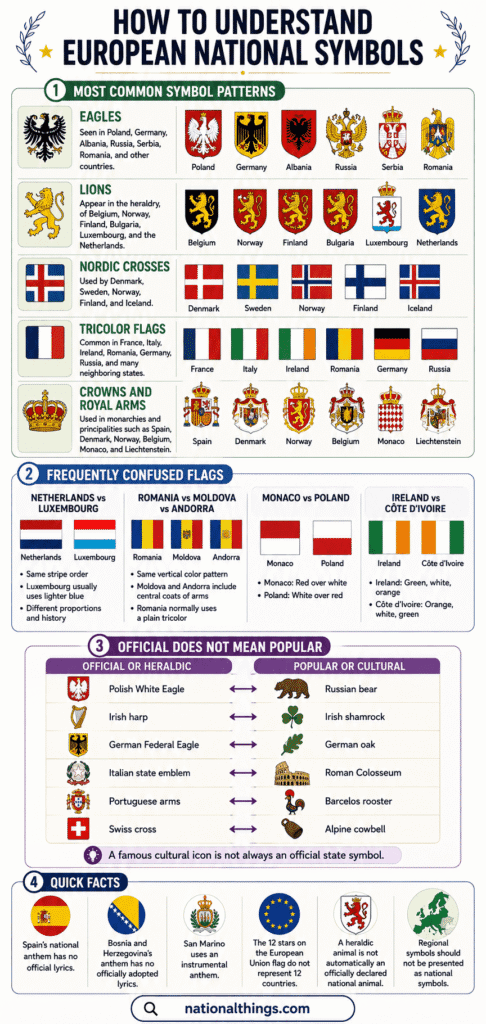
Similar and Commonly Confused European Symbols
Small differences in shade, proportion, emblem placement, and stripe order can separate two national flags.
Netherlands and Luxembourg Flags
Both use horizontal red, white, and blue.
The Netherlands normally uses a darker blue.
Luxembourg uses a lighter blue.
Their official proportions may differ.
Their historical origins are separate.
Monaco and Other Similar Red-and-White Flags
Monaco and Indonesia both use red above white. Their most visible difference is usually proportion.
Poland reverses the order, placing white above red.
Romania, Moldova, and Andorra
All three use vertical blue, yellow, and red bands.
Romania uses the plain tricolor.
Moldova places its coat of arms in the center.
Andorra also includes a central coat of arms but uses different proportions and heraldic details.
Ireland and Similar Vertical Tricolors
Ireland uses green, white, and orange from hoist to fly. Côte d’Ivoire uses the reverse order: orange, white, and green.
Orientation matters. A reversed flag can represent a completely different country.
European Union Symbols Versus National Symbols
The EU flag has 12 gold stars on blue. The number 12 represents unity and harmony, not the number of member states.
The EU also uses:
“Ode to Joy” as its anthem
“United in diversity” as its motto
Europe Day on 9 May
The euro as a shared currency symbol
These symbols do not replace the flags, arms, or anthems of member countries.
Royal Symbols Versus State Symbols
A crown, royal monogram, or personal standard may appear during a monarch’s reign. It does not always represent the whole state in every setting.
This distinction matters in the United Kingdom, Sweden, Denmark, Norway, Belgium, the Netherlands, Spain, Monaco, Luxembourg, and Liechtenstein.
National Symbols Versus Regional Symbols
Regional governments may have their own symbols:
Scotland and Wales within the United Kingdom
Flanders and Wallonia within Belgium
Catalonia and the Basque Country within Spain
German federal states
Swiss cantons
Bosnia and Herzegovina’s entities
A regional flag should not appear in a table as the sovereign country’s national flag.
Historical Symbols Versus Current Symbols
Countries often restore, replace, or redesign symbols after political change.
Examples include:
Post-communist restoration in Central and Eastern Europe
New symbols after Yugoslavia’s breakup
North Macedonia’s 1995 flag change
Changes in Russia after the Soviet period
Revised emblems in Romania, Serbia, Montenegro, and other states
Every historical image should carry a date and status label.
Official Versus Popular Symbols: Accuracy Checklist
Use this checklist before calling an animal, plant, object, or phrase an official national symbol.
Questions to Ask About Every Symbol
Which authority selected it?
Does a law or constitution mention it?
When did the designation occur?
Does it represent the whole country?
Is it part of a coat of arms?
Did a public poll choose it?
Is the claim repeated only by travel or trivia websites?
Do government sources use the word “official”?
Claims That Require Extra Caution
Check these labels carefully:
National animal
National bird
National flower
National tree
National dish
National sport
National costume
National monument
These categories often come from custom rather than legislation.
How to Handle Conflicting Sources
Use precise language:
“Officially designated by…”
“Appears on the national coat of arms”
“Selected in a public vote”
“Traditionally associated with…”
“Widely regarded as…”
“Promoted as a national symbol by…”
Do not hide a disagreement or turn a popular claim into a legal fact.
Regional Comparison Tables
A large all-Europe table can become difficult to read on mobile devices. Regional summaries offer better clarity.
Eastern and Northern Europe Comparison Table
Most common flag forms: Horizontal tricolors, Nordic crosses, and Baltic tricolors
Frequent heraldic figures: Eagles, lions, crosses, stars, and crowns
Special cases: Vatican City, San Marino, Andorra, Monaco, and states formed after Yugoslavia
Main accuracy issue: Mixing ancient or regional imagery with current state emblems
Western Europe Comparison Table
Political forms: Federal republics, constitutional monarchies, principalities, and direct-democratic federalism
Frequent symbols: Lions, eagles, crowns, republican personifications, and tricolors
Strong cultural figures: Marianne, Helvetia, the Gallic rooster, and Dutch orange
Main accuracy issue: Confusing royal, federal, regional, and popular symbols
Transcontinental and Classification Cases Table
Russia: Transcontinental; classified in Eastern Europe by UN M49
Türkiye: Transcontinental; classified in Western Asia by UN M49
Kazakhstan: Mostly Central Asian with a smaller European part
Armenia, Azerbaijan, and Georgia: South Caucasus states with European political and cultural connections
Cyprus: Geographically classified in Western Asia but politically integrated with Europe
Kosovo: European location with disputed sovereign status
Common Misconceptions About European National Symbols
The largest errors come from assuming that every online symbol list follows legal or geographic rules.
Every Country Has an Official National Animal
Many countries do not have one. A famous animal may come from heraldry, folklore, sport, tourism, or political cartoons.
A blank category is more accurate than an invented answer.
A Heraldic Animal Is Automatically the National Animal
Poland’s eagle and Norway’s lion clearly appear in official arms. That fact proves their heraldic role. It does not always prove that a separate law declared them “the national animal.”
The same rule applies to plants, birds, crowns, and weapons on coats of arms.
Every European Country Belongs to the European Union
The EU has 27 countries. The UN M49 European regions contain 44 sovereign states. Switzerland, Norway, the United Kingdom, Iceland, and several Balkan countries show why the terms cannot be used as synonyms.
Similar Flags Have the Same Meaning
The Netherlands and Luxembourg use similar colors. Ireland and Côte d’Ivoire use reversed layouts. Romania, Moldova, and Andorra share a tricolor pattern.
Their histories and legal specifications remain different.
Famous Cultural Icons Are Official State Symbols
The Eiffel Tower, Dutch windmill, Spanish bull, Russian bear, Greek owl, and Portuguese rooster are recognizable. Recognition alone does not give them constitutional or heraldic status.
Trusted Sources and References
The following official sources help you verify European country classifications, flags, emblems, anthems, and political memberships.
United Nations Statistics Division: M49 Geographic Regions This United Nations reference explains which countries and territories belong to Eastern, Northern, Southern, and Western Europe. It also helps separate sovereign countries from dependencies and transcontinental classification cases.
European Union: Countries and Basic EU Information This official EU page explains the difference between Europe and the European Union. It provides current information about the EU’s 27 member countries, shared institutions, and the euro.
European Union: Official European Symbols Readers can use this source to learn about the European flag, anthem, and motto. It also makes clear that EU symbols do not replace the national symbols of individual European countries.
Council of Europe: Member States This official list helps readers distinguish the Council of Europe from the European Union. It also shows why countries such as Türkiye, Georgia, Armenia, and Azerbaijan may appear in wider political definitions of Europe.
World Intellectual Property Organization: Article 6ter WIPO provides information about state flags, coats of arms, official emblems, and other protected government signs. It is especially useful for checking whether an image represents a sovereign state, an international organization, or a lower public authority.
Official National Government and Constitutional Websites Country-specific claims should be checked through presidential offices, royal households, parliaments, ministries, national archives, and heraldic authorities. For example, the French Presidency explains France’s flag, anthem, Marianne, motto, rooster, and state seal, while the British Royal Family explains the United Kingdom’s Royal Arms and their heraldic elements.
FAQs About the National Symbols of European Countries
How Many Countries Are Included in a List of European National Symbols?
This article uses 44 sovereign states in the four UN M49 European subregions. A broader list may add transcontinental or politically European states such as Türkiye, Armenia, Azerbaijan, Georgia, Cyprus, and Kazakhstan. Kosovo normally receives a separate note because its independence does not have universal recognition.
Is Europe the Same as the European Union?
No. Europe is a continent. The EU is a union of 27 European countries. European non-EU states include the United Kingdom, Norway, Switzerland, Iceland, Albania, Serbia, and several others.
Which Countries Belong to Both Europe and Asia?
Russia, Türkiye, and Kazakhstan have territory on both sides of commonly used Europe-Asia boundaries. Armenia, Azerbaijan, and Georgia belong to the South Caucasus and may appear in either European or Asian discussions. The UN M49 system places them in Western Asia.
Is Kosovo Included Among European Countries?
Kosovo lies in Europe and operates with its own flag, emblem, anthem, government, and institutions. However, its sovereign status remains disputed.
Do All European Countries Have Official National Animals?
No. Some countries recognize an animal through law or a national institution. Others use an animal in heraldry. A third group has only a popular animal association.
What Are the Most Common Animals in European Heraldry?
Eagles and lions appear most often. Double-headed eagles also occur in several Eastern and Southeastern European traditions. Other animals include bulls, horses, dragons, griffins, unicorns, and birds of prey.
Why Do So Many European Flags Use Red, White, and Blue?
The colors come from several sources, including medieval arms, royal houses, revolutionary movements, Slavic cooperation, maritime traditions, and neighboring influence.
Conclusion: Understanding Europe Through Its National Symbols
European national symbols preserve stories of monarchy, revolution, independence, religion, geography, war, peace, and cultural revival. A Nordic cross links several neighboring flags, yet each design represents a separate state. Eagles and lions appear across the continent, but their crowns, poses, colors, and historical meanings differ.
The most important rule is simple: do not place every symbol in the same category. A state emblem, public-vote bird, royal badge, folk flower, regional flag, and tourism icon have different levels of authority.
A strong guide to the National Symbols of European Countries explains both the symbol and its status. That approach gives students, travelers, and general readers a clearer picture of how European nations represent themselves.