





National Flower of India Explained with Meanings and History
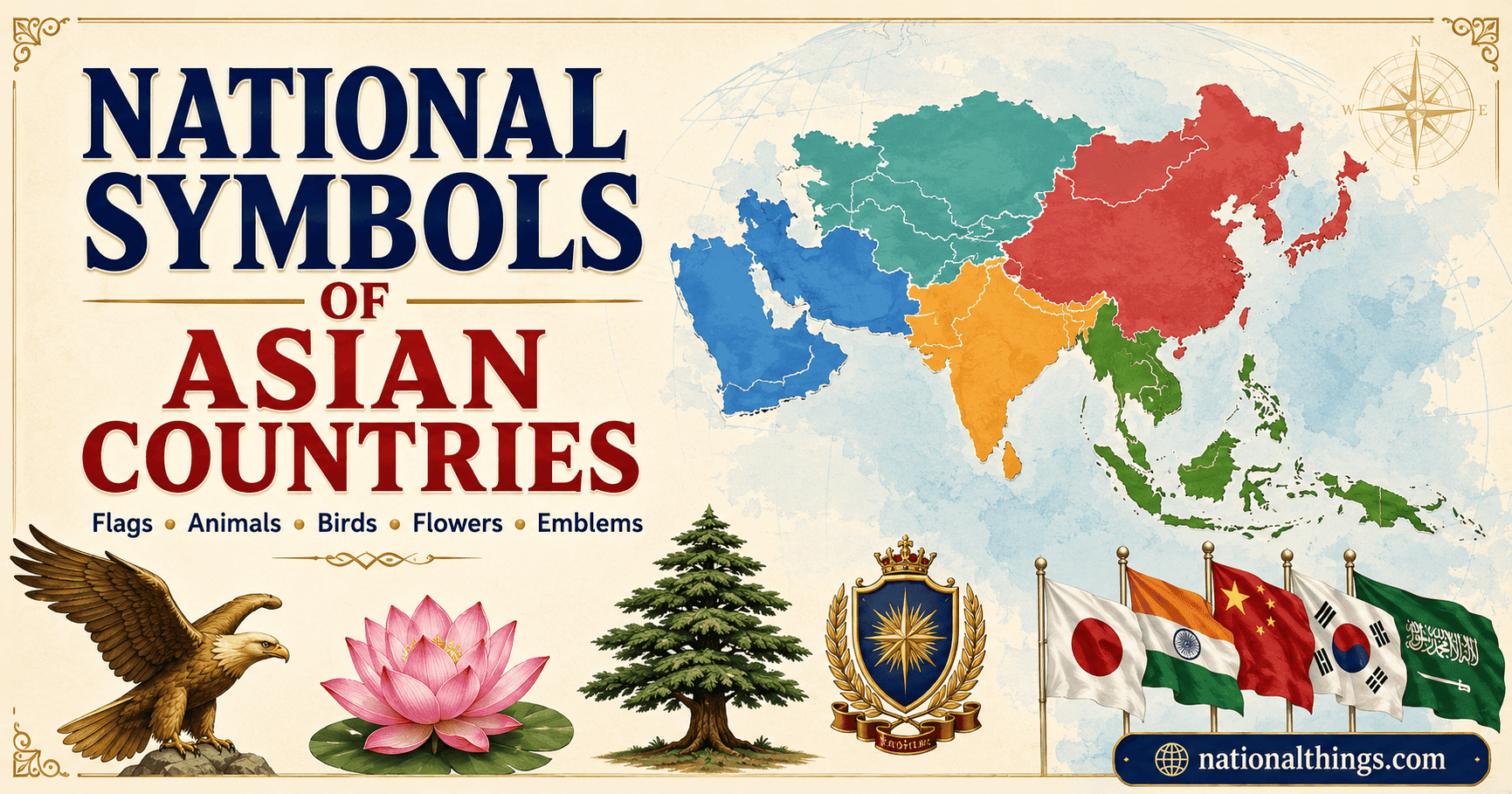
The National Flower of India is the Lotus scientifically known as Nelumbo nucifera. This sacred flower represents purity, wisdom, peace,…
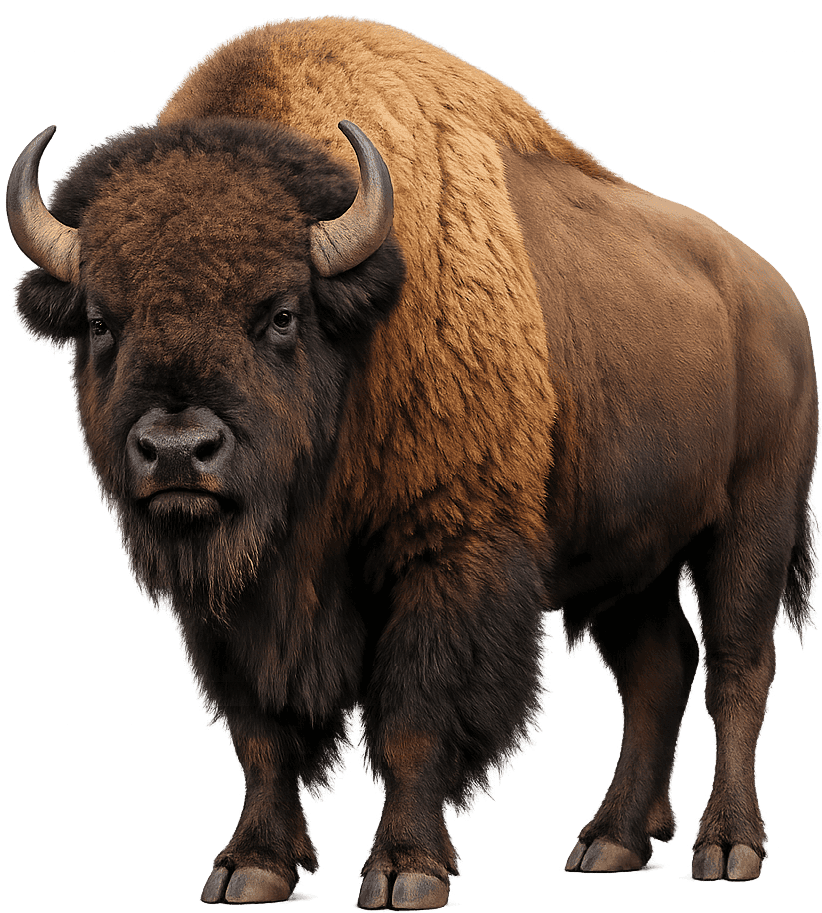
The national animal of the USA is commonly identified as the American bison, but its exact legal title is the national mammal of the United States. This massive native animal once moved across North America in herds containing thousands of individuals. It shaped grasslands, supported Indigenous communities, and became part of American history.
The American bison nearly disappeared during the nineteenth century. Large-scale killing and habitat loss reduced a population of tens of millions to fewer than 1,000 animals. Careful breeding, habitat protection, Tribal restoration, and public conservation programs helped the species survive. The United States officially recognized the bison as its national mammal in 2016.
The American bison is widely described as the National Animal of the USA. Federal law uses the more exact title national mammal. The United States has not created a separate legal category called “national animal.”
This means the most accurate information is:
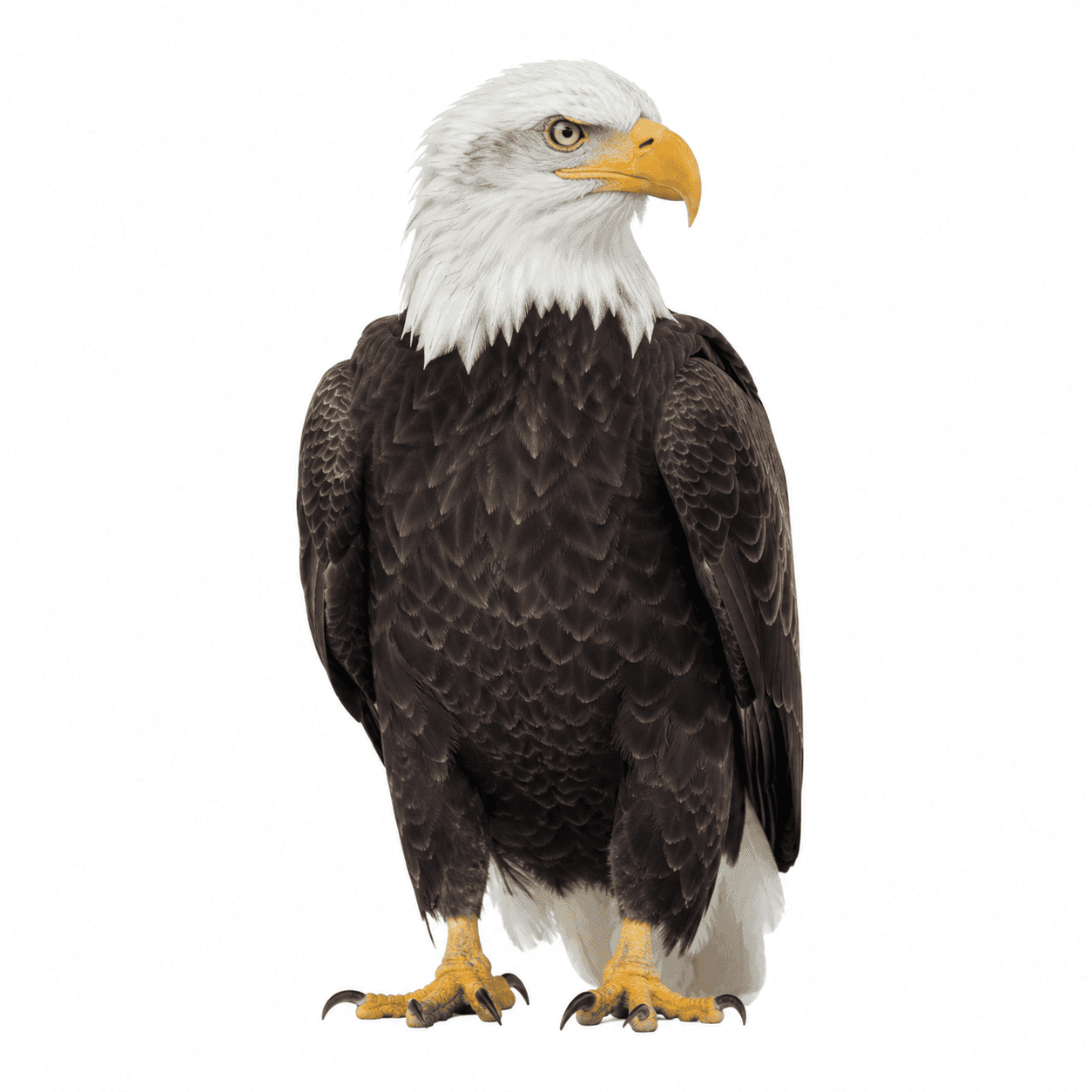
The American bison shares its national-symbol status with the bald eagle. The bald eagle is the official national bird while the bison is the official national mammal.
President Barack Obama signed the National Bison Legacy Act into law on May 9, 2016. The law adopted the North American bison as the national mammal of the United States.
The legislation passed through Congress as H.R. 2908. It became Public Law 114-152 after receiving presidential approval. The law did not create new wildlife-management rules. It gave the bison an official national title while leaving existing government policies and conservation decisions unchanged.
Congress highlighted several reasons for the designation:
The designation gave formal legal recognition to an animal that had represented the United States for generations.
The American bison was chosen because it connects nature, history, culture, and conservation. Few animals have influenced the land and people of North America as deeply.
Before European settlement, tens of millions of bison lived across much of the continent. They ranged from northern Mexico to interior Alaska and from California to New York and Georgia. Their movement affected vegetation, soil, water, predators, insects, and many other species.
The bison also represents several qualities often connected with the United States:
Its official status does not come from physical power alone. The American bison tells a wider story about the country’s land, people, mistakes, and conservation work.
| Fact | Information |
|---|---|
| Common name | American bison |
| Other common name | Buffalo |
| Scientific name | Bison bison |
| Animal class | Mammalia |
| Animal family | Bovidae |
| Official title | National Mammal of the United States |
| Year officially designated | 2016 |
| Adult male | Bull |
| Adult female | Cow |
| Young bison | Calf |
| Male weight | Up to about 2,000 pounds |
| Female weight | Up to about 1,000 pounds |
| Main diet | Grasses, sedges, leafy plants, and other vegetation |
| Typical young | One calf |
| Gestation period | About nine and a half months |
| Wild lifespan | Commonly around 12 to 20 years |
| Maximum running speed | About 35 to 40 miles per hour |
| Native range | North America |
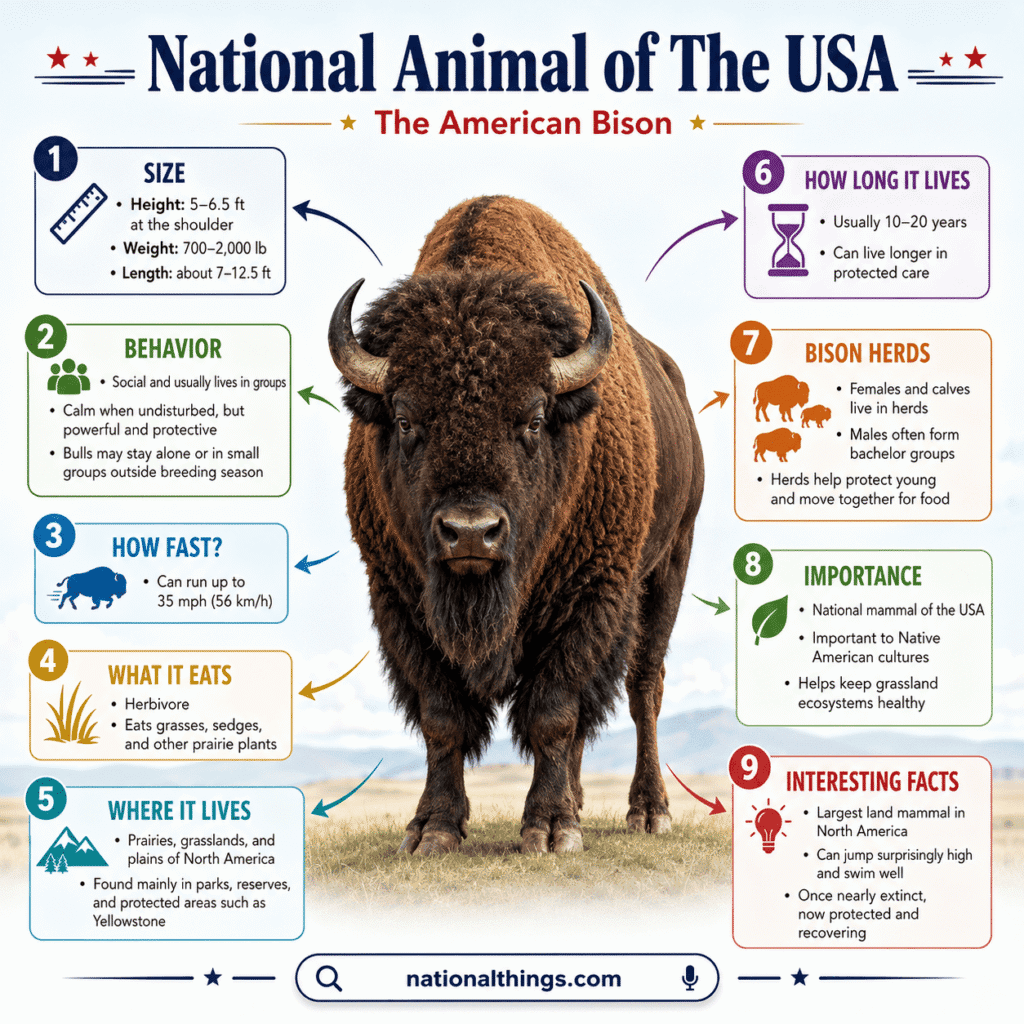
Bison are the largest land mammals in North America. Their great size can make them look slow, but they can run much faster than most people. They can also turn quickly, jump, and swim.
The American bison belongs to the cattle family. Its basic scientific classification is:
North America has two main bison subspecies.
The plains bison has the scientific name Bison bison bison. It historically lived across the central grasslands, plains, and many areas of the lower United States and southern Canada.
It usually has:
Most bison seen in parks and conservation herds in the lower 48 states are plains bison.
The wood bison has the scientific name Bison bison athabascae. It mainly occurs in northern Canada and parts of Alaska.
It generally has:
Both belong to the American bison species, but they developed different physical features in response to their habitats.
An American bison has a large head, muscular shoulders, curved horns, and a high hump above its front legs. Its front body looks much heavier than its rear body.
The coat is usually dark brown. Hair around the head, neck, shoulders, and front legs grows long and thick. The hair over the back and rear body is shorter. This uneven coat gives the animal its familiar shape.
Important physical features include:
Both males and females have horns. Bulls normally have thicker horns and much larger bodies. Cows usually have thinner horns and a lighter build.
The shoulder hump contains strong muscles supported by long spinal bones. These muscles help the bison move its heavy head. During winter, it can swing its head through deep snow to uncover grass.
Adult bulls can weigh about 2,000 pounds and stand close to six feet tall at the shoulder. Adult cows often weigh about 1,000 pounds and stand around four to five feet tall. A newborn calf may weigh between 30 and 70 pounds.
A typical adult can measure around 10 to 12 feet from its head to the rear of its body. The animal’s heavy shoulders and thick coat make it appear even larger.
Its size provides several advantages:
Visitors should never judge a bison by its calm appearance. A resting or slowly grazing animal can suddenly charge when it feels threatened.
People across the United States often call the American bison a buffalo. The name is widely understood and has deep historical and cultural use. However, bison is the more accurate scientific name.
True buffalo species live mainly in Africa and Asia. Examples include:
American bison differ from true buffalo in several ways. Bison have a large shoulder hump, a thick shaggy coat, and a broad head. Many true buffalo have longer horns and do not have the same heavy hump.
The word “buffalo” may have developed from the French word bœuf, which means beef or ox. European visitors used familiar words when describing the unfamiliar North American animal.
In scientific writing, American bison is the clearest term. In history and Indigenous cultural contexts, buffalo remains an important and accepted name.
American bison once occupied one of the largest ranges of any native North American herbivore. They lived across grasslands, open forests, valleys, plains, and northern environments.
Their historical range included parts of:
Modern bison live in a much smaller part of that range. They now occur in:
Bison can survive in several environments, but they need enough land, food, water, and room for seasonal movement. Plains bison prefer open grassland and prairie. Wood bison can live in northern meadows, wetlands, open woodland, and forest edges.
Yellowstone National Park has special importance because bison have lived there continuously since prehistoric times. Many other modern herds began through reintroduction programs.
American bison are herbivores. They eat plants rather than meat. Their diet changes with the season and available vegetation.
Their main foods include:
Bison may spend many hours each day feeding. Their wide mouths allow them to collect large amounts of grass. They often move slowly while grazing and continue travelling as local food conditions change.
During winter, bison use their large heads to push or sweep snow aside. This movement exposes dry grass underneath. Their thick coats and strong bodies help them survive cold wind, snow, and low temperatures.
Bison also need water, although they can sometimes use snow as an additional source of moisture during winter.
Bison are social animals. They form herds whose size and structure change during the year.
Cows and calves often stay together in larger family groups. Adult bulls may live alone or form small male groups outside the breeding season. During the summer mating period, bulls join mixed herds and compete for access to females.
Bison communicate through:
A bull may lower its head, raise its tail, paw the ground, or face a person or another animal when it feels threatened. These signs should never be ignored.
Bison also perform a behaviour called wallowing. They roll in dry soil or create shallow dusty areas with their hooves. Wallowing may help them remove loose hair, reduce biting insects, leave scent, and display strength.
Their movement and behaviour change with weather, food, predators, insects, breeding activity, and human disturbance.
A bison can run at about 35 to 40 miles per hour. This speed is much faster than an average human can run.
Bison can also:
Their large size often creates a false sense of safety. People may think they can move away before the animal reaches them. In reality, a bison can cover a short distance very quickly.
Running from a bison at close range may not provide enough protection. The safest choice is to maintain a large distance and avoid causing the animal to react.
A bison herd is not always one fixed group. Individuals may join or leave as food, weather, mating, and family needs change.
Common social groups include:
Cows provide most of the direct care for calves. Young animals learn movement patterns, feeding behaviour, and responses to danger by remaining near their mothers and other herd members.
Adult bulls do not normally lead the herd in the way people may imagine. Herd movement often develops through the combined behaviour of many animals.
Large gatherings can form when food is concentrated or during the breeding season. The herd may then divide into smaller groups again.
The bison mating season is often called the rut. It usually takes place from summer into early autumn.
During the rut:
Pregnancy lasts about nine and a half months. A cow usually gives birth to one calf during spring or early summer. Twins are uncommon.
Newborn calves have reddish-brown fur and are sometimes called red dogs. Their colour becomes darker as they grow. Calves can stand and follow their mothers soon after birth. They continue nursing for several months while also learning to eat plants.
Female bison may begin reproducing at about two or three years old. Bulls become physically mature earlier but often do not breed successfully until they are larger and strong enough to compete with older males.
Bison commonly live for about 12 to 20 years in the wild. Animals under human care may live longer and sometimes reach approximately 25 years.
Factors that affect lifespan include:
Calves face greater danger than healthy adults. Wolves, bears, and other predators may target young or weak animals. Large adult bison have few natural predators, although wolves may sometimes hunt them in coordinated groups.
Old age can reduce a bison’s ability to feed, travel, and survive difficult winters.
Bison do more than eat grass. They act as ecosystem engineers, which means their activities change the land in ways that affect other plants and animals.
Their grazing can:
Their wallows create shallow depressions in the soil. These places may collect rainwater and support insects, plants, and small animals. Dusty wallows also create areas with different soil conditions.
Bison carry seeds in their thick coats. Seeds may fall in new places as the animals travel. Their dung returns nutrients to the soil and supports insects and microorganisms. Those insects then provide food for birds and other wildlife.
Their hooves break and mix the soil. Their long-distance movement once connected different grassland areas. Restoring bison can therefore support the wider recovery of native prairie ecosystems.
The American bison has held economic, cultural, nutritional, and spiritual importance for many Indigenous nations for thousands of years. Each nation has its own traditions, language, knowledge, and relationship with the animal. The meaning of the bison should not be reduced to one general story.
Bison provided materials for:
Many communities used the animal carefully and developed detailed knowledge about herd movement, hunting, food preparation, land management, and spiritual practice.
The destruction of large bison herds caused severe harm to Indigenous communities that depended on them. It damaged food systems, economies, cultural practices, and relationships with ancestral lands.
Tribal nations now lead major buffalo-restoration programs. These projects can support:
The InterTribal Buffalo Council currently brings together many Tribal nations working to restore and manage buffalo on Tribal lands.
Bison once shaped travel and life across the plains. Their trails influenced routes used by other animals and people. Their movements appeared in oral histories, early written accounts, maps, paintings, and later photographs.
During the nineteenth century, commercial hunting expanded rapidly. Bison were killed for hides, meat, tongues, bones, and sport. Railroads gave hunters easier access to herds and markets. Habitat changed as settlement, agriculture, fencing, and livestock spread across former bison lands.
The destruction had two major effects:
Images of massive piles of bison bones remain a powerful record of this period. The decline was not a normal natural event. It resulted mainly from deliberate and uncontrolled human activity.
Before widespread European settlement, tens of millions of bison lived in North America. Estimates often place the earlier population near 30 million or more.
By the late nineteenth century, only around 1,000 bison remained. Some records describe only a few hundred surviving in the United States. Small groups existed in protected places, private herds, and isolated wild populations.
The decline happened because of:
The species survived because a small number of people and organizations protected the remaining animals. Tribal communities, private ranchers, conservationists, zoos, and government agencies all played roles at different stages.
Organized bison conservation grew near the start of the twentieth century. The American Bison Society formed in 1905 with support from conservationists including William Hornaday and Theodore Roosevelt.
Early restoration work included moving captive-bred animals into protected areas. In 1907, 15 bison from the New York Zoological Park were sent to the Wichita Mountains Wildlife Refuge. This became an important early reintroduction of a large mammal that had nearly disappeared.
In 1913, 14 bison were sent to Wind Cave National Park. Descendants from this herd later supported other restoration programs.
Recovery efforts grew through:
The recovery saved the species from total extinction. However, the return of large numbers does not mean that every herd has equal conservation value. Truly wild herds with strong genetic diversity and enough natural habitat remain limited.
Modern bison numbers are much higher than they were in the late 1800s. However, most bison do not live as fully wild animals in large open ecosystems.
Current federal information separates them into different groups:
Commercial bison may live on ranches and receive livestock-style management. Conservation herds focus more closely on wildlife, genetics, natural behaviour, ecosystem restoration, or historical importance.
This distinction matters. A high total population does not fully replace the ecological role of millions of wild bison moving across connected grasslands.
The plains bison is not generally considered at immediate risk of disappearing as a species. Hundreds of thousands exist in commercial and conservation herds.
However, conservation concerns remain. These include:
A herd can contain many animals but still face genetic or ecological problems. Conservation programs therefore focus on more than population size. They also consider health, ancestry, habitat, natural behaviour, and long-term survival.
Federal agencies, Tribal nations, states, conservation organizations, and private land managers continue to work on these issues.
Tribal-led restoration has become one of the most important parts of modern bison recovery. It returns buffalo to communities that maintained cultural and spiritual relationships with the animal long before the United States existed.
Tribal restoration projects may combine:
The InterTribal Buffalo Council includes 86 Tribes in 22 states and helps manage more than 20,000 buffalo. It supports herd development, technical training, animal transfers, health programs, and cultural restoration.
Federal programs also transfer healthy bison from public herds to Tribal nations when herd management requires removing animals. This approach can protect genetics while returning buffalo to ancestral lands.
People can see bison in several national parks, wildlife refuges, Tribal lands, state parks, and conservation areas.
Well-known locations include:
Yellowstone supports thousands of relatively free-ranging bison. Wind Cave has a historically important conservation herd. Badlands protects bison in a large wilderness area. Theodore Roosevelt National Park manages separate herds in its North and South Units.
Visitors should check official park information before travelling. Access, road conditions, herd location, and safety rules can change by season.
Bison are wild and unpredictable animals. Their calm appearance does not mean they are tame.
The National Park Service advises people to remain at least 100 feet or 30 metres away. This distance equals about two full bus lengths. When bison stand near a road, visitors should usually observe them from inside a vehicle.
Follow these safety rules:
People sometimes cause dangerous encounters by walking too close for selfies. Giving the animal space protects both the visitor and the bison.
The American bison appeared in national imagery long before receiving its official title in 2016.
Examples include:
The Department of the Interior has used a bison on its official seal since 1912. The Buffalo nickel entered circulation in 1913 and became one of the best-known American coin designs.
Bison also appear on the state flags of Wyoming and Kansas. Several states have adopted the animal as an official state symbol.
These uses helped establish the bison as an image of strength, open land, survival, and the American West before Congress gave it national legal recognition.
The National Animal of the USA carries several meanings.
Its muscular body, large head, and powerful movement represent physical strength.
The species survived a fall from tens of millions to fewer than 1,000 animals.
Bison connect modern Americans with the natural and human history of North America.
Their recovery shows that coordinated action can prevent extinction.
Buffalo restoration supports living Indigenous cultures rather than only preserving a historical memory.
Wild bison help create varied habitats and recycle nutrients within prairie ecosystems.
The bison’s meaning is therefore not limited to the past. It remains connected with current questions about land, wildlife, Tribal sovereignty, food systems, and responsible conservation.
The American bison is commonly called the national animal of the United States. Its official federal title is the national mammal.
Federal law does not use the title “national animal.” It officially adopts the North American bison as the national mammal of the United States.
The National Bison Legacy Act became law on May 9, 2016.
President Barack Obama signed the act into law.
Its scientific name is Bison bison.
In North America, both names commonly refer to the same animal. Bison is the scientific term. True buffalo species live in Africa and Asia.
The bald eagle is the national bird. The American bison is the national mammal and is commonly called the national animal.
It shaped grassland ecosystems, supported Indigenous communities, influenced American history, and became a major conservation success story.
Yes. They are wild animals that can charge, run quickly, and cause serious injuries. Visitors should remain at least 100 feet away.
It mainly eats grasses, sedges, weeds, leafy plants, and other vegetation.
It can reach about 35 to 40 miles per hour over a short distance.
National Bison Day celebrates the animal’s historical, cultural, ecological, and economic importance. It is observed on the first Saturday in November.
The National Animal of the USA is the American bison, although its exact legal title is the national mammal of the United States. Congress gave it this official status through the National Bison Legacy Act in 2016.
The bison is North America’s largest land mammal. It has a heavy shoulder hump, curved horns, thick brown hair, and enough speed to outrun a person. It once lived across a vast part of the continent and played a major role in grassland ecosystems.
Its history also carries a serious lesson. Human activity reduced tens of millions of bison to fewer than 1,000. Conservation work stopped the species from disappearing, but restoring truly wild herds remains an ongoing task.
The American bison represents strength, survival, cultural continuity, and responsible conservation. Its national status recognizes not only an impressive animal but also its deep relationship with the land and people of the United States.
I used the official sources to verify facts such as:
By these below attached links: